MCAT 2025 - Psychology & Sociology
Study online at https://quizlet.com/_gdsnb2
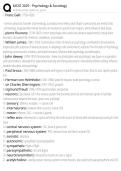
1. Franz Gall: (1758-1828):
- German physician; founder of phrenology, a pseudoscience linking skull shape to personality and mental traits
- phrenology: proposed that mental faculties are localized in specific brain regions, which influence skull shape
2. pierre flourens: (1794-1867): French physiologist who used brain ablation experiments to study brain
functions: discovered the cerebrum, cerebellum, and medulla
3. William james: (1842-1910): functionalism: father of American psychology; contributed to functionalism,
emphasizing the purpose of mental processes in adapting to the environment; authored The Principles of Psychology,
exploring consciousness, emotion, and habit formation; influence both psychology and philosophy
4. John dewey: (1859-1910) functionalism ; American philosopher and psychologist; key figure in pragmatism
and functionalism; advocated for experiential learning and linking education to real world problem-solving; influence
modern education and psychology
5. Paul broca: (1824-1880) studied people with legions in specific regions of brain; Broca's area: speech produc-
tion
6. Herman von Helmholtz: (1821-1894) speed of impulse; made psychology a science
7. sir Charles Sherrington: (1857-1952) synapses
8. sigmund freud: (1856-1939) psychoanalytic perspective
9. neurons: specialized cell in the nervous system that transmits electrical and chemical signals to facilitate
communication between the brain, spinal cord, and body
10. sensory: afferent, receptors --> spinal cord
11. interneurons: between other neurons; mainly CNS
12. motor: efferent, CNS --> muscles & glands
13. reflex arcs: interneurons in spinal cord relay info to the source of stimuli while simultaneously routing it to the
brain
14. central nervous system: CNS; brain & spinal cord
15. peripheral nervous system: PNS; nervous tissue and fibers outside CNS
16. somatic: voluntary
17. autonomic: sympathetic & parasympathetic
18. sympathetic: fight or flight
19. parasympathetic: rest and digest
20. neurotransmitters: released by neurons to carry a signal
21. acetylcholine: used by somatic nervous system to move muscles; also used by the parasympathetic and CNS
, MCAT 2025 - Psychology & Sociology
Study online at https://quizlet.com/_gdsnb2
22. dopamine: maintains smooth movements and steady posture
23. endorphins & enkephalins: natural pain killers
24. epinephrine & noepinephrine: maintain wakefulness and mediate fight or flight response
25. epinephrine: does epinephrine or norepinephrine act as a hormone?
26. norepinephrine: does epinephrine or norepinephrine act as a neurotransmitter?
27. y-aminobutyric acid (GABA): inhibitory neurotransmitters; act as brain "stabilizers"; glycine has a
similar function
28. glutamate: acts as an excitatory neurotransmitter
29. serotonin: modulates mood, sleep, eating, and dreaming
30. hypothalamus & anterior pituitary: the endocrine system is tied to the nervous system through
the ___________________ and the _________________ _________________
31. cortisol: stress hormone released by the adrenal cortex
32. testosterone: mediate libido; increases aggressive behavior; produced in goals, released by adrenal cortex
33. estrogen: mediate libido; produced in gonads, released by adrenal cortex
34. epinephrine & norepinephrine: released by adrenal medulla and cause physiological changes
associated with the sympathetic nervous system
35. hindbrain: cerebellum, medulla oblongata, reticular formation
36. midbrain: inferior and superior colliculi
37. forebrain: thalamus, hypothalamus, basal ganglia, limbic system, cerebral cortex
38. thalamus: relay station for sensory information
39. hypothalamus: homeostasis & the 4 F's; integrates with endocrine system; hypothalamus --> hypophyseal
portal --> anterior pituitary
40. basal ganglia: smooths movements and helps postural stability
41. septal nuclei: pleasure and addiction
42. amygdala: fear and aggression
43. hippocampus: emotion and memory
44. 4: how many lobes are in the cerebral cortex
45. frontal: executive function, impulse control, speech, motor
46. parietal: touch, pressure, temp, pain, spatial processing
47. occipital: visual
48. temporal: sound, speech perception, memory, emotion
49. left cerebral hemisphere: analytic, language, logic, math; usually dominant
Study online at https://quizlet.com/_gdsnb2
1. Franz Gall: (1758-1828):
- German physician; founder of phrenology, a pseudoscience linking skull shape to personality and mental traits
- phrenology: proposed that mental faculties are localized in specific brain regions, which influence skull shape
2. pierre flourens: (1794-1867): French physiologist who used brain ablation experiments to study brain
functions: discovered the cerebrum, cerebellum, and medulla
3. William james: (1842-1910): functionalism: father of American psychology; contributed to functionalism,
emphasizing the purpose of mental processes in adapting to the environment; authored The Principles of Psychology,
exploring consciousness, emotion, and habit formation; influence both psychology and philosophy
4. John dewey: (1859-1910) functionalism ; American philosopher and psychologist; key figure in pragmatism
and functionalism; advocated for experiential learning and linking education to real world problem-solving; influence
modern education and psychology
5. Paul broca: (1824-1880) studied people with legions in specific regions of brain; Broca's area: speech produc-
tion
6. Herman von Helmholtz: (1821-1894) speed of impulse; made psychology a science
7. sir Charles Sherrington: (1857-1952) synapses
8. sigmund freud: (1856-1939) psychoanalytic perspective
9. neurons: specialized cell in the nervous system that transmits electrical and chemical signals to facilitate
communication between the brain, spinal cord, and body
10. sensory: afferent, receptors --> spinal cord
11. interneurons: between other neurons; mainly CNS
12. motor: efferent, CNS --> muscles & glands
13. reflex arcs: interneurons in spinal cord relay info to the source of stimuli while simultaneously routing it to the
brain
14. central nervous system: CNS; brain & spinal cord
15. peripheral nervous system: PNS; nervous tissue and fibers outside CNS
16. somatic: voluntary
17. autonomic: sympathetic & parasympathetic
18. sympathetic: fight or flight
19. parasympathetic: rest and digest
20. neurotransmitters: released by neurons to carry a signal
21. acetylcholine: used by somatic nervous system to move muscles; also used by the parasympathetic and CNS
, MCAT 2025 - Psychology & Sociology
Study online at https://quizlet.com/_gdsnb2
22. dopamine: maintains smooth movements and steady posture
23. endorphins & enkephalins: natural pain killers
24. epinephrine & noepinephrine: maintain wakefulness and mediate fight or flight response
25. epinephrine: does epinephrine or norepinephrine act as a hormone?
26. norepinephrine: does epinephrine or norepinephrine act as a neurotransmitter?
27. y-aminobutyric acid (GABA): inhibitory neurotransmitters; act as brain "stabilizers"; glycine has a
similar function
28. glutamate: acts as an excitatory neurotransmitter
29. serotonin: modulates mood, sleep, eating, and dreaming
30. hypothalamus & anterior pituitary: the endocrine system is tied to the nervous system through
the ___________________ and the _________________ _________________
31. cortisol: stress hormone released by the adrenal cortex
32. testosterone: mediate libido; increases aggressive behavior; produced in goals, released by adrenal cortex
33. estrogen: mediate libido; produced in gonads, released by adrenal cortex
34. epinephrine & norepinephrine: released by adrenal medulla and cause physiological changes
associated with the sympathetic nervous system
35. hindbrain: cerebellum, medulla oblongata, reticular formation
36. midbrain: inferior and superior colliculi
37. forebrain: thalamus, hypothalamus, basal ganglia, limbic system, cerebral cortex
38. thalamus: relay station for sensory information
39. hypothalamus: homeostasis & the 4 F's; integrates with endocrine system; hypothalamus --> hypophyseal
portal --> anterior pituitary
40. basal ganglia: smooths movements and helps postural stability
41. septal nuclei: pleasure and addiction
42. amygdala: fear and aggression
43. hippocampus: emotion and memory
44. 4: how many lobes are in the cerebral cortex
45. frontal: executive function, impulse control, speech, motor
46. parietal: touch, pressure, temp, pain, spatial processing
47. occipital: visual
48. temporal: sound, speech perception, memory, emotion
49. left cerebral hemisphere: analytic, language, logic, math; usually dominant