
Early European Empires: Introduction and Context
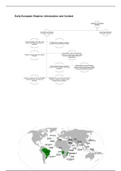
Expansion of European
Empires
Mercantilism and the age Age of Imperialism [after
of voyages of exploration industrial revolution]
Economic ideology of the 16th - 17th
Foreign trade monoploies, chartered
centuries priortising state control of
companies and accumulation of bullion
economy
Most warlike: conflict and competition
Portugese, Spanish and Dutch empires centred on commerece and trade; religion
emerged and culture and political authority vs
independence
Linked outward march of European
Triple dynamic focused on economic
nations: vital for each nation to maintain
resources, military strength and territorial
economic control through military means,
acquistion
forcing technological innovations
Martitime strength was the key to building 'Mongols of the era' but the found it dificult
strong economies, resources and to adapt to cultures and religious of the
territories societies they encountered
, The Conquest of Ceuta [North Africa] in 1415 marked the beginning of the
Portuguese and European trans-oceanic world-wide expansion
Cueta, Moroccan port-town, located across the Strait of Gibraltar
King Joao I
Declared a permanent Portuguese possession and served as a springboard
for further conquests
o Strategic: ensured control over Strait of Gibralter
o Buffer against Muslim piracy
o Ceuta was a recipient of valuable exotic commodities from a trans-
Saharan and trans-Middle eastern trade networks
o A result of the Iberian policy of re-conquest: Portugal had been under
foreign (mainly Muslim) domination
Consolidation during the reign of Joao II:
Sponsored voyages by Diogo Cao and Bartolomeu
Dias: passed the Cape of Good Hope and reached
Indian Ocean and Vasco da Gama reach India in
1490s
Advanced nautical technology and the art of navigation
– crucial to imperial expansion
Portuguese colonies: Angola, Mozambique and
Guinea Bissau
Engagement with Atlantic Islands:
First half of 15th century, interested in three archipelagos: Madeira,
Azores and Canary Islands
Environmental destruction and demographic collapse
Cape Verde, Sao Tome and Principle: “slave islands” of the
notorious Portuguese imperial rule
Empire in Latin America:
Brazil: 1500 expedition by Pedro Alvares Cabral
Serious colonial admin began around 1548 after
interaction with indigenous peoples
Attention shifting to South America from Asia
Sugar was a promising plantation crop and Portuguese
hoped to find similar discoveries to that of silver in Peru by
the Spanish
Forced labour, land alienation, slave plantations and
creole cultures were major outcomes from Portuguese
colonialization of Brazil
Expansion of European
Empires
Mercantilism and the age Age of Imperialism [after
of voyages of exploration industrial revolution]
Economic ideology of the 16th - 17th
Foreign trade monoploies, chartered
centuries priortising state control of
companies and accumulation of bullion
economy
Most warlike: conflict and competition
Portugese, Spanish and Dutch empires centred on commerece and trade; religion
emerged and culture and political authority vs
independence
Linked outward march of European
Triple dynamic focused on economic
nations: vital for each nation to maintain
resources, military strength and territorial
economic control through military means,
acquistion
forcing technological innovations
Martitime strength was the key to building 'Mongols of the era' but the found it dificult
strong economies, resources and to adapt to cultures and religious of the
territories societies they encountered
, The Conquest of Ceuta [North Africa] in 1415 marked the beginning of the
Portuguese and European trans-oceanic world-wide expansion
Cueta, Moroccan port-town, located across the Strait of Gibraltar
King Joao I
Declared a permanent Portuguese possession and served as a springboard
for further conquests
o Strategic: ensured control over Strait of Gibralter
o Buffer against Muslim piracy
o Ceuta was a recipient of valuable exotic commodities from a trans-
Saharan and trans-Middle eastern trade networks
o A result of the Iberian policy of re-conquest: Portugal had been under
foreign (mainly Muslim) domination
Consolidation during the reign of Joao II:
Sponsored voyages by Diogo Cao and Bartolomeu
Dias: passed the Cape of Good Hope and reached
Indian Ocean and Vasco da Gama reach India in
1490s
Advanced nautical technology and the art of navigation
– crucial to imperial expansion
Portuguese colonies: Angola, Mozambique and
Guinea Bissau
Engagement with Atlantic Islands:
First half of 15th century, interested in three archipelagos: Madeira,
Azores and Canary Islands
Environmental destruction and demographic collapse
Cape Verde, Sao Tome and Principle: “slave islands” of the
notorious Portuguese imperial rule
Empire in Latin America:
Brazil: 1500 expedition by Pedro Alvares Cabral
Serious colonial admin began around 1548 after
interaction with indigenous peoples
Attention shifting to South America from Asia
Sugar was a promising plantation crop and Portuguese
hoped to find similar discoveries to that of silver in Peru by
the Spanish
Forced labour, land alienation, slave plantations and
creole cultures were major outcomes from Portuguese
colonialization of Brazil


