Decolonisation and Independence
Key Concepts:
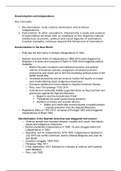
1. Decolonisation: ends colonial domination and achieves
independence
2. Postcolonial: lit. after colonialism: theoretically a study and analysis
of postcolonial societies with an emphasis on the lingering cultural,
intellectual, economic, political and social legacies of colonialism.
Colonial mentality continues beyond the formal end of colonialism.
Decolonisation in the New World
® Haiti was the first colony to declare independence in 1804
o
® Spanish American Wars of Independence (1808-1833) were triggered by
Napoleon’s invasion and conquest of Spain in 1808 which triggered political
instability
o Before: Bourbon monarchy had instituted economic and political
reforms of American colonies, designed to increased economic
productivity and output and to limit the increasing political power of the
settler creole elite
o Increased productivity and tax revenue, burden fell heavily on mixed-
race creole laboring class, Indigenous Americans
o Economic hardship for lower classes in Spanish American Society
o Peru: over 100 uprisings 1730-1814
o Colonial and creole elite initially supported these as they had their own
grievances against the Spanish Monarchy
Began to see the revolutionary threat
Threatened the caste system/social hierarchy
Abolition of slavery and societal reforms
Settler and creole elite moved towards a royalist position
– wanted protection from the Spanish Monarchy
® Napoleonic Wars of 1792-1815: conquest of Portugal 1807 which triggered
independence of Brazil 1822
Decolonisation in the Spanish Americas was staggered and uneven:
® Violence spread over decades between royalists and creole, free blacks,
slaves and indigenous Americans
® Bolivia proclaimed independence in 1809: 16-year struggle before full
independence in 1824
® Argentina: war for independence 1810-1818, independence declared in
July 1816 but conflict continued, lead by Manuel Belgrano and Jose de
San Martin
® Ecuador’s struggle: 1809-1822
® Paraguay: May 1811
® Chile: September 1810, followed by a decade of violence until royalists
were defeated
® Peru: July 1826
Key Concepts:
1. Decolonisation: ends colonial domination and achieves
independence
2. Postcolonial: lit. after colonialism: theoretically a study and analysis
of postcolonial societies with an emphasis on the lingering cultural,
intellectual, economic, political and social legacies of colonialism.
Colonial mentality continues beyond the formal end of colonialism.
Decolonisation in the New World
® Haiti was the first colony to declare independence in 1804
o
® Spanish American Wars of Independence (1808-1833) were triggered by
Napoleon’s invasion and conquest of Spain in 1808 which triggered political
instability
o Before: Bourbon monarchy had instituted economic and political
reforms of American colonies, designed to increased economic
productivity and output and to limit the increasing political power of the
settler creole elite
o Increased productivity and tax revenue, burden fell heavily on mixed-
race creole laboring class, Indigenous Americans
o Economic hardship for lower classes in Spanish American Society
o Peru: over 100 uprisings 1730-1814
o Colonial and creole elite initially supported these as they had their own
grievances against the Spanish Monarchy
Began to see the revolutionary threat
Threatened the caste system/social hierarchy
Abolition of slavery and societal reforms
Settler and creole elite moved towards a royalist position
– wanted protection from the Spanish Monarchy
® Napoleonic Wars of 1792-1815: conquest of Portugal 1807 which triggered
independence of Brazil 1822
Decolonisation in the Spanish Americas was staggered and uneven:
® Violence spread over decades between royalists and creole, free blacks,
slaves and indigenous Americans
® Bolivia proclaimed independence in 1809: 16-year struggle before full
independence in 1824
® Argentina: war for independence 1810-1818, independence declared in
July 1816 but conflict continued, lead by Manuel Belgrano and Jose de
San Martin
® Ecuador’s struggle: 1809-1822
® Paraguay: May 1811
® Chile: September 1810, followed by a decade of violence until royalists
were defeated
® Peru: July 1826