Lenin vs Stalin: The Ruler
that Did Most to Transform
Russia, 1855-1953
1
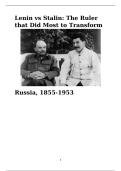
, Vladimir Lenin (left) and Joseph Stalin (right) in Gorky (c. 1922) via
Keystone/Getty Images
This piece of work was an A Level Coursework which received a high A* grade. The
essay looks at all the Russian rulers from 1855-1953, assessing which one was most
important to the country’s development.
Russia underwent a vast transformation in the years 1855-1953, most evidently
through the displacement of the Tsarist Empire and feudal structure by the
establishment of the Soviet Union and communism. Russia’s civilisation in 1855
– a feudalistic country confined by the principles of ‘autocracy, orthodoxy and
nationality’ – resulted in the restriction of society, resulting in a 37% serf
population and an educated class amounting to 1% 1. Consequently, the
contrasting nature of the Soviet Union’s emergence from WWII as a global
superpower can be deemed all the more remarkable, and therefore identifying
of the leader most responsible for the transformation all the more significant.
Although the essay will assess the economic, political and social change, it is
important to note that certain areas of transformation hold more weight. This
essay will place greater importance on economic change, due to the fact that it
overlaps with social transformation and was most impactful on Russian society,
however, this will not be used as a deciding factor. The political and ideological
transformation will also be assessed to give a final judgement. A common
misinterpretation would be to suggest that the tsarist rulers – Alexander II,
Alexander III and Nicholas II – were completely redundant in Russia’s
transformation due to the outdated institutions in which they governed by.
However, their contributions – whether positively transformative or restricting –
shaped the eventual revolution of 1917, therefore are noteworthy. However, for
the most part, they viewed transformation as a restraint to their absolutist
powers, subsequently, neither can be adjudicated as the most transformative
ruler. This allows for the discussion to form a debate between the final two
leaders; Lenin and Stalin. Lenin’s transformation can be substantiated through
his coordinating of the October revolution, political modernisation and success
in consolidating the revolution, arguably laying the groundworks for his
successor. Despite this, Stalin’s longer-lasting rule, the fulfilment of his
principal objectives, and his predecessor’s failure to finalise his changes meant
that Stalin’s transformations outweighed that of Lenin’s.
1
Moon, D., ‘The Russian Peasant 1600-1930’ (1999), pages 204-205
2
that Did Most to Transform
Russia, 1855-1953
1
, Vladimir Lenin (left) and Joseph Stalin (right) in Gorky (c. 1922) via
Keystone/Getty Images
This piece of work was an A Level Coursework which received a high A* grade. The
essay looks at all the Russian rulers from 1855-1953, assessing which one was most
important to the country’s development.
Russia underwent a vast transformation in the years 1855-1953, most evidently
through the displacement of the Tsarist Empire and feudal structure by the
establishment of the Soviet Union and communism. Russia’s civilisation in 1855
– a feudalistic country confined by the principles of ‘autocracy, orthodoxy and
nationality’ – resulted in the restriction of society, resulting in a 37% serf
population and an educated class amounting to 1% 1. Consequently, the
contrasting nature of the Soviet Union’s emergence from WWII as a global
superpower can be deemed all the more remarkable, and therefore identifying
of the leader most responsible for the transformation all the more significant.
Although the essay will assess the economic, political and social change, it is
important to note that certain areas of transformation hold more weight. This
essay will place greater importance on economic change, due to the fact that it
overlaps with social transformation and was most impactful on Russian society,
however, this will not be used as a deciding factor. The political and ideological
transformation will also be assessed to give a final judgement. A common
misinterpretation would be to suggest that the tsarist rulers – Alexander II,
Alexander III and Nicholas II – were completely redundant in Russia’s
transformation due to the outdated institutions in which they governed by.
However, their contributions – whether positively transformative or restricting –
shaped the eventual revolution of 1917, therefore are noteworthy. However, for
the most part, they viewed transformation as a restraint to their absolutist
powers, subsequently, neither can be adjudicated as the most transformative
ruler. This allows for the discussion to form a debate between the final two
leaders; Lenin and Stalin. Lenin’s transformation can be substantiated through
his coordinating of the October revolution, political modernisation and success
in consolidating the revolution, arguably laying the groundworks for his
successor. Despite this, Stalin’s longer-lasting rule, the fulfilment of his
principal objectives, and his predecessor’s failure to finalise his changes meant
that Stalin’s transformations outweighed that of Lenin’s.
1
Moon, D., ‘The Russian Peasant 1600-1930’ (1999), pages 204-205
2