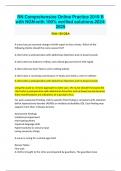
RN HESI EXIT EXAM VERSION 1 V1 2026
FINAL PAPER COMPLETE 160 QUESTIONS
AND ANSWERS ALREADY PASSED
⩥ A client is scheduled to undergo an upper gastrointestinal (GI) series,
and the nurse provides instructions to the client about the test. Which
statement by the client indicates a need for further instruction?
A) "The test will take about 30 minutes"
B) "I need to fast for 8 hours before the test"
C) "I need to drink citrate of magnesia the night before the test and give
myself a Fleet enema on the morning of the test."
D) "I need to take a laxative after the test is completed, because the
liquid that I'll have to drink for the test can be constipating.". Answer: C)
"I need to drink citrate of magnesia the night before the test and give
myself a Fleet enema on the morning of the test."
Rationale
An upper GI series involves visualization of the esophagus, duodenum,
and upper
jejunum by means of the use of a contrast medium. It involves
swallowing a contrast
medium (usually barium), which is administered in a flavored
milkshake. Films are taken
, at intervals during the test, which takes about 30 minutes. No special
preparation is
necessary before a GI series, except that NPO status must be maintained
for 8 hours
before the test. After an upper GI series, the client is prescribed a
laxative to hasten
elimination of the barium. Barium that remains in the colon may become
hard and
difficult to expel, leading to fecal impaction.
⩥ A nurse on the evening shift checks a physician's prescriptions and
notes that the dose of a prescribed medication is higher than the normal
dose. The nurse calls the physician's answering service and is told that
the physician if off for the night and will be available the next morning.
The nurse should:
A) call the nursing supervisor
B) Ask the answering service to contact the on-call physician
C) Withhold the medication until the physician can be reached in the
morning
D) Administer the medication but consult the physician when he
becomes available. Answer: B) Ask the answering service to contact the
on-call physician
⩥ An emergency department (ED) nurse is monitoring a client with
suspected acute
FINAL PAPER COMPLETE 160 QUESTIONS
AND ANSWERS ALREADY PASSED
⩥ A client is scheduled to undergo an upper gastrointestinal (GI) series,
and the nurse provides instructions to the client about the test. Which
statement by the client indicates a need for further instruction?
A) "The test will take about 30 minutes"
B) "I need to fast for 8 hours before the test"
C) "I need to drink citrate of magnesia the night before the test and give
myself a Fleet enema on the morning of the test."
D) "I need to take a laxative after the test is completed, because the
liquid that I'll have to drink for the test can be constipating.". Answer: C)
"I need to drink citrate of magnesia the night before the test and give
myself a Fleet enema on the morning of the test."
Rationale
An upper GI series involves visualization of the esophagus, duodenum,
and upper
jejunum by means of the use of a contrast medium. It involves
swallowing a contrast
medium (usually barium), which is administered in a flavored
milkshake. Films are taken
, at intervals during the test, which takes about 30 minutes. No special
preparation is
necessary before a GI series, except that NPO status must be maintained
for 8 hours
before the test. After an upper GI series, the client is prescribed a
laxative to hasten
elimination of the barium. Barium that remains in the colon may become
hard and
difficult to expel, leading to fecal impaction.
⩥ A nurse on the evening shift checks a physician's prescriptions and
notes that the dose of a prescribed medication is higher than the normal
dose. The nurse calls the physician's answering service and is told that
the physician if off for the night and will be available the next morning.
The nurse should:
A) call the nursing supervisor
B) Ask the answering service to contact the on-call physician
C) Withhold the medication until the physician can be reached in the
morning
D) Administer the medication but consult the physician when he
becomes available. Answer: B) Ask the answering service to contact the
on-call physician
⩥ An emergency department (ED) nurse is monitoring a client with
suspected acute