the 2025UK.STUDIES//2025
OCR A/AS Level question
OCR Apaper,
Level History
including
A the
Y104-01
complete
England
Question
1377–1455
Paper with
Verified
Exam-Ready
Question
Examiner
paper with
MarkMarking
Scheme.
Scheme
Covers
Attached.pdf
all examinable
Page
content
1 of 21
with Verifie
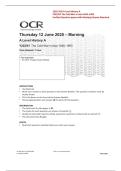
2025 OCR A Level History A
Y104/01 England 1377–1455
Verified Question paper with Marking Scheme Attached
Oxford Cambridge and RSA
Friday 6 June 2025 – Afternoon
A Level History A
Y104/01 England 1377–1455
Time allowed: 1 hour 30 minutes
You must have:
• the OCR 12-page Answer Booklet
INSTRUCTIONS
• Use black ink.
• Write your answer to each question in the Answer Booklet. The question numbers must be
clearly shown.
• Fill in the boxes on the front of the Answer Booklet.
• Answer Question 1 in Section A. Answer either Question 2 or Question 3 in Section B.
INFORMATION
• The total mark for this paper is 50.
• The marks for each question are shown in brackets [ ].
• Quality of extended response will be assessed in questions marked with an asterisk (*).
• This document has 4 pages.
ADVICE
• Read each question carefully before you start your answer.
© OCR 2025 [F/506/4252] OCR is an exempt Charity
DC (WW) 359017 Turn over
S Level question
Downloadpaper,
the 2025
including
OCRthe
A/AS
complete
Level question
Questionpaper,
Paperincluding
with Exam-Ready
the complete
Page
Examiner
1 of
Question
21 Mark
Paper
Scheme.
with Exam-Ready
Covers all examinable
Examinercontent
Mark Scheme.
with Verified
CoversAnswers
all examinable
,the 2025UK.STUDIES//2025
OCR A/AS Level question
OCR Apaper,
Level History
including
A the
Y104-01
complete
England
Question
1377–1455
Paper with
Verified
Exam-Ready
Question
Examiner
paper with
MarkMarking
Scheme.
Scheme
Covers
Attached.pdf
all examinable
Page
content
2 of 21
with Verifie
2
Section A Richard II
1377–1399
Study the four sources and answer Question 1.
1 ‘The influence of de la Pole and de Vere was the main reason for the problems Richard II faced during
the period from 1385 to 1387.’
Use the four sources in their historical context to assess how far they support this view. [30]
Source A: The Lords offer the king their advice.
That it please the king that his position regarding the revenues and charges on his exchequer should be
reviewed and examined by certain lords with the intention of making good arrangements about how and by
what means his position can be upheld and what provision shall be taken for his household.
That it please the king to attract to himself good and honourable men of standing and to associate with
them and avoid the company of others because in doing so he will attract to himself the hearts and loves of
his people. In doing the contrary he will create great peril for himself and his realm.
Lords’ advice about the government of the realm c.1385
Source B: A fragment of a lost chronicle outlines views about de Vere.
Many of the more experienced nobility and senior gentry represented to the king that the new glory of
Robert de Vere, created marquess of Dublin and duke of Ireland, reflected very badly on the reputation of
the English and Irish nations, in that they were so abused and oppressed by a fellow subject. But king
Richard sent them away without thanks, his nature being against any wholesome advice. He did not fail to
acquaint the duke of Ireland not only with the advice, but also the name of the adviser which he had
childishly discovered. De Vere’s ambition had grown to such heights that even moderate persons, and
more so the haughty, thought it high time to reduce him in size.
Chronicle, 1386
Source C: A Chronicler describes the situation in the autumn of 1386.
At the time of the parliament the king lingered at Eltham. So the nobles and the commons came and told
the king that he ought to remove the chancellor [Michael de la Pole] from his position. This angered the
king; he ordered them to keep quiet about these matters and to proceed with the parliament’s business,
saying he would not remove the lowest kitchen boy from his post to please them. The chancellor had
asked the commons for four fifteenths, payable in a year, and the same number of tenths from the clergy,
saying that the king was so much in debt and encumbered by the burdens of war and his household that
he could not otherwise be relieved. But the lords and commons said that they absolutely did not wish to
discuss even the smallest matter until the king showed himself in parliament.
Knighton’s Chronicle, 1337–1396
© OCR 2025 Y104/01 Jun25
S Level question
Downloadpaper,
the 2025
including
OCRthe
A/AS
complete
Level question
Questionpaper,
Paperincluding
with Exam-Ready
the complete
Page
Examiner
2 of
Question
21 Mark
Paper
Scheme.
with Exam-Ready
Covers all examinable
Examinercontent
Mark Scheme.
with Verified
CoversAnswers
all examinable
,the 2025UK.STUDIES//2025
OCR A/AS Level question
OCR Apaper,
Level History
including
A the
Y104-01
complete
England
Question
1377–1455
Paper with
Verified
Exam-Ready
Question
Examiner
paper with
MarkMarking
Scheme.
Scheme
Covers
Attached.pdf
all examinable
Page
content
3 of 21
with Verifie
3
Source D: A monk gives an account of tensions between the king and the nobles in 1387.
The king sent for the duke of Gloucester and the earls of Arundel and Warwick. The king said to them, ‘How dare
you rebel and take up arms against the peace of my kingdom?’ The duke of Gloucester replied, ‘We are not
rebels, nor do we arm ourselves against the peace of the kingdom but to
protect your life against the enemies of ourselves and of the realm. We ask and insist that you call a
parliament immediately and that you take into custody our enemies, your sycophants, and cause
them to be present there’. ‘You shall have a parliament’ said the king ‘but I shall not harm them. I shall treat
you as less than the lowest of your kitchen-boys’. The archbishop of Canterbury begged the king to consent to
reform and this the king granted. But the next day he changed his mind and went to the Tower of London.
Continuation of the Eulogium Historiarum, written c.1405
© OCR 2025 Y104/01 Jun25 Turn over
S Level question
Downloadpaper,
the 2025
including
OCRthe
A/AS
complete
Level question
Questionpaper,
Paperincluding
with Exam-Ready
the complete
Page
Examiner
3 of
Question
21 Mark
Paper
Scheme.
with Exam-Ready
Covers all examinable
Examinercontent
Mark Scheme.
with Verified
CoversAnswers
all examinable
OCR A/AS Level question
OCR Apaper,
Level History
including
A the
Y104-01
complete
England
Question
1377–1455
Paper with
Verified
Exam-Ready
Question
Examiner
paper with
MarkMarking
Scheme.
Scheme
Covers
Attached.pdf
all examinable
Page
content
1 of 21
with Verifie
2025 OCR A Level History A
Y104/01 England 1377–1455
Verified Question paper with Marking Scheme Attached
Oxford Cambridge and RSA
Friday 6 June 2025 – Afternoon
A Level History A
Y104/01 England 1377–1455
Time allowed: 1 hour 30 minutes
You must have:
• the OCR 12-page Answer Booklet
INSTRUCTIONS
• Use black ink.
• Write your answer to each question in the Answer Booklet. The question numbers must be
clearly shown.
• Fill in the boxes on the front of the Answer Booklet.
• Answer Question 1 in Section A. Answer either Question 2 or Question 3 in Section B.
INFORMATION
• The total mark for this paper is 50.
• The marks for each question are shown in brackets [ ].
• Quality of extended response will be assessed in questions marked with an asterisk (*).
• This document has 4 pages.
ADVICE
• Read each question carefully before you start your answer.
© OCR 2025 [F/506/4252] OCR is an exempt Charity
DC (WW) 359017 Turn over
S Level question
Downloadpaper,
the 2025
including
OCRthe
A/AS
complete
Level question
Questionpaper,
Paperincluding
with Exam-Ready
the complete
Page
Examiner
1 of
Question
21 Mark
Paper
Scheme.
with Exam-Ready
Covers all examinable
Examinercontent
Mark Scheme.
with Verified
CoversAnswers
all examinable
,the 2025UK.STUDIES//2025
OCR A/AS Level question
OCR Apaper,
Level History
including
A the
Y104-01
complete
England
Question
1377–1455
Paper with
Verified
Exam-Ready
Question
Examiner
paper with
MarkMarking
Scheme.
Scheme
Covers
Attached.pdf
all examinable
Page
content
2 of 21
with Verifie
2
Section A Richard II
1377–1399
Study the four sources and answer Question 1.
1 ‘The influence of de la Pole and de Vere was the main reason for the problems Richard II faced during
the period from 1385 to 1387.’
Use the four sources in their historical context to assess how far they support this view. [30]
Source A: The Lords offer the king their advice.
That it please the king that his position regarding the revenues and charges on his exchequer should be
reviewed and examined by certain lords with the intention of making good arrangements about how and by
what means his position can be upheld and what provision shall be taken for his household.
That it please the king to attract to himself good and honourable men of standing and to associate with
them and avoid the company of others because in doing so he will attract to himself the hearts and loves of
his people. In doing the contrary he will create great peril for himself and his realm.
Lords’ advice about the government of the realm c.1385
Source B: A fragment of a lost chronicle outlines views about de Vere.
Many of the more experienced nobility and senior gentry represented to the king that the new glory of
Robert de Vere, created marquess of Dublin and duke of Ireland, reflected very badly on the reputation of
the English and Irish nations, in that they were so abused and oppressed by a fellow subject. But king
Richard sent them away without thanks, his nature being against any wholesome advice. He did not fail to
acquaint the duke of Ireland not only with the advice, but also the name of the adviser which he had
childishly discovered. De Vere’s ambition had grown to such heights that even moderate persons, and
more so the haughty, thought it high time to reduce him in size.
Chronicle, 1386
Source C: A Chronicler describes the situation in the autumn of 1386.
At the time of the parliament the king lingered at Eltham. So the nobles and the commons came and told
the king that he ought to remove the chancellor [Michael de la Pole] from his position. This angered the
king; he ordered them to keep quiet about these matters and to proceed with the parliament’s business,
saying he would not remove the lowest kitchen boy from his post to please them. The chancellor had
asked the commons for four fifteenths, payable in a year, and the same number of tenths from the clergy,
saying that the king was so much in debt and encumbered by the burdens of war and his household that
he could not otherwise be relieved. But the lords and commons said that they absolutely did not wish to
discuss even the smallest matter until the king showed himself in parliament.
Knighton’s Chronicle, 1337–1396
© OCR 2025 Y104/01 Jun25
S Level question
Downloadpaper,
the 2025
including
OCRthe
A/AS
complete
Level question
Questionpaper,
Paperincluding
with Exam-Ready
the complete
Page
Examiner
2 of
Question
21 Mark
Paper
Scheme.
with Exam-Ready
Covers all examinable
Examinercontent
Mark Scheme.
with Verified
CoversAnswers
all examinable
,the 2025UK.STUDIES//2025
OCR A/AS Level question
OCR Apaper,
Level History
including
A the
Y104-01
complete
England
Question
1377–1455
Paper with
Verified
Exam-Ready
Question
Examiner
paper with
MarkMarking
Scheme.
Scheme
Covers
Attached.pdf
all examinable
Page
content
3 of 21
with Verifie
3
Source D: A monk gives an account of tensions between the king and the nobles in 1387.
The king sent for the duke of Gloucester and the earls of Arundel and Warwick. The king said to them, ‘How dare
you rebel and take up arms against the peace of my kingdom?’ The duke of Gloucester replied, ‘We are not
rebels, nor do we arm ourselves against the peace of the kingdom but to
protect your life against the enemies of ourselves and of the realm. We ask and insist that you call a
parliament immediately and that you take into custody our enemies, your sycophants, and cause
them to be present there’. ‘You shall have a parliament’ said the king ‘but I shall not harm them. I shall treat
you as less than the lowest of your kitchen-boys’. The archbishop of Canterbury begged the king to consent to
reform and this the king granted. But the next day he changed his mind and went to the Tower of London.
Continuation of the Eulogium Historiarum, written c.1405
© OCR 2025 Y104/01 Jun25 Turn over
S Level question
Downloadpaper,
the 2025
including
OCRthe
A/AS
complete
Level question
Questionpaper,
Paperincluding
with Exam-Ready
the complete
Page
Examiner
3 of
Question
21 Mark
Paper
Scheme.
with Exam-Ready
Covers all examinable
Examinercontent
Mark Scheme.
with Verified
CoversAnswers
all examinable