1
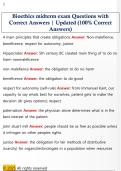
Bioethics Exam Questions with Correct
Answers | Updated (100% Correct Answers)
What are the characteristics of good reasons in ethics? Answer: -
relevant to position
-provide evidence for a position
-support a conclusion as an argument
-appeals not to evidence but to a principle
-should not contradict each other and be logically consistent
truth Answer: how premises correspond or not to the world
validity Answer: the formal relations between premises and
conclusion
Slippery slope Answer: argument that a small change in the current
practice will lead to terrible results; no logical place to draw the line
Conceptual Answer: once a small change is made, other changes
will logically follow, appeals to something good in human nature
Empirical Answer: taking the first step unleashes something bad in
human nature
Ad hominem Answer: - "to the man"
© 2025 All rights reserved
,2
-a personal attack on someone else
Tu quoque Answer: --"you too"
--two wrongs make a right
--Justifying our actions by claiming that others have committed the
same wrong
Straw man/Red herring Answer: bringing up irrelevant issues;
focusing on different issue than one originally advocated because
the different issue is easier to refute
ex) "We should reject Obamacare because it will lead to death
panels where people are forced to have advance directives before
they know they are dying or know what their options are."
straw man Answer: --"So you're saying I evolved from a monkey?
Then how come I don't throw feces and climb trees?"
--Evolution doesn't make that claim, but by claiming that it does,
the arguer is trying to beat down a much easier argument.
Red Herring Answer: --"So you believe in evolution? I'll bet your
parents would be disappointed in you."
--The arguer is distracting from the issue by bringing his opponent's
parents into this - they have no impact on whether or not the
theory is correct.
© 2025 All rights reserved
,3
Post hoc, ergo propter hoc Answer: --"After This, Therefore,
Because of This"
--confuses temporal priority with causality
--ex) "In the 1960s, women started working outside the home, and a
few years later, rates of divorce soared. Therefore, if we want to
preserve the family, we should prevent women from working
outside the home."
--Just because one event occurred before another does not mean
the first was caused by the second ---- everything in history came
before X event, it does not mean that they are correlated
Appeal to authority Answer: --using any authority to justify an
argument
--Ex) Using an ant expert's opinion on rock bands
--Reasons and arguments justify a position, not just any authority
Appeal to feelings and upbringing Answer: --using personal feelings
or upbringing to justify something
--Ex) "I was brought up to believe that men were the hunters and
women were the hunted, so a woman should wait until a man finds
her and asks her out."
--You can be brought up the wrong way
© 2025 All rights reserved
, 4
Ad populum Answer: --everybody does it
--Ex) "All the other physicians do it. Why shouldn't I take such gifts,
too?"
False dichotomy Answer: --"Either-Or"
--presenting an issue with only two extremes
Equivocation Answer: --use of ambiguous language to conceal the
truth
--Ex) "Sex offenders should only be allowed to live in certain areas,
so Alan Jones should not live here."
Begging the question Answer: --when a conclusion that requires
good reasons is assumed without argument
--Ex) Saying only humans can be persons is begging the question
which is whether only humans can be persons
moral relativism Answer: --saying that right and wrong is internally
defined by each society/culture so we can't judge other cultures for
their practices because all of our moral systems are right
--may sound nice in theory but in practice it allows for the Nazis to
be justified because "we can't judge that culture"
utilitarianism Answer: gggn
© 2025 All rights reserved
Bioethics Exam Questions with Correct
Answers | Updated (100% Correct Answers)
What are the characteristics of good reasons in ethics? Answer: -
relevant to position
-provide evidence for a position
-support a conclusion as an argument
-appeals not to evidence but to a principle
-should not contradict each other and be logically consistent
truth Answer: how premises correspond or not to the world
validity Answer: the formal relations between premises and
conclusion
Slippery slope Answer: argument that a small change in the current
practice will lead to terrible results; no logical place to draw the line
Conceptual Answer: once a small change is made, other changes
will logically follow, appeals to something good in human nature
Empirical Answer: taking the first step unleashes something bad in
human nature
Ad hominem Answer: - "to the man"
© 2025 All rights reserved
,2
-a personal attack on someone else
Tu quoque Answer: --"you too"
--two wrongs make a right
--Justifying our actions by claiming that others have committed the
same wrong
Straw man/Red herring Answer: bringing up irrelevant issues;
focusing on different issue than one originally advocated because
the different issue is easier to refute
ex) "We should reject Obamacare because it will lead to death
panels where people are forced to have advance directives before
they know they are dying or know what their options are."
straw man Answer: --"So you're saying I evolved from a monkey?
Then how come I don't throw feces and climb trees?"
--Evolution doesn't make that claim, but by claiming that it does,
the arguer is trying to beat down a much easier argument.
Red Herring Answer: --"So you believe in evolution? I'll bet your
parents would be disappointed in you."
--The arguer is distracting from the issue by bringing his opponent's
parents into this - they have no impact on whether or not the
theory is correct.
© 2025 All rights reserved
,3
Post hoc, ergo propter hoc Answer: --"After This, Therefore,
Because of This"
--confuses temporal priority with causality
--ex) "In the 1960s, women started working outside the home, and a
few years later, rates of divorce soared. Therefore, if we want to
preserve the family, we should prevent women from working
outside the home."
--Just because one event occurred before another does not mean
the first was caused by the second ---- everything in history came
before X event, it does not mean that they are correlated
Appeal to authority Answer: --using any authority to justify an
argument
--Ex) Using an ant expert's opinion on rock bands
--Reasons and arguments justify a position, not just any authority
Appeal to feelings and upbringing Answer: --using personal feelings
or upbringing to justify something
--Ex) "I was brought up to believe that men were the hunters and
women were the hunted, so a woman should wait until a man finds
her and asks her out."
--You can be brought up the wrong way
© 2025 All rights reserved
, 4
Ad populum Answer: --everybody does it
--Ex) "All the other physicians do it. Why shouldn't I take such gifts,
too?"
False dichotomy Answer: --"Either-Or"
--presenting an issue with only two extremes
Equivocation Answer: --use of ambiguous language to conceal the
truth
--Ex) "Sex offenders should only be allowed to live in certain areas,
so Alan Jones should not live here."
Begging the question Answer: --when a conclusion that requires
good reasons is assumed without argument
--Ex) Saying only humans can be persons is begging the question
which is whether only humans can be persons
moral relativism Answer: --saying that right and wrong is internally
defined by each society/culture so we can't judge other cultures for
their practices because all of our moral systems are right
--may sound nice in theory but in practice it allows for the Nazis to
be justified because "we can't judge that culture"
utilitarianism Answer: gggn
© 2025 All rights reserved