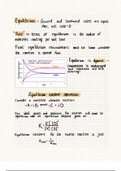
Equilibrium forward and backward rates are
equal
thus net rate 0
Rate in terms of equilibrium is the number of
molecules reacting per unit time
Final equilibrium concentrations must be sane wherever
the reaction is started from
Equilibrium is dynamic
composition is unchanged
but reactions are still
occurring
Equilibrium constant expression
consider a reversible chemical reaction
AA 1613 cc do
For ideal gases and solutions the reaction will come to
with an
equilibrium constant
equilibrium as given
c d
kc In b
AT B
Equilibrium constant for the reverse reaction is just
1
Kback TLforw
, If we multiply the reaction by n for equilibrium
constant we simply get Knc
From the equation we can conclude that if Kpl
favors the products
equilibrium
similarly if K 41 equilibrium favors reactants
Best way to to understand
optimising reaction is
how temperature pressure and concentration of
reactants affect the equilibrium position
Homogeneous equilibrium Reactants and Products are
in the same phase
Heterogeneous equilibrium Reactants and products exist in
different phases gas liquid solid
Heterogeneous chemical equilibria
consider saturated solution in equilibrium with solid
SATURATED The dissolved SATURATED
solution goamngeyntoratniafferishthwesolution
EXCESS gy much solid is
souo Present Excess
SOLID
If
similarly liquid works in a same manner with vapour
Due to fixed concentration
Reactants and Products in the form of pure solid or
pure liquid don't appear in equilibrium constant expression
equal
thus net rate 0
Rate in terms of equilibrium is the number of
molecules reacting per unit time
Final equilibrium concentrations must be sane wherever
the reaction is started from
Equilibrium is dynamic
composition is unchanged
but reactions are still
occurring
Equilibrium constant expression
consider a reversible chemical reaction
AA 1613 cc do
For ideal gases and solutions the reaction will come to
with an
equilibrium constant
equilibrium as given
c d
kc In b
AT B
Equilibrium constant for the reverse reaction is just
1
Kback TLforw
, If we multiply the reaction by n for equilibrium
constant we simply get Knc
From the equation we can conclude that if Kpl
favors the products
equilibrium
similarly if K 41 equilibrium favors reactants
Best way to to understand
optimising reaction is
how temperature pressure and concentration of
reactants affect the equilibrium position
Homogeneous equilibrium Reactants and Products are
in the same phase
Heterogeneous equilibrium Reactants and products exist in
different phases gas liquid solid
Heterogeneous chemical equilibria
consider saturated solution in equilibrium with solid
SATURATED The dissolved SATURATED
solution goamngeyntoratniafferishthwesolution
EXCESS gy much solid is
souo Present Excess
SOLID
If
similarly liquid works in a same manner with vapour
Due to fixed concentration
Reactants and Products in the form of pure solid or
pure liquid don't appear in equilibrium constant expression