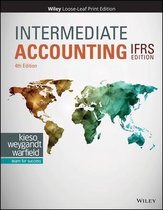
Solution Manual For
Intermediate Accounting IFRS 4th Edition by Donald E. Kieso, Jerry J.
Weygandt, Terry D. Warfield Chapter 1-24
CHAPTER 1
Financial Reporting and Accounting Standards
NW
ASSIGNMENT CLASSIFICATION TABLE
U
Topics Questions Concepts for
Solution Manual for Intermediate Accounting IFRS,Analysis 4th Edition by Donald E. Kieso,
Jerry J. Weygandt, and Terry D. Warfield: Complete Step-by-Step Solutions
Rhi
1. Demystify
Global markets IFRS complexities
and financial reporting. with this
1, 2, 3, indispensable
4 4 solution manual for
Intermediate Accounting IFRS, 4th Edition—the global benchmark for accounting
2. Objective of financial reporting. 5, 6, 7, 8, 9, 10 2, 3
excellence. Authored by Donald E. Kieso, Jerry J. Weygandt, and Terry D. Warfield,
SzzE
3. it provides
Standard-setting exhaustive, step-by-step
organizations. solutions
11, 12, 13, 14, to every
1, 2,exercise,
3, 5, 6, 8, problem,
9, and
case—over 1,800 in total—across 15, 20+ chapters.
16, 17, 18 Tackle
11 core IFRS standards:
revenue recognition (IFRS 15), financial instruments (IFRS 9), leases (IFRS 16),
4. Financial consolidations, impairment testing,
reporting challenges. pensions,
19, 20, 21, 22, and fair
3, 7,value
8, 10,measurements,
11, 12 all
23, 24, 25
synced with 2026 IASB amendments on sustainability reporting, digital currencies,
nDu
ASSIGNMENT andCHARACTERISTICS
ESG integrations. TABLE
Detailed explanations include journal entries, T-accounts, ratio computations, and
Level of Time
conceptual analyses, fostering IFRS mastery for international CPA, ACCA, or CFA
Item Description Difficulty (minutes)
prep. With cross-references to textbook illustrations and real-world vignettes (e.g.,
Ors
CA1.1 multinational
IFRS consolidations), this manual accelerates learning
and standard-setting. Simple for undergrads,
5–10
CA1.2 grads,
IFRS andand instructors. Transform challenges into clarity—grasp
standard-setting. Simple global 5–10nuances,
CA1.3 streamline assignments, and launch
Financial reporting and accounting standards.your IFRS-savvy career
Simple with Kieso, Weygandt,
15–20
Ce
CA1.4 and Warfield's
Financial authoritative precision!
accounting. Simple 15–20
CA1.5 Need for IASB. Simple 15–20
CA1.6 IASB role in standard-setting. Simple 15–20
S
CA1.7 Accounting numbers and the environment. Simple 10–15
CA1.8 Politicalization of IFRS. Complex 15–20
CA1.9 Models for setting IFRS. Simple 10–15
CA1.10 Economic consequences. Moderate 10–15
CA1.11 Rule-making Issues. Complex 20–25
CA1.12 Financial reporting pressures. Moderate 25–35
Copyright © 2020 Wiley Kieso, IFRS,4/e, Solutions Manual (For Instructor Use Only) 1-1-1
, ANSWERS TO QUESTIONS
1. World markets are becoming increasingly intertwined. The tremendous variety and volume of both
exported and imported goods indicates the extensive involvement in international trade. As a
result, the move towards adoption of international financial reporting standards has and will
continue in the future.
LO: 1, Bloom: K, Difficulty: Simple, Time: 3-5, AACSB: None, AICPA BB: None, AICPA FC: Reporting, AICPA PC: Communication
2. Financial accounting measures, classifies, and summarizes in report form those activities and that
information which relate to the enterprise as a whole for use by parties both internal and external
to a business enterprise. Managerial accounting also measures, classifies, and summarizes in
report form enterprise activities, but the communication is for the use of internal, managerial
parties, and relates more to subsystems of the entity. Managerial accounting is management
NW
decision-oriented and directed more toward product line, division, and profit center reporting.
LO: 1, Bloom: K, Difficulty: Simple, Time: 3-5, AACSB: None, AICPA BB: None, AICPA FC: Reporting, AICPA PC: Communication
3. Financial statements generally refer to the four basic financial statements: statement of financial
U
position, statement of comprehensive income (or income statement), statement of cash flows, and
statement of changes in equity. Financial reporting is a broader concept; it includes the basic
financial statements and any other means of communicating financial and economic data to
interested external parties.
Rhi
LO: 1, Bloom: K, Difficulty: Simple, Time: 3-5, AACSB: None, AICPA BB: None, AICPA FC: Reporting, AICPA PC: Communication
4. If a company‘s financial performance is measured accurately, fairly, and on a timely basis, the right
managers and companies are able to attract investment capital. To provide unreliable and
SzzE
irrelevant information leads to poor capital allocation which adversely affects the securities market.
LO: 1, Bloom: K, Difficulty: Simple, Time: 3-5, AACSB: None, AICPA BB: None, AICPA FC: Reporting, AICPA PC: Communication
5. A single set of high quality accounting standards ensures adequate comparability. Investors are
able to make better investment decisions if they receive financial information from a U.S. company
nDu
that is comparable to an international competitor.
LO: 2, Bloom: K, Difficulty: Simple, Time: 3-5, AACSB: None, AICPA BB: None, AICPA FC: Reporting, AICPA PC: Communication
6. The objective of general-purpose financial reporting is to provide financial information about the
reporting entity that is useful to present and potential equity investors, lenders, and other creditors
Ors
in making decisions about providing resources to the entity.
LO: 2, Bloom: K, Difficulty: Simple, Time: 3-5, AACSB: None, AICPA BB: None, AICPA FC: Reporting, AICPA PC: Communication
7. General-purpose financial statements provide financial reporting information to a wide variety of
Ce
users. To be cost effective in providing this information, general-purpose financial statements
provide at the least cost the most useful information possible.
LO: 2, Bloom: K, Difficulty: Simple, Time: 3-5, AACSB: None, AICPA BB: None, AICPA FC: Reporting, AICPA PC: Communication
S
8. Shareholders, creditors, suppliers, employees, and regulators all use general-purpose financial
statements. The primary user group is capital providers (shareholders and creditors).
LO: 2, Bloom: K, Difficulty: Simple, Time: 3-5, AACSB: None, AICPA BB: None, AICPA FC: Reporting, AICPA PC: Communication
9. The proprietary perspective is not considered appropriate because this perspective generally does
not reflect a realistic view of the financial reporting environment. Instead, the entity perspective
is adopted which is consistent with the present business environment where most companies
engaged in financial reporting have substance separate and distinct from their owners.
LO: 2, Bloom: K, Difficulty: Simple, Time: 3-5, AACSB: None, AICPA BB: None, AICPA FC: Reporting, AICPA PC: Communication
1-1-2 Copyright © 2020 Wiley Kieso, IFRS, 4/e, Solutions Manual (For Instructor Use Only)
, Questions Chapter 1 (Continued)
10. This statement is not correct. The objective of financial reporting is primarily to provide information
to investors interested in assessing the company‘s ability to generate net cash inflows and
management‘s ability to protect and enhance the capital providers‘ investments. Financial
reporting should help investors assess the amounts, timing and uncertainty of prospective cash
inflows.
LO: 2, Bloom: K, Difficulty: Simple, Time: 3-5, AACSB: None, AICPA BB: None, AICPA FC: Reporting, AICPA PC: Communication
11. The two organizations involved in international standard-setting are IOSCO (International Organi-
zation of Securities Commissions) and the IASB (International Accounting Standards Board.) The
IOSCO does not set accounting standards, but ensures that the global markets can operate in an
efficient and effective manner. Conversely, the IASB‘s mission is to develop a single set of high
quality, enforceable and global financial reporting standards (IFRSs) for general-purpose financial
statements.
NW
LO: 3, Bloom: K, Difficulty: Simple, Time: 3-5, AACSB: None, AICPA BB: None, AICPA FC: Reporting, AICPA PC: Communication
12. IOSCO (International Organization of Securities Commissions) is an association of organizations
that regulate the world‘s securities markets. Members are generally the main financial regulators
U
for a given country. IOSCO does not set accounting standards.
LO: 3, Bloom: K, Difficulty: Simple, Time: 3-5, AACSB: None, AICPA BB: None, AICPA FC: Reporting, AICPA PC: Communication
Rhi
13. The mission of the IASB (International Accounting Standards Board) is to develop, in the public
interest, a single set of high quality, enforceable global international financial reporting standards
(IFRSs) for general-purpose financial statements.
LO: 3, Bloom: K, Difficulty: Simple, Time: 3-5, AACSB: None, AICPA BB: None, AICPA FC: Reporting, AICPA PC: Communication
SzzE
14. The purpose of the Monitoring Board is to establish a link between accounting standard-setters
and those public authorities (such as IOSCO) that generally oversee accounting standard-setters.
This board also provides political legitimacy to the overall organization.
LO: 3, Bloom: K, Difficulty: Simple, Time: 3-5, AACSB: None, AICPA BB: None, AICPA FC: Reporting, AICPA PC: Communication
nDu
15. The IASB preliminary views are based on research and analysis conducted by the IASB staff.
IASB exposure drafts are issued after the Board evaluates research and public response to
preliminary views. IASB standards are issued after the Board evaluates responses to the exposure
draft.
Ors
LO: 3, Bloom: K, Difficulty: Simple, Time: 3-5, AACSB: None, AICPA BB: None, AICPA FC: Reporting, AICPA PC: Communication
16. IASB International Financial Reporting Standards are financial accounting standards issued by the
IASB and are referred to as International Financial Reporting Standards (IFRS). The IFRS
Ce
Conceptual Framework for Financial Reporting sets forth fundamental objectives and concepts
that the Board uses in developing future standards of financial reporting. The intent of the
Conceptual Framework is to form a cohesive set of interrelated concepts that will serve as tools for
solving existing and emerging problems in a consistent manner.
S
LO: 3, Bloom: K, Difficulty: Simple, Time: 3-5, AACSB: None, AICPA BB: None, AICPA FC: Reporting, AICPA PC: Communication
17. In ranking from the most authoritative to least authoritative, International Financial Reporting
Standards are the most authoritative, followed by International Financial Reporting Standard
Interpretations and then the Conceptual Framework for Financial Reporting.
LO: 3, Bloom: K, Difficulty: Simple, Time: 3-5, AACSB: None, AICPA BB: None, AICPA FC: Reporting, AICPA PC: Communication
Copyright © 2020 Wiley Kieso, IFRS,4/e, Solutions Manual (For Instructor Use Only) 1-1-3
, Questions Chapter 1 (Continued)
18. The International Financial Reporting Standards Interpretations Committee (IFRIC) applies a
principles-based approach in providing interpretative guidance. The IFRIC issues interpretations
that cover newly identified financial reporting issues not specifically dealt with in IFRS, and issues
where conflicting interpretations have developed, or seem likely to develop in the absence of
authoritative guidance.
LO: 3, Bloom: K, Difficulty: Simple, Time: 3-5, AACSB: None, AICPA BB: None, AICPA FC: Reporting, AICPA PC: Communication
19. Some major challenges facing the accounting profession relate to the following items:
Nonfinancial measurement—how to report significant key performance measurements such as
customer satisfaction indexes, backlog information and reject rates on goods purchased.
Forward-looking information—how to report more future-oriented information.
Soft assets—how to report on intangible assets, such as market know-how, market
dominance, and well-trained employees.
NW
Timeliness—how to report more real-time information.
LO: 4, Bloom: K, Difficulty: Simple, Time: 3-5, AACSB: None, AICPA BB: None, AICPA FC: Reporting, AICPA PC: Communication
20. The sources of pressure are innumerable, but the most intense and continuous pressure to
U
change or influence the development of IFRS come from individual companies, industry
associations, governmental agencies, practicing accountants, academicians, professional
accounting organizations, and investing public.
Rhi
LO: 4, Bloom: K, Difficulty: Simple, Time: 3-5, AACSB: None, AICPA BB: None, AICPA FC: Reporting, AICPA PC: Communication
21. Economic consequences means the impact of accounting reports on the wealth positions of
issuers and users of financial information, and the decision-making behavior resulting from that
SzzE
impact. In other words, accounting information impacts various users in many different ways which
leads to wealth transfers among these various groups.
If politics plays an important role in the development of accounting rules, the rules will be subject
to manipulation for the purpose of furthering whatever policy prevails at the moment. No matter
how well intentioned the rule-maker may be, if information is designed to indicate that investing in
nDu
a particular enterprise involves less risk than it actually does, or is designed to encourage invest-
ment in a particular segment of the economy, financial reporting will suffer an irreplaceable loss of
credibility.
LO: 4, Bloom: K, Difficulty: Simple, Time: 3-5, AACSB: None, AICPA BB: None, AICPA FC: Reporting, AICPA PC: Communication
Ors
22. No one particular proposal is expected in answer to this question. The students‘ proposals,
however, should be defensible relative to the following criteria:
(1) The method must be efficient, responsive, and expeditious.
(2) The method must be free of bias and be above or insulated from pressure groups.
Ce
(3) The method must command widespread support if it does not have legislative authority.
(4) The method must produce sound yet practical accounting principles or standards.
The students‘ proposals might take the form of alterations of the existing methodology, an accoun-
S
ting court (as proposed by Leonard Spacek), or governmental device.
LO: 4, Bloom: K, Difficulty: Simple, Time: 3-5, AACSB: None, AICPA BB: None, AICPA FC: Reporting, AICPA PC: Communication
23. Concern exists about fraudulent financial reporting because it can undermine the entire financial
reporting process. Failure to provide information to users that is accurate can lead to inappropriate
allocations of resources in our economy. In addition, failure to detect massive fraud can lead to
additional governmental oversight of the accounting profession.
LO: 4, Bloom: K, Difficulty: Simple, Time: 3-5, AACSB: None, AICPA BB: None, AICPA FC: Reporting, AICPA PC: Communication
1-1-4 Copyright © 2020 Wiley Kieso, IFRS, 4/e, Solutions Manual (For Instructor Use Only)
Intermediate Accounting IFRS 4th Edition by Donald E. Kieso, Jerry J.
Weygandt, Terry D. Warfield Chapter 1-24
CHAPTER 1
Financial Reporting and Accounting Standards
NW
ASSIGNMENT CLASSIFICATION TABLE
U
Topics Questions Concepts for
Solution Manual for Intermediate Accounting IFRS,Analysis 4th Edition by Donald E. Kieso,
Jerry J. Weygandt, and Terry D. Warfield: Complete Step-by-Step Solutions
Rhi
1. Demystify
Global markets IFRS complexities
and financial reporting. with this
1, 2, 3, indispensable
4 4 solution manual for
Intermediate Accounting IFRS, 4th Edition—the global benchmark for accounting
2. Objective of financial reporting. 5, 6, 7, 8, 9, 10 2, 3
excellence. Authored by Donald E. Kieso, Jerry J. Weygandt, and Terry D. Warfield,
SzzE
3. it provides
Standard-setting exhaustive, step-by-step
organizations. solutions
11, 12, 13, 14, to every
1, 2,exercise,
3, 5, 6, 8, problem,
9, and
case—over 1,800 in total—across 15, 20+ chapters.
16, 17, 18 Tackle
11 core IFRS standards:
revenue recognition (IFRS 15), financial instruments (IFRS 9), leases (IFRS 16),
4. Financial consolidations, impairment testing,
reporting challenges. pensions,
19, 20, 21, 22, and fair
3, 7,value
8, 10,measurements,
11, 12 all
23, 24, 25
synced with 2026 IASB amendments on sustainability reporting, digital currencies,
nDu
ASSIGNMENT andCHARACTERISTICS
ESG integrations. TABLE
Detailed explanations include journal entries, T-accounts, ratio computations, and
Level of Time
conceptual analyses, fostering IFRS mastery for international CPA, ACCA, or CFA
Item Description Difficulty (minutes)
prep. With cross-references to textbook illustrations and real-world vignettes (e.g.,
Ors
CA1.1 multinational
IFRS consolidations), this manual accelerates learning
and standard-setting. Simple for undergrads,
5–10
CA1.2 grads,
IFRS andand instructors. Transform challenges into clarity—grasp
standard-setting. Simple global 5–10nuances,
CA1.3 streamline assignments, and launch
Financial reporting and accounting standards.your IFRS-savvy career
Simple with Kieso, Weygandt,
15–20
Ce
CA1.4 and Warfield's
Financial authoritative precision!
accounting. Simple 15–20
CA1.5 Need for IASB. Simple 15–20
CA1.6 IASB role in standard-setting. Simple 15–20
S
CA1.7 Accounting numbers and the environment. Simple 10–15
CA1.8 Politicalization of IFRS. Complex 15–20
CA1.9 Models for setting IFRS. Simple 10–15
CA1.10 Economic consequences. Moderate 10–15
CA1.11 Rule-making Issues. Complex 20–25
CA1.12 Financial reporting pressures. Moderate 25–35
Copyright © 2020 Wiley Kieso, IFRS,4/e, Solutions Manual (For Instructor Use Only) 1-1-1
, ANSWERS TO QUESTIONS
1. World markets are becoming increasingly intertwined. The tremendous variety and volume of both
exported and imported goods indicates the extensive involvement in international trade. As a
result, the move towards adoption of international financial reporting standards has and will
continue in the future.
LO: 1, Bloom: K, Difficulty: Simple, Time: 3-5, AACSB: None, AICPA BB: None, AICPA FC: Reporting, AICPA PC: Communication
2. Financial accounting measures, classifies, and summarizes in report form those activities and that
information which relate to the enterprise as a whole for use by parties both internal and external
to a business enterprise. Managerial accounting also measures, classifies, and summarizes in
report form enterprise activities, but the communication is for the use of internal, managerial
parties, and relates more to subsystems of the entity. Managerial accounting is management
NW
decision-oriented and directed more toward product line, division, and profit center reporting.
LO: 1, Bloom: K, Difficulty: Simple, Time: 3-5, AACSB: None, AICPA BB: None, AICPA FC: Reporting, AICPA PC: Communication
3. Financial statements generally refer to the four basic financial statements: statement of financial
U
position, statement of comprehensive income (or income statement), statement of cash flows, and
statement of changes in equity. Financial reporting is a broader concept; it includes the basic
financial statements and any other means of communicating financial and economic data to
interested external parties.
Rhi
LO: 1, Bloom: K, Difficulty: Simple, Time: 3-5, AACSB: None, AICPA BB: None, AICPA FC: Reporting, AICPA PC: Communication
4. If a company‘s financial performance is measured accurately, fairly, and on a timely basis, the right
managers and companies are able to attract investment capital. To provide unreliable and
SzzE
irrelevant information leads to poor capital allocation which adversely affects the securities market.
LO: 1, Bloom: K, Difficulty: Simple, Time: 3-5, AACSB: None, AICPA BB: None, AICPA FC: Reporting, AICPA PC: Communication
5. A single set of high quality accounting standards ensures adequate comparability. Investors are
able to make better investment decisions if they receive financial information from a U.S. company
nDu
that is comparable to an international competitor.
LO: 2, Bloom: K, Difficulty: Simple, Time: 3-5, AACSB: None, AICPA BB: None, AICPA FC: Reporting, AICPA PC: Communication
6. The objective of general-purpose financial reporting is to provide financial information about the
reporting entity that is useful to present and potential equity investors, lenders, and other creditors
Ors
in making decisions about providing resources to the entity.
LO: 2, Bloom: K, Difficulty: Simple, Time: 3-5, AACSB: None, AICPA BB: None, AICPA FC: Reporting, AICPA PC: Communication
7. General-purpose financial statements provide financial reporting information to a wide variety of
Ce
users. To be cost effective in providing this information, general-purpose financial statements
provide at the least cost the most useful information possible.
LO: 2, Bloom: K, Difficulty: Simple, Time: 3-5, AACSB: None, AICPA BB: None, AICPA FC: Reporting, AICPA PC: Communication
S
8. Shareholders, creditors, suppliers, employees, and regulators all use general-purpose financial
statements. The primary user group is capital providers (shareholders and creditors).
LO: 2, Bloom: K, Difficulty: Simple, Time: 3-5, AACSB: None, AICPA BB: None, AICPA FC: Reporting, AICPA PC: Communication
9. The proprietary perspective is not considered appropriate because this perspective generally does
not reflect a realistic view of the financial reporting environment. Instead, the entity perspective
is adopted which is consistent with the present business environment where most companies
engaged in financial reporting have substance separate and distinct from their owners.
LO: 2, Bloom: K, Difficulty: Simple, Time: 3-5, AACSB: None, AICPA BB: None, AICPA FC: Reporting, AICPA PC: Communication
1-1-2 Copyright © 2020 Wiley Kieso, IFRS, 4/e, Solutions Manual (For Instructor Use Only)
, Questions Chapter 1 (Continued)
10. This statement is not correct. The objective of financial reporting is primarily to provide information
to investors interested in assessing the company‘s ability to generate net cash inflows and
management‘s ability to protect and enhance the capital providers‘ investments. Financial
reporting should help investors assess the amounts, timing and uncertainty of prospective cash
inflows.
LO: 2, Bloom: K, Difficulty: Simple, Time: 3-5, AACSB: None, AICPA BB: None, AICPA FC: Reporting, AICPA PC: Communication
11. The two organizations involved in international standard-setting are IOSCO (International Organi-
zation of Securities Commissions) and the IASB (International Accounting Standards Board.) The
IOSCO does not set accounting standards, but ensures that the global markets can operate in an
efficient and effective manner. Conversely, the IASB‘s mission is to develop a single set of high
quality, enforceable and global financial reporting standards (IFRSs) for general-purpose financial
statements.
NW
LO: 3, Bloom: K, Difficulty: Simple, Time: 3-5, AACSB: None, AICPA BB: None, AICPA FC: Reporting, AICPA PC: Communication
12. IOSCO (International Organization of Securities Commissions) is an association of organizations
that regulate the world‘s securities markets. Members are generally the main financial regulators
U
for a given country. IOSCO does not set accounting standards.
LO: 3, Bloom: K, Difficulty: Simple, Time: 3-5, AACSB: None, AICPA BB: None, AICPA FC: Reporting, AICPA PC: Communication
Rhi
13. The mission of the IASB (International Accounting Standards Board) is to develop, in the public
interest, a single set of high quality, enforceable global international financial reporting standards
(IFRSs) for general-purpose financial statements.
LO: 3, Bloom: K, Difficulty: Simple, Time: 3-5, AACSB: None, AICPA BB: None, AICPA FC: Reporting, AICPA PC: Communication
SzzE
14. The purpose of the Monitoring Board is to establish a link between accounting standard-setters
and those public authorities (such as IOSCO) that generally oversee accounting standard-setters.
This board also provides political legitimacy to the overall organization.
LO: 3, Bloom: K, Difficulty: Simple, Time: 3-5, AACSB: None, AICPA BB: None, AICPA FC: Reporting, AICPA PC: Communication
nDu
15. The IASB preliminary views are based on research and analysis conducted by the IASB staff.
IASB exposure drafts are issued after the Board evaluates research and public response to
preliminary views. IASB standards are issued after the Board evaluates responses to the exposure
draft.
Ors
LO: 3, Bloom: K, Difficulty: Simple, Time: 3-5, AACSB: None, AICPA BB: None, AICPA FC: Reporting, AICPA PC: Communication
16. IASB International Financial Reporting Standards are financial accounting standards issued by the
IASB and are referred to as International Financial Reporting Standards (IFRS). The IFRS
Ce
Conceptual Framework for Financial Reporting sets forth fundamental objectives and concepts
that the Board uses in developing future standards of financial reporting. The intent of the
Conceptual Framework is to form a cohesive set of interrelated concepts that will serve as tools for
solving existing and emerging problems in a consistent manner.
S
LO: 3, Bloom: K, Difficulty: Simple, Time: 3-5, AACSB: None, AICPA BB: None, AICPA FC: Reporting, AICPA PC: Communication
17. In ranking from the most authoritative to least authoritative, International Financial Reporting
Standards are the most authoritative, followed by International Financial Reporting Standard
Interpretations and then the Conceptual Framework for Financial Reporting.
LO: 3, Bloom: K, Difficulty: Simple, Time: 3-5, AACSB: None, AICPA BB: None, AICPA FC: Reporting, AICPA PC: Communication
Copyright © 2020 Wiley Kieso, IFRS,4/e, Solutions Manual (For Instructor Use Only) 1-1-3
, Questions Chapter 1 (Continued)
18. The International Financial Reporting Standards Interpretations Committee (IFRIC) applies a
principles-based approach in providing interpretative guidance. The IFRIC issues interpretations
that cover newly identified financial reporting issues not specifically dealt with in IFRS, and issues
where conflicting interpretations have developed, or seem likely to develop in the absence of
authoritative guidance.
LO: 3, Bloom: K, Difficulty: Simple, Time: 3-5, AACSB: None, AICPA BB: None, AICPA FC: Reporting, AICPA PC: Communication
19. Some major challenges facing the accounting profession relate to the following items:
Nonfinancial measurement—how to report significant key performance measurements such as
customer satisfaction indexes, backlog information and reject rates on goods purchased.
Forward-looking information—how to report more future-oriented information.
Soft assets—how to report on intangible assets, such as market know-how, market
dominance, and well-trained employees.
NW
Timeliness—how to report more real-time information.
LO: 4, Bloom: K, Difficulty: Simple, Time: 3-5, AACSB: None, AICPA BB: None, AICPA FC: Reporting, AICPA PC: Communication
20. The sources of pressure are innumerable, but the most intense and continuous pressure to
U
change or influence the development of IFRS come from individual companies, industry
associations, governmental agencies, practicing accountants, academicians, professional
accounting organizations, and investing public.
Rhi
LO: 4, Bloom: K, Difficulty: Simple, Time: 3-5, AACSB: None, AICPA BB: None, AICPA FC: Reporting, AICPA PC: Communication
21. Economic consequences means the impact of accounting reports on the wealth positions of
issuers and users of financial information, and the decision-making behavior resulting from that
SzzE
impact. In other words, accounting information impacts various users in many different ways which
leads to wealth transfers among these various groups.
If politics plays an important role in the development of accounting rules, the rules will be subject
to manipulation for the purpose of furthering whatever policy prevails at the moment. No matter
how well intentioned the rule-maker may be, if information is designed to indicate that investing in
nDu
a particular enterprise involves less risk than it actually does, or is designed to encourage invest-
ment in a particular segment of the economy, financial reporting will suffer an irreplaceable loss of
credibility.
LO: 4, Bloom: K, Difficulty: Simple, Time: 3-5, AACSB: None, AICPA BB: None, AICPA FC: Reporting, AICPA PC: Communication
Ors
22. No one particular proposal is expected in answer to this question. The students‘ proposals,
however, should be defensible relative to the following criteria:
(1) The method must be efficient, responsive, and expeditious.
(2) The method must be free of bias and be above or insulated from pressure groups.
Ce
(3) The method must command widespread support if it does not have legislative authority.
(4) The method must produce sound yet practical accounting principles or standards.
The students‘ proposals might take the form of alterations of the existing methodology, an accoun-
S
ting court (as proposed by Leonard Spacek), or governmental device.
LO: 4, Bloom: K, Difficulty: Simple, Time: 3-5, AACSB: None, AICPA BB: None, AICPA FC: Reporting, AICPA PC: Communication
23. Concern exists about fraudulent financial reporting because it can undermine the entire financial
reporting process. Failure to provide information to users that is accurate can lead to inappropriate
allocations of resources in our economy. In addition, failure to detect massive fraud can lead to
additional governmental oversight of the accounting profession.
LO: 4, Bloom: K, Difficulty: Simple, Time: 3-5, AACSB: None, AICPA BB: None, AICPA FC: Reporting, AICPA PC: Communication
1-1-4 Copyright © 2020 Wiley Kieso, IFRS, 4/e, Solutions Manual (For Instructor Use Only)