

Quality, Continuous Improvement, And Lean Six Sigma WGU D469 – Ques
tions With Proper Solutions
Study online at https://quizlet.com/_ifdl70
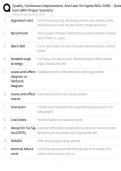
1. Appraisal costs Costs of measuring, testing, and analyzing materials, parts, products, and the
productive process to make sure they conform to design specifications.
2. Benchmark A level of quality achievement established by one company that other companies
seek to achieve (i.e., a goal).
3. Black Belt In a Six Sigma program, the leader of a quality improvement project; a full-time
position.
4. breakthrough In Six Sigma, a five-step process for improvement projects: define, measure,
strategy analyze, improve, and control.
5. cause-and-effect A graphical description of the elements of a specific quality problem.
diagram or
fishbone
diagram
6. cause-and-effect A grid used to prioritize causes of quality problems.
matrix
7. champion A member of top management who is responsible for project success in a Six
Sigma program.
8. Cost Index The ratio of quality cost to manufacturing cost.
9. design for Six Sig- A systematic methodology to design products and processes that meet customer
ma (DFSS) expectations and can be produced at Six Sigma quality levels.
10. DMADV Define, measure, analyze, design, and verify.
11. external failure Costs of poor quality incurred after the product gets to the customer; that is,
costs customer service, lost sales, and so on.
, Quality, Continuous Improvement, And Lean Six Sigma WGU D469 – Ques
tions With Proper Solutions
Study online at https://quizlet.com/_ifdl70
12. fitness for use A measure of how well a product or service does what the consumer thinks it is
supposed to do and wants it to do.
13. Green Belt In a Six Sigma program, a project team member, a part-time position.
14. index numbers Ratios that measure quality costs relative to some base accounting values such as
sales or product units.
15. internal failure Costs of poor-quality products discovered during the production process—that
costs is, scrap, rework, and the like.
16. Kaizen Involving everyone in the workplace in a process of gradual, organized, and
continuous improvement.
17. labor index The ratio of quality cost to direct labor hours.
18. Lean Six Sigma Integrating Six Sigma and lean systems.
19. Master Black Belt In a Six Sigma program, a teacher and mentor for Black Belts; a full-time position.
20. Pareto analysis A method for identifying the causes of poor quality, which usually shows that most
quality problems result from only a few causes.
21. participative Involving employees directly in the quality-management process to identify and
problem solving solve problems.
22. Partnering A relationship between a company and its supplier based on mutual quality
standards.
23. prevention costs Costs incurred during product design and manufacturing that prevent noncon-
formance to specifications.
24. process flow- A diagram of the steps in a job, operation, or process.
chart
tions With Proper Solutions
Study online at https://quizlet.com/_ifdl70
1. Appraisal costs Costs of measuring, testing, and analyzing materials, parts, products, and the
productive process to make sure they conform to design specifications.
2. Benchmark A level of quality achievement established by one company that other companies
seek to achieve (i.e., a goal).
3. Black Belt In a Six Sigma program, the leader of a quality improvement project; a full-time
position.
4. breakthrough In Six Sigma, a five-step process for improvement projects: define, measure,
strategy analyze, improve, and control.
5. cause-and-effect A graphical description of the elements of a specific quality problem.
diagram or
fishbone
diagram
6. cause-and-effect A grid used to prioritize causes of quality problems.
matrix
7. champion A member of top management who is responsible for project success in a Six
Sigma program.
8. Cost Index The ratio of quality cost to manufacturing cost.
9. design for Six Sig- A systematic methodology to design products and processes that meet customer
ma (DFSS) expectations and can be produced at Six Sigma quality levels.
10. DMADV Define, measure, analyze, design, and verify.
11. external failure Costs of poor quality incurred after the product gets to the customer; that is,
costs customer service, lost sales, and so on.
, Quality, Continuous Improvement, And Lean Six Sigma WGU D469 – Ques
tions With Proper Solutions
Study online at https://quizlet.com/_ifdl70
12. fitness for use A measure of how well a product or service does what the consumer thinks it is
supposed to do and wants it to do.
13. Green Belt In a Six Sigma program, a project team member, a part-time position.
14. index numbers Ratios that measure quality costs relative to some base accounting values such as
sales or product units.
15. internal failure Costs of poor-quality products discovered during the production process—that
costs is, scrap, rework, and the like.
16. Kaizen Involving everyone in the workplace in a process of gradual, organized, and
continuous improvement.
17. labor index The ratio of quality cost to direct labor hours.
18. Lean Six Sigma Integrating Six Sigma and lean systems.
19. Master Black Belt In a Six Sigma program, a teacher and mentor for Black Belts; a full-time position.
20. Pareto analysis A method for identifying the causes of poor quality, which usually shows that most
quality problems result from only a few causes.
21. participative Involving employees directly in the quality-management process to identify and
problem solving solve problems.
22. Partnering A relationship between a company and its supplier based on mutual quality
standards.
23. prevention costs Costs incurred during product design and manufacturing that prevent noncon-
formance to specifications.
24. process flow- A diagram of the steps in a job, operation, or process.
chart


