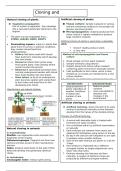
Cloning and
biotechnology
Natural cloning of plants Artificial cloning of plants
Vegetative propagation Tissue culture: Sample is placed on various
Part of a plant is separated , then develops nutrient-containing mediums to encourage cell
into a new plant genetically identical to the division and shoot growth.
original. Micropropagation: material produced from
tissue culture is rapidly multiplied to produce
The plant can be propagated from…. large numbers of plants.
STEMS, LEAVES, BUDS, ROOTS
Artificial cloning of plants is used when a desirable
Perennating organs= organs in plants that plant:
allow them to survive in adverse conditions,
Doesn’t readily produce seeds
they contain stored food from
Is very rare
photosynthesis.
Doesn’t respond well to natural cloning
Bulbs leaf bases swell with stored Method of micropropagation and tissue
food, buds form internally which develop culture
into new shoots.
1. Small sample cut from plant (explant)
Runners lateral stem grows away
2. Sample sterilised using ethanol
from parent plant; roots develop where
3. Explant placed into sterile culture medium
runner touches the ground
containing plant hormones to stimulate mitosis
Rhizomes specialised horizontal stem
4. Cells proliferate to form callus, which is then
running underground swollen with stored
divided up, so clumps are transferred to a new
food, buds develop into new shoots
culture medium
Stem tubers tip of an underground
5. Plantlets are potted into compost to grow into
stem becomes swollen with stored food
to form tuber and buds form on this
ADVANTAGES DISADVANTAGES
developing into shoots.
- Large production of - Reduces genetic
How farmers use natural cloning: plants regardless of variation
weather conditions - more susceptible to
- Splitting up bulbs - increases the diseases and
- Removing young plants from runners number of rare changes in the
- Cutting up rhizomes plants environment
- quicker process - expensive process
Artificial cloning in animals
Artificial twinning- where the split of an early
embryo is produced manually so two foetuses
develop from the halves of the divided embryo
Process of artificial twinning:
1. A animal with desirable traits is treated with
hormones (to super ovulate).
2. Ova is fertilised either by artificial insemination
Natural cloning in animals or naturally
3. Early embryos are removes from uterus and
In invertebrates: obtained for fertilisation using semen in the lab
Starfish- can regenerate entire animals from 4. By day 6 the cells are still totipotent so are split
fragments of the original. to produce many smaller embryos
Flatworms/sponges- fragment and form new 5. Each of the split embryos are grown in a lab for
identical animals as part of their reproductive 3 days
process. 6. Each embryo is implanted into a different
Hydra- produce small buds on the side of their surrogate mother as single pregnancies carry
body that develop into genetically identical fewer risks than twins
clones. 7. Embryos develop into foetuses and born
naturally, a number of identical clones are
In vertebrates:
produced by different surrogate mothers.
monozygotic twins- embryo splits during
biotechnology
Natural cloning of plants Artificial cloning of plants
Vegetative propagation Tissue culture: Sample is placed on various
Part of a plant is separated , then develops nutrient-containing mediums to encourage cell
into a new plant genetically identical to the division and shoot growth.
original. Micropropagation: material produced from
tissue culture is rapidly multiplied to produce
The plant can be propagated from…. large numbers of plants.
STEMS, LEAVES, BUDS, ROOTS
Artificial cloning of plants is used when a desirable
Perennating organs= organs in plants that plant:
allow them to survive in adverse conditions,
Doesn’t readily produce seeds
they contain stored food from
Is very rare
photosynthesis.
Doesn’t respond well to natural cloning
Bulbs leaf bases swell with stored Method of micropropagation and tissue
food, buds form internally which develop culture
into new shoots.
1. Small sample cut from plant (explant)
Runners lateral stem grows away
2. Sample sterilised using ethanol
from parent plant; roots develop where
3. Explant placed into sterile culture medium
runner touches the ground
containing plant hormones to stimulate mitosis
Rhizomes specialised horizontal stem
4. Cells proliferate to form callus, which is then
running underground swollen with stored
divided up, so clumps are transferred to a new
food, buds develop into new shoots
culture medium
Stem tubers tip of an underground
5. Plantlets are potted into compost to grow into
stem becomes swollen with stored food
to form tuber and buds form on this
ADVANTAGES DISADVANTAGES
developing into shoots.
- Large production of - Reduces genetic
How farmers use natural cloning: plants regardless of variation
weather conditions - more susceptible to
- Splitting up bulbs - increases the diseases and
- Removing young plants from runners number of rare changes in the
- Cutting up rhizomes plants environment
- quicker process - expensive process
Artificial cloning in animals
Artificial twinning- where the split of an early
embryo is produced manually so two foetuses
develop from the halves of the divided embryo
Process of artificial twinning:
1. A animal with desirable traits is treated with
hormones (to super ovulate).
2. Ova is fertilised either by artificial insemination
Natural cloning in animals or naturally
3. Early embryos are removes from uterus and
In invertebrates: obtained for fertilisation using semen in the lab
Starfish- can regenerate entire animals from 4. By day 6 the cells are still totipotent so are split
fragments of the original. to produce many smaller embryos
Flatworms/sponges- fragment and form new 5. Each of the split embryos are grown in a lab for
identical animals as part of their reproductive 3 days
process. 6. Each embryo is implanted into a different
Hydra- produce small buds on the side of their surrogate mother as single pregnancies carry
body that develop into genetically identical fewer risks than twins
clones. 7. Embryos develop into foetuses and born
naturally, a number of identical clones are
In vertebrates:
produced by different surrogate mothers.
monozygotic twins- embryo splits during