Respiratio
n
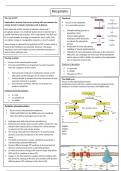
The role of ATP Glycolysis
Respiration= process that occurs in living cells and releases the Occurs in the cytoplasm.
energy stored in organic molecules such as glucose. Is an anaerobic process.
Each molecule of ATP consists of adenine, ribose and 3
1. Phosphorylating glucose to glucose
phosphate groups. It is relatively stable when in solution but is
phosphate, then phosphorylating to
readily hydrolysed by enzymes. ATP is hydrolysed into ADP and
hexose bisphosphate,
Pi, a small quantity of energy is released for use in cells. Cells
hydrolyses 2ATP molecules
can obtain energy in manageable amounts, so it isn’t wasted.
to release the phosphate
Some energy is released from hydrolysis of ATP as heat which is groups.
found to be inefficient and wasteful. However, this keeps 2. Production of triose phosphate,
organisms warm and enables enzyme-controlled reactions to (splitting of hexose bisphosphate).
work at their optimum rate. 3. Oxidation of triose phosphate molecules as the coenzyme
NAD picks up a hydrogen ion from each triose phosphate
The link reaction which reduces NAD to NADH, this oxidises triosephosphate
into 2 molecules of pyruvate.
Occurs in the mitochondrial matrix.
Pyruvate and NADH are transported via active transport Products of glycolysis:
from the cytoplasm to the matrix. 2 x pyruvate
2 x NADH
1. Each pyruvate molecule is oxidised to acetate as the Net gain of ATP= 2
NAD picks up the hydrogen ion to reduce to NADH.
2. Carbon dioxide is released from the conversion of each The KREB cycle
pyruvate molecule to acetate. Occurs in the mitochondrial matrix.
3. Each Acetate combines with the Co-enzyme A to acetyleCoA reacts with the 4-carbon molecule releasing CoA to
produce acetylCoA. produce a 6-carbon molecule that enters the KREBS cycle.
Products of the link reaction:
2 x CO2
2 x acetyleCoA
2 x NADH
Oxidative phosphorylation
Occurs at the mitochondrial membrane.
NADH and FADH from the KREB cycle are reoxidised
when they deliver hydrogen ions to the ETC. In a series of redox reactions, the KREB cycle generates reduced
coenzymes and ATP by substrate level phosphorylation CO2 is lost.
1. Hydrogen ions split into protons and electrons. Products per cycle:
2. Electrons pass along carrier proteins which contain Fe+, the
electron then reduces this to reduced Fe+ which donates 6NADH
an electron to the next carrier protein. 2FADH
3. The energy released from reducing Fe+ is used to pump 2ATP
protons across the membrane to the inner membrane 4CO2
space.
4. The build up of protons creates a gradient to generate a
chemiosmotic potential difference.
5. Protons diffuse through ATP synthase (a channel proton)
down by chemiosmosis down a potential gradient.
6. An influx of protons changes the enzyme shape that allows
ADP and Pi to combine to form ATP.
7. Oxygen is the final electron acceptor which combines with
the electrons coming off the ETC and combine with protons
diffusing down ATP synthase to then form H2O.
n
The role of ATP Glycolysis
Respiration= process that occurs in living cells and releases the Occurs in the cytoplasm.
energy stored in organic molecules such as glucose. Is an anaerobic process.
Each molecule of ATP consists of adenine, ribose and 3
1. Phosphorylating glucose to glucose
phosphate groups. It is relatively stable when in solution but is
phosphate, then phosphorylating to
readily hydrolysed by enzymes. ATP is hydrolysed into ADP and
hexose bisphosphate,
Pi, a small quantity of energy is released for use in cells. Cells
hydrolyses 2ATP molecules
can obtain energy in manageable amounts, so it isn’t wasted.
to release the phosphate
Some energy is released from hydrolysis of ATP as heat which is groups.
found to be inefficient and wasteful. However, this keeps 2. Production of triose phosphate,
organisms warm and enables enzyme-controlled reactions to (splitting of hexose bisphosphate).
work at their optimum rate. 3. Oxidation of triose phosphate molecules as the coenzyme
NAD picks up a hydrogen ion from each triose phosphate
The link reaction which reduces NAD to NADH, this oxidises triosephosphate
into 2 molecules of pyruvate.
Occurs in the mitochondrial matrix.
Pyruvate and NADH are transported via active transport Products of glycolysis:
from the cytoplasm to the matrix. 2 x pyruvate
2 x NADH
1. Each pyruvate molecule is oxidised to acetate as the Net gain of ATP= 2
NAD picks up the hydrogen ion to reduce to NADH.
2. Carbon dioxide is released from the conversion of each The KREB cycle
pyruvate molecule to acetate. Occurs in the mitochondrial matrix.
3. Each Acetate combines with the Co-enzyme A to acetyleCoA reacts with the 4-carbon molecule releasing CoA to
produce acetylCoA. produce a 6-carbon molecule that enters the KREBS cycle.
Products of the link reaction:
2 x CO2
2 x acetyleCoA
2 x NADH
Oxidative phosphorylation
Occurs at the mitochondrial membrane.
NADH and FADH from the KREB cycle are reoxidised
when they deliver hydrogen ions to the ETC. In a series of redox reactions, the KREB cycle generates reduced
coenzymes and ATP by substrate level phosphorylation CO2 is lost.
1. Hydrogen ions split into protons and electrons. Products per cycle:
2. Electrons pass along carrier proteins which contain Fe+, the
electron then reduces this to reduced Fe+ which donates 6NADH
an electron to the next carrier protein. 2FADH
3. The energy released from reducing Fe+ is used to pump 2ATP
protons across the membrane to the inner membrane 4CO2
space.
4. The build up of protons creates a gradient to generate a
chemiosmotic potential difference.
5. Protons diffuse through ATP synthase (a channel proton)
down by chemiosmosis down a potential gradient.
6. An influx of protons changes the enzyme shape that allows
ADP and Pi to combine to form ATP.
7. Oxygen is the final electron acceptor which combines with
the electrons coming off the ETC and combine with protons
diffusing down ATP synthase to then form H2O.