Cell division, diversity,
and organisation
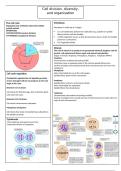
The cell cycle Interphase
Regulated cycle of division with intermediate
growth periods Interphase is made up of 3 stages:
INTERPHASE G1: cell synthesises proteins for replication (e.g. tubulin for spindle
MITOSIS/MEOSIS (nuclear division)
fibres) and the cell size doubles.
CYTOKINESIS (cytoplasmic division)
S: DNA replication occurs so that chromosomes have 2 sister chromatids
joined at a centromere.
G2: Organelles divide.
Mitosis
The role of mitosis is to produce two genetically identical daughter cells for
growth, cell replacement/tissue repair and asexual reproduction.
Stages of mitosis: Prophase, Metaphase, Anaphase, Telophase (PMAT)
Prophase
Chromosomes condense becoming visible.
Centrioles move to opposite poles of the cell and spindle fibres form.
nuclear envelope and nucleolus break down (chromosomes are free in the
cytoplasm)
Metaphase
Cell cycle regulation Sister chromatids line up at the cell equator.
Spindle fibres attach to the centromere.
Checkpoints regulated by cell signalling proteins
ensure damaged cells do not progress to the next Anaphase
stage of the cycle. Spindle fibres contract, centromeres divide.
Sister chromatids are separated.
Between G1 & S phase: Spindle fibres then break down.
Cell checks for DNA damage, after restriction point Telophase
cells enter the cycle. Chromosomes decondense becoming invisible.
Nuclear envelopes form around each set of chromosomes (2 nuclei with one
Between G2 & M phase:
copy of each chromosome)
Cell checks chromosome replication.
Metaphase checkpoint:
Cell checks that sister chromatids have attached to
the spindle correctly.
Cytokinesis
Cell membrane cleavage furrow forms
Contractile division of cytoplasm
and organisation
The cell cycle Interphase
Regulated cycle of division with intermediate
growth periods Interphase is made up of 3 stages:
INTERPHASE G1: cell synthesises proteins for replication (e.g. tubulin for spindle
MITOSIS/MEOSIS (nuclear division)
fibres) and the cell size doubles.
CYTOKINESIS (cytoplasmic division)
S: DNA replication occurs so that chromosomes have 2 sister chromatids
joined at a centromere.
G2: Organelles divide.
Mitosis
The role of mitosis is to produce two genetically identical daughter cells for
growth, cell replacement/tissue repair and asexual reproduction.
Stages of mitosis: Prophase, Metaphase, Anaphase, Telophase (PMAT)
Prophase
Chromosomes condense becoming visible.
Centrioles move to opposite poles of the cell and spindle fibres form.
nuclear envelope and nucleolus break down (chromosomes are free in the
cytoplasm)
Metaphase
Cell cycle regulation Sister chromatids line up at the cell equator.
Spindle fibres attach to the centromere.
Checkpoints regulated by cell signalling proteins
ensure damaged cells do not progress to the next Anaphase
stage of the cycle. Spindle fibres contract, centromeres divide.
Sister chromatids are separated.
Between G1 & S phase: Spindle fibres then break down.
Cell checks for DNA damage, after restriction point Telophase
cells enter the cycle. Chromosomes decondense becoming invisible.
Nuclear envelopes form around each set of chromosomes (2 nuclei with one
Between G2 & M phase:
copy of each chromosome)
Cell checks chromosome replication.
Metaphase checkpoint:
Cell checks that sister chromatids have attached to
the spindle correctly.
Cytokinesis
Cell membrane cleavage furrow forms
Contractile division of cytoplasm