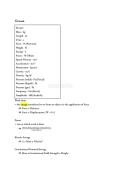
Formula
SI unit:
Mass - kg
Length - m
Time - s
Force - N (Newton)
Weight - N
Energy - J
Power - W (Watt)
Speed/Velocity - m/s
Acceleration - m/s2
Momentum - kg m/s
Gravity - m/s2
Density - kg/m3
Pressure (solid) - Pa (Pascal)
isabelle
Pressure (liquid) - Pa
Pressure (gas) - Pa
Frequency - Hz (Hertz)
Amplitude - dB (decibels)
Work done
= the energy transferred to or from an object via the application of force
➔ Force x Distance
➔ Force x Displacement ( W = Fs )
Power
= rate at which work is done
𝑊𝑜𝑟𝑘 𝑑𝑜𝑛𝑒/ 𝐸𝑛𝑒𝑟𝑔𝑦 𝑇𝑟𝑎𝑛𝑠𝑓𝑒𝑟𝑟𝑒𝑑
➔ 𝑇𝑖𝑚𝑒 𝑇𝑎𝑘𝑒𝑛
Kinetic Energy
➔ ½ x Mass x Velocity2
Gravitational Potential Energy
➔ Mass x Gravitational Field Strength x Height
,Electrical Energy
➔ Power x Time
Speed
𝐷𝑖𝑠𝑡𝑎𝑛𝑐𝑒
➔ 𝑇𝑖𝑚𝑒
𝑠
➔ V= 𝑡
5
➔ Conversion: km/h → m/s: × 18
Velocity
= similar to speed but is affected by direction
𝐷𝑖𝑠𝑡𝑎𝑛𝑐𝑒
➔ 𝑇𝑖𝑚𝑒
Acceleration
𝐶ℎ𝑎𝑛𝑔𝑒 𝑖𝑛 𝑆𝑝𝑒𝑒𝑑
➔ 𝑇𝑖𝑚𝑒
𝑉−𝑢
➔ a= 𝑡
➔ V: final speed
➔ u: initial speed isabelle
➔ t: time taken
Deceleration
➔ Negative acceleration
➔ -a
➔ Final answer for deceleration has no negative
Density
𝑀𝑎𝑠𝑠
➔ 𝑉𝑜𝑙𝑢𝑚𝑒
➔ Density is directly proportional to Mass
➔ Density is inversely proportional to Volume
➔ If two materials are made from the same material, their density is the same.
Momentum
➔ P = mv
➔ Mass × Velocity
, Force
➔ Mass × Acceleration
➔ Balanced Force:
Net force = resultant force
= 0 {a stationary object in rest/ a moving object will continue to move
at a constant speed}
- the centre = G {centre of gravity}
- When aircraft is moving in balanced condition {constant speed}
i) lift = weight
ii) thrust = drag {air resistance}{friction}
➔ Unbalanced Force:
Net force ≠ 0
{moving object experiences an acceleration}
➢ Cannot change the mass of an object
➢
isabelle
➢
Mass
= amount of matter in a substance
➔ Is constant, regardless of place
➔ Not affected by gravity
SI unit:
Mass - kg
Length - m
Time - s
Force - N (Newton)
Weight - N
Energy - J
Power - W (Watt)
Speed/Velocity - m/s
Acceleration - m/s2
Momentum - kg m/s
Gravity - m/s2
Density - kg/m3
Pressure (solid) - Pa (Pascal)
isabelle
Pressure (liquid) - Pa
Pressure (gas) - Pa
Frequency - Hz (Hertz)
Amplitude - dB (decibels)
Work done
= the energy transferred to or from an object via the application of force
➔ Force x Distance
➔ Force x Displacement ( W = Fs )
Power
= rate at which work is done
𝑊𝑜𝑟𝑘 𝑑𝑜𝑛𝑒/ 𝐸𝑛𝑒𝑟𝑔𝑦 𝑇𝑟𝑎𝑛𝑠𝑓𝑒𝑟𝑟𝑒𝑑
➔ 𝑇𝑖𝑚𝑒 𝑇𝑎𝑘𝑒𝑛
Kinetic Energy
➔ ½ x Mass x Velocity2
Gravitational Potential Energy
➔ Mass x Gravitational Field Strength x Height
,Electrical Energy
➔ Power x Time
Speed
𝐷𝑖𝑠𝑡𝑎𝑛𝑐𝑒
➔ 𝑇𝑖𝑚𝑒
𝑠
➔ V= 𝑡
5
➔ Conversion: km/h → m/s: × 18
Velocity
= similar to speed but is affected by direction
𝐷𝑖𝑠𝑡𝑎𝑛𝑐𝑒
➔ 𝑇𝑖𝑚𝑒
Acceleration
𝐶ℎ𝑎𝑛𝑔𝑒 𝑖𝑛 𝑆𝑝𝑒𝑒𝑑
➔ 𝑇𝑖𝑚𝑒
𝑉−𝑢
➔ a= 𝑡
➔ V: final speed
➔ u: initial speed isabelle
➔ t: time taken
Deceleration
➔ Negative acceleration
➔ -a
➔ Final answer for deceleration has no negative
Density
𝑀𝑎𝑠𝑠
➔ 𝑉𝑜𝑙𝑢𝑚𝑒
➔ Density is directly proportional to Mass
➔ Density is inversely proportional to Volume
➔ If two materials are made from the same material, their density is the same.
Momentum
➔ P = mv
➔ Mass × Velocity
, Force
➔ Mass × Acceleration
➔ Balanced Force:
Net force = resultant force
= 0 {a stationary object in rest/ a moving object will continue to move
at a constant speed}
- the centre = G {centre of gravity}
- When aircraft is moving in balanced condition {constant speed}
i) lift = weight
ii) thrust = drag {air resistance}{friction}
➔ Unbalanced Force:
Net force ≠ 0
{moving object experiences an acceleration}
➢ Cannot change the mass of an object
➢
isabelle
➢
Mass
= amount of matter in a substance
➔ Is constant, regardless of place
➔ Not affected by gravity