C1
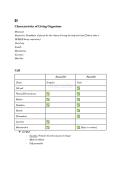
Characteristics of Living Organisms
Movement
Respiration (breakdown of glucose for the release of energy for body activities)(*plants take in
OXYGEN during respiration)
Sensitivity
Growth
Reproduction
Excretion
Nutrition
Cell
Animal Cell Plant Cell
Shape Irregular Fixed
Cell wall isabelle ✅
Plasma/Cell membrane ✅ ✅
Nucleus ✅ ✅
Cytoplasm ✅ ✅
Vacuole ✅
Chloroplasts ✅
Lysosome ✅
Mitochondria ✅ ✅ (fewer in number)
❖ Cell Wall
- Function: Protects the cell and gives its shape
- Made of cellulose
- Fully permeable
, ❖ Cell membrane (plasma)
- Function: Control in and out of substances of a cell
- Semi-permeable - small molecule (glucose) can go through; big molecule (sucrose)
cannot go through
❖ Nucleus
- Function: Controls all life activities in a cell
- Carry genetic information
❖ Cytoplasm
- Function: The site where chemical reactions of a cell occur
❖ Vacuole
- Function: Storage of minerals
❖ Chloroplast
- Function: Stores chlorophyll which is a green pigment that absorbs light from the sun
for photosynthesis
- Site for photosynthesis to occur
❖ Lysosome
- Function: To digest food or dead tissues
❖ Mitochondria
isabelle
- Function: Powerhouse of a cell - generate energy for the cell to use
- Sausage-like
Plant
❖ Root hair cell
- Large surface area - water can be obtained deeper in soil - absorb water efficiently
via osmosis
- Vacuole contains minerals & water (concentrated)
- Absorbs:
Water through osmosis - bcuz soil has higher water potential than the cytoplasm of
the root hair cell
Minerals through active transport
Water & Minerals through diffusion
- Supplied with glucose: from leaves, then transport through the phloem
❖ Xylem
- Vascular bundle
- Transports water & minerals from the roots to the stem and the leaves
- Structural support
- (on the top; inner circle)
, ❖ Phloem
- Vascular bundle
- Transports nutrients (sucrose & amino acids) made by the plant from
photosynthesising leaves to roots and stem
- (on the bottom; outer circle)
❖ Wax cuticle
- Waterproof - to avoid water loss via transpiration
- Transparent - light can go through
❖ Epidermal cell
- To protect the leaf
- No chloroplast
❖ Palisade mesophyll cell
- Contains the most abundant of chloroplast
- Photosynthesize the fastest
- Produce most simple sugar (glucose)
- In distilled water: swell
In salty water: shrink {water potential in the cell is more than the salty water}
❖ Spongy mesophyll cell
- Contains chloroplast
- Can photosynthesize
isabelle
- Main function: allow gaseous exchange
- Where evaporation of water occurs
❖ Guard cell
- Main function: control the opening and closing of stomata
- Contains a few chloroplasts
- Can photosynthesize
❖ Stomata
- Main function: gaseous exchange
- Water vapour diffuses out of stomata after evaporation
Characteristics of Living Organisms
Movement
Respiration (breakdown of glucose for the release of energy for body activities)(*plants take in
OXYGEN during respiration)
Sensitivity
Growth
Reproduction
Excretion
Nutrition
Cell
Animal Cell Plant Cell
Shape Irregular Fixed
Cell wall isabelle ✅
Plasma/Cell membrane ✅ ✅
Nucleus ✅ ✅
Cytoplasm ✅ ✅
Vacuole ✅
Chloroplasts ✅
Lysosome ✅
Mitochondria ✅ ✅ (fewer in number)
❖ Cell Wall
- Function: Protects the cell and gives its shape
- Made of cellulose
- Fully permeable
, ❖ Cell membrane (plasma)
- Function: Control in and out of substances of a cell
- Semi-permeable - small molecule (glucose) can go through; big molecule (sucrose)
cannot go through
❖ Nucleus
- Function: Controls all life activities in a cell
- Carry genetic information
❖ Cytoplasm
- Function: The site where chemical reactions of a cell occur
❖ Vacuole
- Function: Storage of minerals
❖ Chloroplast
- Function: Stores chlorophyll which is a green pigment that absorbs light from the sun
for photosynthesis
- Site for photosynthesis to occur
❖ Lysosome
- Function: To digest food or dead tissues
❖ Mitochondria
isabelle
- Function: Powerhouse of a cell - generate energy for the cell to use
- Sausage-like
Plant
❖ Root hair cell
- Large surface area - water can be obtained deeper in soil - absorb water efficiently
via osmosis
- Vacuole contains minerals & water (concentrated)
- Absorbs:
Water through osmosis - bcuz soil has higher water potential than the cytoplasm of
the root hair cell
Minerals through active transport
Water & Minerals through diffusion
- Supplied with glucose: from leaves, then transport through the phloem
❖ Xylem
- Vascular bundle
- Transports water & minerals from the roots to the stem and the leaves
- Structural support
- (on the top; inner circle)
, ❖ Phloem
- Vascular bundle
- Transports nutrients (sucrose & amino acids) made by the plant from
photosynthesising leaves to roots and stem
- (on the bottom; outer circle)
❖ Wax cuticle
- Waterproof - to avoid water loss via transpiration
- Transparent - light can go through
❖ Epidermal cell
- To protect the leaf
- No chloroplast
❖ Palisade mesophyll cell
- Contains the most abundant of chloroplast
- Photosynthesize the fastest
- Produce most simple sugar (glucose)
- In distilled water: swell
In salty water: shrink {water potential in the cell is more than the salty water}
❖ Spongy mesophyll cell
- Contains chloroplast
- Can photosynthesize
isabelle
- Main function: allow gaseous exchange
- Where evaporation of water occurs
❖ Guard cell
- Main function: control the opening and closing of stomata
- Contains a few chloroplasts
- Can photosynthesize
❖ Stomata
- Main function: gaseous exchange
- Water vapour diffuses out of stomata after evaporation