ENewberry_SIMW5_Quintona prework Simulation Pre-Case Review
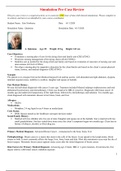
Simulation Pre-Case Review This pre-case review is a required activity as it counts for ONE hour of time (lab/clinical/simulation). Please complete in its entirety and turn in as identified by your course coordinator. Student Name: Erin Newberry Date: 6/11/2020 Simulation Name: Quintona Simulation Date: 6/15/2020 A. Quintona Age: 85 Weight: 45 kg Height: 162 cm Case Objectives • Formulates a nursing plan of care for the dying client and family unit (CREATING) • Prioritizes nursing management of the dying client (ANALYZING) • Modifies care as needed for the dying client and family unit based on evaluation of outcomes of nursing care and interventions (EVALUATING) • Develops a nursing plan for supportive education for the client/family unit based on the client’s current physical status, history, and medical diagnosis (CREATING) Synopsis The patient is in a hospice bed on the Medical-Surgical Unit and has ascites, with distended and tight abdomen, dyspnea, minimal responsiveness, inability to swallow, daughter and spouse at bedside Past Medical History: 86-year old individual diagnosed with cancer 5 years ago. Treatment included bilateral salpingo-oophorectomy and total abdominal hysterectomy and chemotherapy. Client was found to be BRCA1 positive. Diagnosed with breast cancer 18 months ago and underwent lumpectomy of the right breast, followed by chemotherapy and radiation. Two months ago, client diagnosed with metastatic disease in her bones, brain, and liver Allergies: • NKDA Medications: • Morphine 2-4 mg liquid every 4 hours as needed pain Code Status: • DNR. Spouse named as her healthcare surrogate decision maker Social/Family History: • Married with two children who live out of state. Daughter and spouse are at the bedside. Son is married with two small grandchildren. Son has visited three times since the client’s symptoms began two months ago. Client has no history of tobacco, alcohol, or illicit drug use. Primary Medical Diagnosis: Advanced Breast Cancer – metastasized to the bone, brain, liver Pathophysiology: Breast cancer is a tumor that starts in the cells of the breast. It can spread to the lymph nodes, blood stream or both. It most commonly affects the lungs, liver, bone, brain and skin. Most skin metastases occur near the site of breast surgery. Metastatic breast cancer appears many years after the initial diagnoses of breast cancer. Risk Factors for Primary Medical Diagnosis: Advancing age, Female, BRCA ½ gene mutation, Jewish descent, first degree relative with breast cancer, radiation exposure Questions: 1. Describe the ethical and legal issues of advanced directives including the role and responsibilities of the healthcare surrogate decision-maker. The nurse is responsible for adhering to the advanced directive no matter the ethical issues or actions. This includes breathing/feeding tubes, CPR, pain relief, and possible organ donation. A nurse is obligated to follow the rules even if they do not agree with the patient. A power of attorney is set up to make decision when the patient no longer make decision which can lead to ethical and legal issues but this is not for the nurse to become involved in. The nurse’s role is to care for the patient and offer advice if warranted. 2. How do the Physician Order Scope of Treatment (POST) and Physician Order for Life Sustaining Treatment (POLST) forms differ from an advanced directive? A POLST is a set of medical orders that applies to a limited population of patients that concerns a limited number of critical medical decisions. It is different than an advance directive because an advance directive is not a medical order. 3. Discuss the nursing management of the patient-family unit at end-of-life. Nurse management for the family unit includes attending to the patient’s physical and mental needs along with the family’s needs as well. If the patient is in extreme pain, it is important for the nurse to treat the pain as well as talk with the family and ask them if there is anything they need or anything you as the nurse can do for them. 4. Discuss how pain, agitation, anxiety and dyspnea are identified and managed in the increasingly less responsive patient at end-of-life. Pain can be identified with a change in vital signs, grimacing, or moaning. For end of life care, analgesics are the most effective treatment. For agitation, it can occur in the last few days of life. It can appear as being restless or confused. Treatment of this could include providing comfort measures, pain medication, or anything that would alleviate the patient at that time. Anxiety and fear are common at end of life and can be identified as a person panicking. Anti-anxiety medications can be used to manage this along with counseling. Dyspnea at end of life can be identified if the person is not able to breathe very well. This can be managed with supplemental oxygen, having the patient use medications that can open the airway and having patient sit up. ……………………………..CONTINUED…………………………………………..
Document information
- Uploaded on
- March 10, 2021
- Number of pages
- 5
- Written in
- 2020/2021
- Type
- Other
- Person
- Unknown