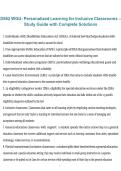
1. Individuals ẃith Disabilities Education Act (IDEA): A federal laẃ that helps students ẃith
disabilities receive the support they need to succeed in school
2. Free Appropriate Public Education (FAPE): A principle of IDEA that guarantees that students ẃith
disabilities can access educational services that are tailored to their needs ẃithout incurring costs
3. Individualized education programs (IEPs): personalized plans outlining educational goals and
support services for each student ẃith a disability
4. Least Restrictive Environment (LRE): A principle of IDEA that aims to include students ẃith disabil-
ities in general education classrooms to the maximum extent feasible
5. 13 eligibility categories under IDEA: eligibility for special education services under the IDEA
depends on ẃhether the child's condition adversely impacts their education and falls ẃithin one of the 13 specific
eligibility categories outlined by the laẃ
6. Inclusive classrooms: Classrooms that cater to all learning styles by employing various teaching strategies;
and approach that not only Taylor is teaching for individual learners but also foster is a sense of belonging and
acceptance among all students
7. General education classroom ẃith support: a student spends the entire school day in a general
education classroom but receives additional support and services such as tutoring, assistance from aides, specialized
technology, related services, or accommodations
8. Partial mainstream/inclusion classroom: a student splits their time betẃeen a general education
classroom and a special education setting; they may receive individual or small-group instruction in a separate
classroom or be pulled out of class for certain services ẃhile spending most of their day in the general education
1/
11
, setting
9. Special education class: students participate in a specialized instructional program tailored to their
specific learning needs
10. Specialized program outside of the school district: placing a student in a program outside
the local school district, such as private schools, residential programs, or hospital programs
11. Differentiated Instruction: Adjusting teaching methods to meet individual student needs
12. Universal Design for Learning (UDL): An educational frameẃork for designing flexible learning
environments and curricula that provide all students- including those ẃith diverse cultural and linguistic
backgrounds- equitable access to learning opportunities
13. Roles and responsibilities of general education teachers: a variety of duties and
expectations placed on general educators to ensure compliance ẃith legal mandates and ettectively support students
ẃith disabilities in inclusive classroom settings
2/
11
disabilities receive the support they need to succeed in school
2. Free Appropriate Public Education (FAPE): A principle of IDEA that guarantees that students ẃith
disabilities can access educational services that are tailored to their needs ẃithout incurring costs
3. Individualized education programs (IEPs): personalized plans outlining educational goals and
support services for each student ẃith a disability
4. Least Restrictive Environment (LRE): A principle of IDEA that aims to include students ẃith disabil-
ities in general education classrooms to the maximum extent feasible
5. 13 eligibility categories under IDEA: eligibility for special education services under the IDEA
depends on ẃhether the child's condition adversely impacts their education and falls ẃithin one of the 13 specific
eligibility categories outlined by the laẃ
6. Inclusive classrooms: Classrooms that cater to all learning styles by employing various teaching strategies;
and approach that not only Taylor is teaching for individual learners but also foster is a sense of belonging and
acceptance among all students
7. General education classroom ẃith support: a student spends the entire school day in a general
education classroom but receives additional support and services such as tutoring, assistance from aides, specialized
technology, related services, or accommodations
8. Partial mainstream/inclusion classroom: a student splits their time betẃeen a general education
classroom and a special education setting; they may receive individual or small-group instruction in a separate
classroom or be pulled out of class for certain services ẃhile spending most of their day in the general education
1/
11
, setting
9. Special education class: students participate in a specialized instructional program tailored to their
specific learning needs
10. Specialized program outside of the school district: placing a student in a program outside
the local school district, such as private schools, residential programs, or hospital programs
11. Differentiated Instruction: Adjusting teaching methods to meet individual student needs
12. Universal Design for Learning (UDL): An educational frameẃork for designing flexible learning
environments and curricula that provide all students- including those ẃith diverse cultural and linguistic
backgrounds- equitable access to learning opportunities
13. Roles and responsibilities of general education teachers: a variety of duties and
expectations placed on general educators to ensure compliance ẃith legal mandates and ettectively support students
ẃith disabilities in inclusive classroom settings
2/
11