Alevel Chemistry Revision PC 04
Revision Material
Duration: 2nd – 8th March
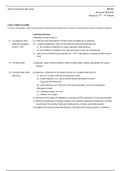
Topic 4 State of matter
The study of the particles in solids, liquids and gases and the interactions between them is important in understanding the physical properties of substances.
Learning outcomes
Candidates should be able to:
4.1 The gaseous state: (a) State the basic assumptions of kinetic theory as applied to an ideal gas
ideal and real gases (b) explain qualitatively in terms of intermolecular forces and molecular size:
and pV = nRT (i) the conditions necessary for a gas to approach ideal behaviour
(ii) the limitations of ideality at very high pressures and very low temperatures
(c) state and use the general gas equation pV = nRT in calculations, including the determination
of Mr
4.2 The liquid state (a) describe, using a kinetic-molecular model, the liquid state, melting, vaporisation and vapour
pressure
4.3 The solid state: lattice (a) describe, in simple terms, the lattice structure of a crystalline solid which is:
structures (i) ionic, as in sodium chloride and magnesium oxide
(ii) simple molecular, as in iodine and the fullerene allotropes of carbon
(C60 and nanotubes only)
(iii) giant molecular, as in silicon(IV) oxide and the graphite, diamond and graphene
allotropes of carbon
(iv) hydrogen-bonded, as in ice
(v) metallic, as in copper
(b) discuss the finite nature of materials as a resource and the importance of recycling processes
(c) outline the importance of hydrogen bonding to the physical properties of substances, including
ice and water (for example, boiling and melting points, viscosity and surface tension)
(d) suggest from quoted physical data the type of structure and bonding present in a substance
Revision Material
Duration: 2nd – 8th March
Topic 4 State of matter
The study of the particles in solids, liquids and gases and the interactions between them is important in understanding the physical properties of substances.
Learning outcomes
Candidates should be able to:
4.1 The gaseous state: (a) State the basic assumptions of kinetic theory as applied to an ideal gas
ideal and real gases (b) explain qualitatively in terms of intermolecular forces and molecular size:
and pV = nRT (i) the conditions necessary for a gas to approach ideal behaviour
(ii) the limitations of ideality at very high pressures and very low temperatures
(c) state and use the general gas equation pV = nRT in calculations, including the determination
of Mr
4.2 The liquid state (a) describe, using a kinetic-molecular model, the liquid state, melting, vaporisation and vapour
pressure
4.3 The solid state: lattice (a) describe, in simple terms, the lattice structure of a crystalline solid which is:
structures (i) ionic, as in sodium chloride and magnesium oxide
(ii) simple molecular, as in iodine and the fullerene allotropes of carbon
(C60 and nanotubes only)
(iii) giant molecular, as in silicon(IV) oxide and the graphite, diamond and graphene
allotropes of carbon
(iv) hydrogen-bonded, as in ice
(v) metallic, as in copper
(b) discuss the finite nature of materials as a resource and the importance of recycling processes
(c) outline the importance of hydrogen bonding to the physical properties of substances, including
ice and water (for example, boiling and melting points, viscosity and surface tension)
(d) suggest from quoted physical data the type of structure and bonding present in a substance