

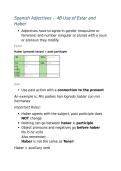
Spanish Adjectives - 4B Use of Estar and
Haber
Adjectives have to agree in gender (masculine or
feminine) and number (singular or plural) with a noun
or pronoun they modify.
Form
Haber (present tense) + past participle
Yo he Vos habéis
.
tú has Ud. han
el, ha
ella,
usd.
nos. hemos
Use
Use past action with a connection to the present
An example is, Mis padres han logrado hablar con mis
hermanas.
Important Rules:
Haber agrees with the subject, past participle does
NOT change
Nothing can go between haber + participle
Object pronouns and negatives go before haber
No lo he visto
Also remember…
Haber is not the same as Tener!
Haber = auxiliary verb
, Tener = possesion
Present Perfect Subjunctive – A form made after the
expressions of doubt, hope or emotion.
P.P is a compound tense that requires 2 verbs. In
English, the present perfect is formed with an
auxiliary verb. In spanish, the present perfect is
formed with the present tense of haber + past
participle.
Conjugations Table
Haber
yo haya
tú hayas
el, ella, usted hayamos
nos. hayan
Vos. hayáis
Uds., ellos, ellas han
Past Participle Useage
The auxiliary verb haber and past participle can NOT be
separated by another Word. All O.P’s (Object Pronouns)
and negative words are placed before haber.
Regular
-ar -ado (jugar jugado)
-er/ir -ido (conocer conocido) or
(cumplir cumplido)
Haber
Adjectives have to agree in gender (masculine or
feminine) and number (singular or plural) with a noun
or pronoun they modify.
Form
Haber (present tense) + past participle
Yo he Vos habéis
.
tú has Ud. han
el, ha
ella,
usd.
nos. hemos
Use
Use past action with a connection to the present
An example is, Mis padres han logrado hablar con mis
hermanas.
Important Rules:
Haber agrees with the subject, past participle does
NOT change
Nothing can go between haber + participle
Object pronouns and negatives go before haber
No lo he visto
Also remember…
Haber is not the same as Tener!
Haber = auxiliary verb
, Tener = possesion
Present Perfect Subjunctive – A form made after the
expressions of doubt, hope or emotion.
P.P is a compound tense that requires 2 verbs. In
English, the present perfect is formed with an
auxiliary verb. In spanish, the present perfect is
formed with the present tense of haber + past
participle.
Conjugations Table
Haber
yo haya
tú hayas
el, ella, usted hayamos
nos. hayan
Vos. hayáis
Uds., ellos, ellas han
Past Participle Useage
The auxiliary verb haber and past participle can NOT be
separated by another Word. All O.P’s (Object Pronouns)
and negative words are placed before haber.
Regular
-ar -ado (jugar jugado)
-er/ir -ido (conocer conocido) or
(cumplir cumplido)


