Chemistry Paper 2 Topic 9 – Chemistry of the Atmosphere
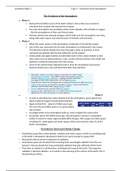
The Evolution of the Atmosphere
Phase 1:
During the first billion years of the Earth’s history, the surface was covered in
volcanoes that erupted and released lots of gases.
The early atmosphere was probably mostly carbon dioxide, with virtually no oxygen
– like the atmospheres of Mars and Venus today.
Volcanic activity also released nitrogen, which built up in the atmosphere over time,
along with water vapour and small amount of methane and ammonia.
Phase 2:
When the water vapour in the atmosphere condensed, it formed the oceans.
Lots of CO2 was removed from the early atmosphere as it dissolved in the oceans.
This dissolved carbon dioxide then went through a series of reactions to form
carbonate precipitates that formed sediments on the seabed.
Green plants and algae evolved and absorbed some of the carbon dioxide so that
they could carry out photosynthesis. Later, marine animals evolved; their shells and
skeletons contained carbonates from the oceans.
Some of the carbon these organisms took in from the atmosphere and oceans
became locked up in rocks and fossil fuels after they had died.
Phase 3:
As well as absorbing the carbon dioxide from the atmosphere, green plants and
algae produced oxygen through photosynthesis:
Algae evolved first – about 2.7 billion years ago.
The over the next billion years or so, green plants
also evolved.
As oxygen levels in the atmosphere built up, more complex life could evolve.
Eventually, about 200 million years ago, the atmosphere reached a composition
similar to what it is today: approximately 80% nitrogen, 20% oxygen and other gases
including CO2, noble gases and water vapour which each total less than 1% of the
Earth’s atmosphere.
Greenhouse Gases and Climate Change
Greenhouse gases like carbon dioxide, methane and water vapour act like an insulating layer
in the Earth’s atmosphere allowing the Earth to be warm enough to support life.
All particles absorb certain frequencies of radiation.
Greenhouse gases do not absorb the incoming short wavelength radiation from the sun –
however, they do absorb the long wavelength radiation that gets reflected off the Earth.
Then they re-radiate it in all directions, including back towards the Earth. The longwave
radiation is thermal radiation, so it results in the warming of the surface of the Earth; this is
the greenhouse effect.
The Evolution of the Atmosphere
Phase 1:
During the first billion years of the Earth’s history, the surface was covered in
volcanoes that erupted and released lots of gases.
The early atmosphere was probably mostly carbon dioxide, with virtually no oxygen
– like the atmospheres of Mars and Venus today.
Volcanic activity also released nitrogen, which built up in the atmosphere over time,
along with water vapour and small amount of methane and ammonia.
Phase 2:
When the water vapour in the atmosphere condensed, it formed the oceans.
Lots of CO2 was removed from the early atmosphere as it dissolved in the oceans.
This dissolved carbon dioxide then went through a series of reactions to form
carbonate precipitates that formed sediments on the seabed.
Green plants and algae evolved and absorbed some of the carbon dioxide so that
they could carry out photosynthesis. Later, marine animals evolved; their shells and
skeletons contained carbonates from the oceans.
Some of the carbon these organisms took in from the atmosphere and oceans
became locked up in rocks and fossil fuels after they had died.
Phase 3:
As well as absorbing the carbon dioxide from the atmosphere, green plants and
algae produced oxygen through photosynthesis:
Algae evolved first – about 2.7 billion years ago.
The over the next billion years or so, green plants
also evolved.
As oxygen levels in the atmosphere built up, more complex life could evolve.
Eventually, about 200 million years ago, the atmosphere reached a composition
similar to what it is today: approximately 80% nitrogen, 20% oxygen and other gases
including CO2, noble gases and water vapour which each total less than 1% of the
Earth’s atmosphere.
Greenhouse Gases and Climate Change
Greenhouse gases like carbon dioxide, methane and water vapour act like an insulating layer
in the Earth’s atmosphere allowing the Earth to be warm enough to support life.
All particles absorb certain frequencies of radiation.
Greenhouse gases do not absorb the incoming short wavelength radiation from the sun –
however, they do absorb the long wavelength radiation that gets reflected off the Earth.
Then they re-radiate it in all directions, including back towards the Earth. The longwave
radiation is thermal radiation, so it results in the warming of the surface of the Earth; this is
the greenhouse effect.