
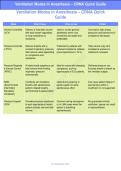
Ventilation Modes in Anesthesia – CRNA Quick Guide
Ventilation Modes in Anesthesia – CRNA Quick
Guide
Mode What It Does When to Use Pitfalls
Volume-Controlled Delivers a fixed tidal volume Used in routine general Can lead to high airway
(VCV) with each breath regardless anesthesia when lung pressures and barotrauma if
of lung compliance or mechanics are stable and compliance decreases.
resistance. predictable.
Pressure-Controlle Delivers breaths with a Preferred for patients with Tidal volume may fall if
d (PCV) constant inspiratory pressure; reduced compliance (obesity, compliance worsens or
tidal volume varies depending pneumoperitoneum, OLV). resistance increases.
on compliance and
E
resistance.
R
O
Pressure-Regulate A hybrid mode targeting a set Ideal for cases with changing Delivered pressure can
d Volume Control tidal volume while limiting compliance, such as fluctuate breath to breath as
ST
(PRVC) inspiratory pressure laparoscopic or ICU patients. the ventilator adapts.
automatically.
Y
D
SIMV Combines set mandatory Used during weaning or Can cause patient fatigue if
(Synchronized breaths with spontaneous partial support to allow spontaneous effort is
D
Intermittent patient-initiated breaths, spontaneous effort. insufficient or not supported.
U
Mandatory synchronized to patient effort.
YB
Ventilation)
D
Pressure Support Provides pressure assistance Common during emergence No guaranteed minute
(PSV) to each spontaneous breath; or in LMA cases when the ventilation; apnea can result
U
patient controls rate and tidal patient is breathing in hypoventilation.
ST
volume. spontaneously.
© StudyBuddy Store
Ventilation Modes in Anesthesia – CRNA Quick
Guide
Mode What It Does When to Use Pitfalls
Volume-Controlled Delivers a fixed tidal volume Used in routine general Can lead to high airway
(VCV) with each breath regardless anesthesia when lung pressures and barotrauma if
of lung compliance or mechanics are stable and compliance decreases.
resistance. predictable.
Pressure-Controlle Delivers breaths with a Preferred for patients with Tidal volume may fall if
d (PCV) constant inspiratory pressure; reduced compliance (obesity, compliance worsens or
tidal volume varies depending pneumoperitoneum, OLV). resistance increases.
on compliance and
E
resistance.
R
O
Pressure-Regulate A hybrid mode targeting a set Ideal for cases with changing Delivered pressure can
d Volume Control tidal volume while limiting compliance, such as fluctuate breath to breath as
ST
(PRVC) inspiratory pressure laparoscopic or ICU patients. the ventilator adapts.
automatically.
Y
D
SIMV Combines set mandatory Used during weaning or Can cause patient fatigue if
(Synchronized breaths with spontaneous partial support to allow spontaneous effort is
D
Intermittent patient-initiated breaths, spontaneous effort. insufficient or not supported.
U
Mandatory synchronized to patient effort.
YB
Ventilation)
D
Pressure Support Provides pressure assistance Common during emergence No guaranteed minute
(PSV) to each spontaneous breath; or in LMA cases when the ventilation; apnea can result
U
patient controls rate and tidal patient is breathing in hypoventilation.
ST
volume. spontaneously.
© StudyBuddy Store


