L2
Evolution and Man
Prof. Anthony Graham
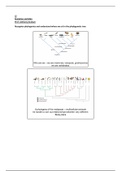
Recognise phylogenies and understand where we sit in the phylogenetic tree
,Understand how phylogenies are arrived at
• Comparisons between gene sequences from different organisms can be used to construct
phylogenies
• Related organisms will share more closely related genes
• First constructed using ribosomal RNA genes
• In the Past: isolate DNA from 2 diff organisms, sequence and look at DNA; assumption is
more closely related organisms share more genes
• Now one can use genome data
• Resolved by gene sequences; nowadays use genome
Understand the importance of fossils in evolution
• Fossil records show the changes in living things which have inhabited the planet at different
points in history
• Shows connection and different stages in development
• An example are the feathers of birds which evolved from the scales of archosaurs
• The fossil record has many examples of feathered dinosaurs; modern birds changed and
evolved from this group of dinosaurs
,Recognise how fossils can reveal the sequence of change in evolution
• Fossils can let us see the sequence of changes through evolution; able to age them and see
when the animal roamed; therefore, can organise the age of fossils relative to one another
• Whales and dolphins started on land, eventually migrated to the sea
• We see a gradual reduction in hind limbs (became less significant) and much greater mobility
in the back
• Able to determine habitat based on what else is in the fossil/rock (i.e salt levels etc.)
• More recent fossils resemble more recent form, older fossils resemble less
, Recognise the conservation of the development programme across animals
• All organisms use the same molecular codes to translate DNA base sequences into protein
amino acid sequences
• The uniformity of the genetic code provides evidence for the interrelatedness of living things
• Mutations can be beneficial, neutral, or harmful for the organism as they create variation
• Selection works on the genetic variation that is already present in any new generation, no
direction to the evolutionary process
• Changes in the genes controlling development can have major effects on the morphology of
the adult organism
• Conserving development programmes prevents harmful mutations which affect ecosystem
• Furthermore, allows for more understanding of the role of diff genes in development; for
example HOX genes
Discuss the importance of HOX genes in fly and human development
• Mutation in Ultrabithorax – a HOX gene – cause the production of an ectopic set of wings
• After mutation in just a single gene, can result in a fruit fly which looks like this
• HOX genes – genes which are transcription factors – transcription factors are proteins which
modulate transcription; important as they can control the expression of hundreds of other
genes
• Ultrabithorax would be purple gene in diagram – genes next to it are also HOX genes; sit
clustered in genome, order of action determined by order of sequence in genome; 1 for
anterior, 4 for middle region etc.
• Important as we also possess HOX genes
Evolution and Man
Prof. Anthony Graham
Recognise phylogenies and understand where we sit in the phylogenetic tree
,Understand how phylogenies are arrived at
• Comparisons between gene sequences from different organisms can be used to construct
phylogenies
• Related organisms will share more closely related genes
• First constructed using ribosomal RNA genes
• In the Past: isolate DNA from 2 diff organisms, sequence and look at DNA; assumption is
more closely related organisms share more genes
• Now one can use genome data
• Resolved by gene sequences; nowadays use genome
Understand the importance of fossils in evolution
• Fossil records show the changes in living things which have inhabited the planet at different
points in history
• Shows connection and different stages in development
• An example are the feathers of birds which evolved from the scales of archosaurs
• The fossil record has many examples of feathered dinosaurs; modern birds changed and
evolved from this group of dinosaurs
,Recognise how fossils can reveal the sequence of change in evolution
• Fossils can let us see the sequence of changes through evolution; able to age them and see
when the animal roamed; therefore, can organise the age of fossils relative to one another
• Whales and dolphins started on land, eventually migrated to the sea
• We see a gradual reduction in hind limbs (became less significant) and much greater mobility
in the back
• Able to determine habitat based on what else is in the fossil/rock (i.e salt levels etc.)
• More recent fossils resemble more recent form, older fossils resemble less
, Recognise the conservation of the development programme across animals
• All organisms use the same molecular codes to translate DNA base sequences into protein
amino acid sequences
• The uniformity of the genetic code provides evidence for the interrelatedness of living things
• Mutations can be beneficial, neutral, or harmful for the organism as they create variation
• Selection works on the genetic variation that is already present in any new generation, no
direction to the evolutionary process
• Changes in the genes controlling development can have major effects on the morphology of
the adult organism
• Conserving development programmes prevents harmful mutations which affect ecosystem
• Furthermore, allows for more understanding of the role of diff genes in development; for
example HOX genes
Discuss the importance of HOX genes in fly and human development
• Mutation in Ultrabithorax – a HOX gene – cause the production of an ectopic set of wings
• After mutation in just a single gene, can result in a fruit fly which looks like this
• HOX genes – genes which are transcription factors – transcription factors are proteins which
modulate transcription; important as they can control the expression of hundreds of other
genes
• Ultrabithorax would be purple gene in diagram – genes next to it are also HOX genes; sit
clustered in genome, order of action determined by order of sequence in genome; 1 for
anterior, 4 for middle region etc.
• Important as we also possess HOX genes