Class 1 - Conceptual framework
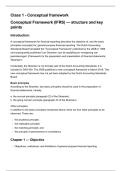
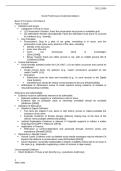
Conceptual Framework (IFRS) — structure and key
points
Introduction:
A conceptual framework for financial reporting describes the objective of, and the basic
principles (concepts) for, general purpose financial reporting. The Dutch Accounting
Standards Board translated the "Conceptual Framework" published by the IASB in 1989
and subsequently published it as 'Stramien voor de opstelling en vormgeving van
jaarrekeningen' (Framework for the preparation and presentation of financial statements;
'Stramien').
Incidentally, the Stramien is not formally part of the Dutch Accounting Standards; it is
included in DAS 930. The IASB published a new conceptual framework in March 2018. This
new conceptual framework has not yet been adopted by the Dutch Accounting Standards
Board.
Basic principles
According to the Stramien, two basic principles should be used in the preparation of
financial statements, namely:
a. the accrual principle (paragraph 22 of the Stramien);
b. the going concern principle (paragraph 23 of the Stramien)
Other principles
In addition to the basic principles mentioned above, there are four other principles to be
observed. These are:
the prudence principle;
the realisation principle;
the matching principle; and
the principle of permanence or consistency
Chapter 1 — Objective
Objectives, usefulness, and limitations of general purpose financial reporting
,Chapter 2 — Qualitative characteristics
Fundamental: relevance and faithful representation
Enhancing: comparability, verifiability, timeliness, understandability
Cost constraint: benefits should justify preparation costs
Prudence: exercise caution under uncertainty; supports neutrality
Measurement uncertainty: high uncertainty can reduce usefulness; slightly less relevant
but more certain information may be preferable
Materiality:
Entity-specific aspect of relevance
Depends on size and/or nature in context
Applies to policy selection and disclosures
Accounting policies need not be applied if immaterial (IAS 8.8)
Disclosures need not be provided if immaterial even if listed as minimum
requirements (IAS 1.31)
Financial statements do not comply with IFRS if they contain material errors or
intentional immaterial errors (IAS 8.8, 41)
,Chapter 3 — Financial statements and reporting entity
Clarifies perspective and boundaries of the reporting entity
Difference highlighted vs Dutch GAAP:
Economic entity concept (IFRS) vs parent entity concept (Dutch GAAP)
Impacts processing of acquisition costs in business combinations and step
acquisitions
Chapter 4 — Elements and unit of account
Elements: assets, liabilities, income, expenses, equity
Unit of account:
“The right(s) and/or obligation(s) to which recognition and measurement apply”
May differ for recognition vs measurement (e.g., individual contract vs portfolio)
Possible units include:
Individual right/obligation
All rights/obligations from a source (e.g., contract)
Subgroup of rights over an asset (different useful lives/patterns)
Portfolio of similar or dissimilar items
Risk exposure within a portfolio
Transactions with shareholders:
Income/expense definitions exclude capital transactions with equity participants
Shareholder contributions/distributions recognized directly in equity
Assess whether the shareholder acted in capacity as shareholder vs as a market
participant
Examples:
, Sale at fair value to shareholder → P&L (market terms)
Gift to shareholder → direct equity (distribution)
Sale above fair value → split: fair value to P&L; excess to equity (contribution)
Chapter 5 — Recognition and derecognition
New CF: probability removed as an explicit recognition criterion; replaced by relevance
considerations
Situations where recognition may not be relevant:
Uncertain whether an asset/liability exists or separable from goodwill
Only a small chance of inflow/outflow of economic benefits
Measurement has high uncertainty with no alternative → lack of faithful
representation
Conceptual Framework (IFRS) — structure and key
points
Introduction:
A conceptual framework for financial reporting describes the objective of, and the basic
principles (concepts) for, general purpose financial reporting. The Dutch Accounting
Standards Board translated the "Conceptual Framework" published by the IASB in 1989
and subsequently published it as 'Stramien voor de opstelling en vormgeving van
jaarrekeningen' (Framework for the preparation and presentation of financial statements;
'Stramien').
Incidentally, the Stramien is not formally part of the Dutch Accounting Standards; it is
included in DAS 930. The IASB published a new conceptual framework in March 2018. This
new conceptual framework has not yet been adopted by the Dutch Accounting Standards
Board.
Basic principles
According to the Stramien, two basic principles should be used in the preparation of
financial statements, namely:
a. the accrual principle (paragraph 22 of the Stramien);
b. the going concern principle (paragraph 23 of the Stramien)
Other principles
In addition to the basic principles mentioned above, there are four other principles to be
observed. These are:
the prudence principle;
the realisation principle;
the matching principle; and
the principle of permanence or consistency
Chapter 1 — Objective
Objectives, usefulness, and limitations of general purpose financial reporting
,Chapter 2 — Qualitative characteristics
Fundamental: relevance and faithful representation
Enhancing: comparability, verifiability, timeliness, understandability
Cost constraint: benefits should justify preparation costs
Prudence: exercise caution under uncertainty; supports neutrality
Measurement uncertainty: high uncertainty can reduce usefulness; slightly less relevant
but more certain information may be preferable
Materiality:
Entity-specific aspect of relevance
Depends on size and/or nature in context
Applies to policy selection and disclosures
Accounting policies need not be applied if immaterial (IAS 8.8)
Disclosures need not be provided if immaterial even if listed as minimum
requirements (IAS 1.31)
Financial statements do not comply with IFRS if they contain material errors or
intentional immaterial errors (IAS 8.8, 41)
,Chapter 3 — Financial statements and reporting entity
Clarifies perspective and boundaries of the reporting entity
Difference highlighted vs Dutch GAAP:
Economic entity concept (IFRS) vs parent entity concept (Dutch GAAP)
Impacts processing of acquisition costs in business combinations and step
acquisitions
Chapter 4 — Elements and unit of account
Elements: assets, liabilities, income, expenses, equity
Unit of account:
“The right(s) and/or obligation(s) to which recognition and measurement apply”
May differ for recognition vs measurement (e.g., individual contract vs portfolio)
Possible units include:
Individual right/obligation
All rights/obligations from a source (e.g., contract)
Subgroup of rights over an asset (different useful lives/patterns)
Portfolio of similar or dissimilar items
Risk exposure within a portfolio
Transactions with shareholders:
Income/expense definitions exclude capital transactions with equity participants
Shareholder contributions/distributions recognized directly in equity
Assess whether the shareholder acted in capacity as shareholder vs as a market
participant
Examples:
, Sale at fair value to shareholder → P&L (market terms)
Gift to shareholder → direct equity (distribution)
Sale above fair value → split: fair value to P&L; excess to equity (contribution)
Chapter 5 — Recognition and derecognition
New CF: probability removed as an explicit recognition criterion; replaced by relevance
considerations
Situations where recognition may not be relevant:
Uncertain whether an asset/liability exists or separable from goodwill
Only a small chance of inflow/outflow of economic benefits
Measurement has high uncertainty with no alternative → lack of faithful
representation