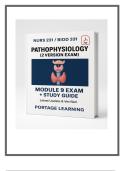
BIOD 331 | NURS 231 Pathophysiology
MODULE 7 EXAM
Actual Questions and Verified Answers
100% Guarantee Pass
Portage Learning, Geneva College
Inside you will get:
Updated Module 7 Exam
True & False Questions
Multiple Choice Questions and Answers
, Expert-Verified Explanations
Question 1
The liver is responsible for each of the following EXCEPT:
- Producing bile
- Stores vitamins and minerals
- Releases insulin
- Synthesizes protein
Answer: Releases insulin.
Verified Rationale:
The liver performs numerous essential metabolic, synthetic, and storage functions, such
as producing bile for fat digestion, synthesizing plasma proteins (e.g., albumin, clotting
factors), and storing vitamins (A, D, B12) and minerals (iron, copper). However, insulin
is released by the beta cells of the pancreas, not the liver. The liver does respond to
insulin by regulating carbohydrate, lipid, and protein metabolism, but it does not
produce or secrete this hormone.
---
The liver is responsible for each of the following EXCEPT:
- Can store 500-1000 mL of blood
- Can store glucose as glycogen
, - Converts ammonia to urea
- Helps with digestion of lipids
Answer: Helps with digestion of lipids.
Verified Rationale:
While the liver is integral to the process of fat digestion through the secretion of bile
salts (which emulsify dietary fats), the actual enzymatic digestion of lipids occurs
primarily via pancreatic lipase in the small intestine. The liver itself is not directly
digesting the lipids but assists by producing bile.
---
Question 2
Complications of gallstones include each of the following EXCEPT:
- Cirrhosis
- Biliary obstruction
- Pancreatitis
- Cholecystitis
Answer: Cirrhosis.
Verified Rationale:
Cirrhosis is a chronic liver disease unrelated to gallstones. It is most commonly due to
chronic alcohol use, chronic hepatitis, or metabolic disorders. Gallstones may cause
biliary obstruction, acute/chronic cholecystitis, and may also lead to pancreatitis if they
block the pancreatic duct, but they do not directly cause cirrhosis.
MODULE 7 EXAM
Actual Questions and Verified Answers
100% Guarantee Pass
Portage Learning, Geneva College
Inside you will get:
Updated Module 7 Exam
True & False Questions
Multiple Choice Questions and Answers
, Expert-Verified Explanations
Question 1
The liver is responsible for each of the following EXCEPT:
- Producing bile
- Stores vitamins and minerals
- Releases insulin
- Synthesizes protein
Answer: Releases insulin.
Verified Rationale:
The liver performs numerous essential metabolic, synthetic, and storage functions, such
as producing bile for fat digestion, synthesizing plasma proteins (e.g., albumin, clotting
factors), and storing vitamins (A, D, B12) and minerals (iron, copper). However, insulin
is released by the beta cells of the pancreas, not the liver. The liver does respond to
insulin by regulating carbohydrate, lipid, and protein metabolism, but it does not
produce or secrete this hormone.
---
The liver is responsible for each of the following EXCEPT:
- Can store 500-1000 mL of blood
- Can store glucose as glycogen
, - Converts ammonia to urea
- Helps with digestion of lipids
Answer: Helps with digestion of lipids.
Verified Rationale:
While the liver is integral to the process of fat digestion through the secretion of bile
salts (which emulsify dietary fats), the actual enzymatic digestion of lipids occurs
primarily via pancreatic lipase in the small intestine. The liver itself is not directly
digesting the lipids but assists by producing bile.
---
Question 2
Complications of gallstones include each of the following EXCEPT:
- Cirrhosis
- Biliary obstruction
- Pancreatitis
- Cholecystitis
Answer: Cirrhosis.
Verified Rationale:
Cirrhosis is a chronic liver disease unrelated to gallstones. It is most commonly due to
chronic alcohol use, chronic hepatitis, or metabolic disorders. Gallstones may cause
biliary obstruction, acute/chronic cholecystitis, and may also lead to pancreatitis if they
block the pancreatic duct, but they do not directly cause cirrhosis.