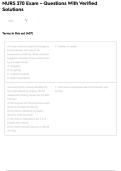
NURS 370 Exam – Questions With Verified
Solutions
Save
Terms in this set (407)
A 4-year-old is brought to Emergency C. Inability to speak
by his parents, who report he
swallowed a small toy. What symptom
suggests complete airway obstruction
by a foreign body?
A. Gagging
B. Coughing
C. Inability to speak
D. Rapid respirations
The adult client is newly admitted to C. The client's respirations are 6 to 8 breaths per
the ward following surgery. Which minute.
assessment finding should be the RN's
priority?
A.The surgical site dressing has a scant
amount of bright red blood.
B.The client is sleeping but easily
arouses when touched.
C.The client's respirations are 6 to 8
breaths per minute.
D.The client's blood pressure is 100/68
mm Hg.
,The nurse is caring for a client who B. "I just can't 'catch my breath"
had a total hip replacement four days
ago. Which assessment requires the
nurse's immediate attention?
A."I have bad pain in my lower leg"
B."I just can't 'catch my breath"
C. "I have to use the bedpan to pee at
least every hour."
D. "The pain medication is not working
today."
There has been a train derailment and D. Client who is 25 years old with an open chest wall
four people are injured. Which patient wound
should the RN see first? Because of open-chest wall wound = at risk for
A.Client who is 20 years of age who pneumothorax or hemothorax = life-threatening.
has unequal pupils and is tachypneic
B.Client who is 80 years old
complaining of a "racing heart" and
has a laceration on his arm
C.Client who is 10 years old with a
swollen wrist
D.Client who is 25 years old with an
open chest wall wound
The client just returned to the nursing C. Oxygen saturation level is 82%
unit following surgery. Which
observation by the RN requires the
most immediate intervention?
A. The client is sleepy
B. The client coughed up blood-
tinged sputum
C. Oxygen saturation level is 82%
D. Jackson-Pratt wound drain is half
full
,At 0730 hours, the oncoming RN is C. The 46-year-old client who had a chest tube
planning care for four clients. Which removed an hour ago and now has dyspnea
client should the RN plan to assess
first?
A.The 23-year-old client with cystic
fibrosis who has pulmonary function
tests scheduled in ten minutes
B.The 35-year-old client admitted the
previous day with bacterial pneumonia
and now has a temperature of 39.4oC
C.The 46-year-old client who had a
chest tube removed an hour ago and
now has dyspnea
D.The 77-year-old client with
tuberculosis who has four anti-
tubercular medications due at 08:00
hours
What is the purpose of the ABCDE To provide life-saving treatment
approach? To break down complex clinical situations into more
manageable parts
To serve as an assessment and treatment algorithm
To establish common situational awareness among all
treatment providers
To buy time to establish a final diagnosis and
treatment (identifies priority needs and guides
nursing practice)
Can be initiated without any equipment and more
advanced interventions can be applied on arrival of
emergency medical services, in a clinic, or at the
hospital.
Assessments should be repeated until the patient is
stable, regularly, and/or at any sign of deterioration.
, What are strategies for prioritizing Central focus on prioritization of Client care:
care? -Priority 1 - life threatening illness (ex: airway
obstruction, myocardial infarction)
-Priority 2 - safety (ex: of patient and family, nurse
and health professionals)
-Priority 3 - client priorities (ex: pain, nausea)
-Priority 4 - nurse priorities (ex: a nursing intervention
appropriate for the situation)
What are normal/expected airway Patient responds in a normal voice
findings? Regular and visible respirations
What are abnormal/unexpected Partial obstruction = voice changes, noisy breathing,
airway findings? and increased breathing effort
Complete obstruction = there is no respiration
despite great effort, unconscious
What are possible airway Head tilt and chin tilt to open airway
interventions? List them. Suction of the airways
Removal of foreign bodies
Conscious - 5 back blows or 5 abdominal thrusts
High oxygen flow should be given ASAP
Endotracheal tube
What are normal/expected breathing Respiratory rate appropriate for age, normal O2Sat
findings? Symmetrical and visible movements of the thoracic
Percussed unilateral dullness or resonance
What are abnormal/unexpected Cyanosis
breathing findings? Distended neck veins
Lateralization of the trachea
Tension pneumothorax (air trapped in pleural space)
Bronchospasms
Solutions
Save
Terms in this set (407)
A 4-year-old is brought to Emergency C. Inability to speak
by his parents, who report he
swallowed a small toy. What symptom
suggests complete airway obstruction
by a foreign body?
A. Gagging
B. Coughing
C. Inability to speak
D. Rapid respirations
The adult client is newly admitted to C. The client's respirations are 6 to 8 breaths per
the ward following surgery. Which minute.
assessment finding should be the RN's
priority?
A.The surgical site dressing has a scant
amount of bright red blood.
B.The client is sleeping but easily
arouses when touched.
C.The client's respirations are 6 to 8
breaths per minute.
D.The client's blood pressure is 100/68
mm Hg.
,The nurse is caring for a client who B. "I just can't 'catch my breath"
had a total hip replacement four days
ago. Which assessment requires the
nurse's immediate attention?
A."I have bad pain in my lower leg"
B."I just can't 'catch my breath"
C. "I have to use the bedpan to pee at
least every hour."
D. "The pain medication is not working
today."
There has been a train derailment and D. Client who is 25 years old with an open chest wall
four people are injured. Which patient wound
should the RN see first? Because of open-chest wall wound = at risk for
A.Client who is 20 years of age who pneumothorax or hemothorax = life-threatening.
has unequal pupils and is tachypneic
B.Client who is 80 years old
complaining of a "racing heart" and
has a laceration on his arm
C.Client who is 10 years old with a
swollen wrist
D.Client who is 25 years old with an
open chest wall wound
The client just returned to the nursing C. Oxygen saturation level is 82%
unit following surgery. Which
observation by the RN requires the
most immediate intervention?
A. The client is sleepy
B. The client coughed up blood-
tinged sputum
C. Oxygen saturation level is 82%
D. Jackson-Pratt wound drain is half
full
,At 0730 hours, the oncoming RN is C. The 46-year-old client who had a chest tube
planning care for four clients. Which removed an hour ago and now has dyspnea
client should the RN plan to assess
first?
A.The 23-year-old client with cystic
fibrosis who has pulmonary function
tests scheduled in ten minutes
B.The 35-year-old client admitted the
previous day with bacterial pneumonia
and now has a temperature of 39.4oC
C.The 46-year-old client who had a
chest tube removed an hour ago and
now has dyspnea
D.The 77-year-old client with
tuberculosis who has four anti-
tubercular medications due at 08:00
hours
What is the purpose of the ABCDE To provide life-saving treatment
approach? To break down complex clinical situations into more
manageable parts
To serve as an assessment and treatment algorithm
To establish common situational awareness among all
treatment providers
To buy time to establish a final diagnosis and
treatment (identifies priority needs and guides
nursing practice)
Can be initiated without any equipment and more
advanced interventions can be applied on arrival of
emergency medical services, in a clinic, or at the
hospital.
Assessments should be repeated until the patient is
stable, regularly, and/or at any sign of deterioration.
, What are strategies for prioritizing Central focus on prioritization of Client care:
care? -Priority 1 - life threatening illness (ex: airway
obstruction, myocardial infarction)
-Priority 2 - safety (ex: of patient and family, nurse
and health professionals)
-Priority 3 - client priorities (ex: pain, nausea)
-Priority 4 - nurse priorities (ex: a nursing intervention
appropriate for the situation)
What are normal/expected airway Patient responds in a normal voice
findings? Regular and visible respirations
What are abnormal/unexpected Partial obstruction = voice changes, noisy breathing,
airway findings? and increased breathing effort
Complete obstruction = there is no respiration
despite great effort, unconscious
What are possible airway Head tilt and chin tilt to open airway
interventions? List them. Suction of the airways
Removal of foreign bodies
Conscious - 5 back blows or 5 abdominal thrusts
High oxygen flow should be given ASAP
Endotracheal tube
What are normal/expected breathing Respiratory rate appropriate for age, normal O2Sat
findings? Symmetrical and visible movements of the thoracic
Percussed unilateral dullness or resonance
What are abnormal/unexpected Cyanosis
breathing findings? Distended neck veins
Lateralization of the trachea
Tension pneumothorax (air trapped in pleural space)
Bronchospasms