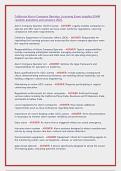
CALIFORNIA ALARM COMPANY
OPERATOR LICENSING EXAM
INSIGHTS
1. Alarm Company Operator (ACO) License
Answer Legally enables companies to operate and otter alarm system services under California
regulations, ensuring compliance with state requirements.
2. California Department of Consumer Affairs (DCA)
Answer Responsible for regulating the licensing process and ensuring that alarm company operators meet
the required standards.
3. Responsibilities of Alarm Company Operator
Answer Typical responsibilities include overseeing installation standards, managing monitoring centers,
and ensuring compliance with local and state laws, but not operating emergency dispatch services directly.
,4. Alarm Company Operator Act
Answer Outlines the legal framework and responsibilities for operators in
California.
5. Basic qualifications for ACO License
Answer Include passing a background check, demonstrating technical proficiency, and meeting ethical
standards, but not holding a degree in electronics engineering.
6. Maintaining an active ACO License
Answer Requires participating in regular continuing education.
7. Regulations enforcement for alarm companies
Answer Enforced through various codes including
the California Penal Code, Business and Professions Code, and Health & Safety Code.
8. Local regulations for alarm companies
,Answer May impose additional requirements such as local ordinances regarding false alarms.
9. Importance of record-keeping under ACO License
Answer Strict documentation is necessary to monitor alarm system reliability and performance.
10. false alarm
Answer An alarm that is triggered without an actual emergency.
11. Intrusion alarm system
Answer Alarm systems designed to detect unauthorized entries by using sensors like
door contacts and motion detectors.
12. Communication equipment
Answer Equipment critical for transmitting signals to the monitoring center, such as telephone, cellular, or
internet connections.
13. glass break detector
, Answer A device specifically designed to sense the sound of breaking glass, indicating potential
intrusion.
14. proper installation of alarm system wiring
Answer Ensures optimal performance and reduced interference, which is essential for reliable
operation.
15. code compliance and optimal sensor placement
Answer Principle most important for ensuring coverage and reliability in alarm system design.
16. National Fire Protection Association (NFPA) standards
Answer Help ensure that alarm systems meet fire safety regulations and maintain reliable performance.
17. risk analysis
Answer Involves determining sensor placement to cover all potential entry points and hazards.
OPERATOR LICENSING EXAM
INSIGHTS
1. Alarm Company Operator (ACO) License
Answer Legally enables companies to operate and otter alarm system services under California
regulations, ensuring compliance with state requirements.
2. California Department of Consumer Affairs (DCA)
Answer Responsible for regulating the licensing process and ensuring that alarm company operators meet
the required standards.
3. Responsibilities of Alarm Company Operator
Answer Typical responsibilities include overseeing installation standards, managing monitoring centers,
and ensuring compliance with local and state laws, but not operating emergency dispatch services directly.
,4. Alarm Company Operator Act
Answer Outlines the legal framework and responsibilities for operators in
California.
5. Basic qualifications for ACO License
Answer Include passing a background check, demonstrating technical proficiency, and meeting ethical
standards, but not holding a degree in electronics engineering.
6. Maintaining an active ACO License
Answer Requires participating in regular continuing education.
7. Regulations enforcement for alarm companies
Answer Enforced through various codes including
the California Penal Code, Business and Professions Code, and Health & Safety Code.
8. Local regulations for alarm companies
,Answer May impose additional requirements such as local ordinances regarding false alarms.
9. Importance of record-keeping under ACO License
Answer Strict documentation is necessary to monitor alarm system reliability and performance.
10. false alarm
Answer An alarm that is triggered without an actual emergency.
11. Intrusion alarm system
Answer Alarm systems designed to detect unauthorized entries by using sensors like
door contacts and motion detectors.
12. Communication equipment
Answer Equipment critical for transmitting signals to the monitoring center, such as telephone, cellular, or
internet connections.
13. glass break detector
, Answer A device specifically designed to sense the sound of breaking glass, indicating potential
intrusion.
14. proper installation of alarm system wiring
Answer Ensures optimal performance and reduced interference, which is essential for reliable
operation.
15. code compliance and optimal sensor placement
Answer Principle most important for ensuring coverage and reliability in alarm system design.
16. National Fire Protection Association (NFPA) standards
Answer Help ensure that alarm systems meet fire safety regulations and maintain reliable performance.
17. risk analysis
Answer Involves determining sensor placement to cover all potential entry points and hazards.