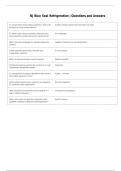
AMT RMA Practice Exam 1| Questions and Answers
Save
An example of a "ball and socket" joint c. hip
is the
a. knee
b. elbow
c. hip
d. ankle
The kidneys are located behind the a. peritoneum
a. peritoneum
b. spinalcolumn
c. bladder
d. sternum
During swallowing, the larynx is b. epiglottis
covered by the
a. tongue
b. epiglottis
c. soft
palate
d. uvula
The protein in epidermal cells that b. keratin
makes the skin relatively waterproof
is
a. elastin
b. keratin
c. melanin
d. collagen
,The function of insulin is to d. assist glucose into the cells
a. promote carbohydrate synthesis
b. convert glucose into fat
c. accelerate liver glycogenolysis
d. assist glucose into the cells
The largest glandular organ in the body is c. liver.
the
Select one:
a. pancreas.
b. gallbladder.
c. liver.
d. heart.
Which of the following constitutes 2%-4% b. Eosinophils
of the WBCs?
a. Neutrophils
b. Eosinophils
c. Platelets
d. Basophils
In what quadrant is the liver located? a. Upper right
a. Upper right
b. Upper left
c. Lower right
d. Lower left
Where do peristaltic waves occur? b. Esophagus
a. Large intestine
b. Esophagus
c. Small Intestine
d. Liver
Muscles are attached to bones by b. tendons
a. fascia
b. tendons
c. ligaments
d. joints
,Where do you find the pulse from the b. Top of foot
patient's dorsalis pedis artery?
a. Wrist
b. Top of foot
c. Ankle
d. Behind the knee
, The body part that matches with the b. leg.
popliteal artery is the
a. feet.
b. leg.
c. groin.
d. neck.
The urinary bladder is located in the c. pelvic cavity.
a. abdominal cavity.
b. dorsal cavity.
c. pelvic cavity.
d. ventral cavity
The destruction of all microorganisms is d. sterilization.
known as
a. disinfection.
b. sanitization.
c. Universal Precaution.
d. sterilization.
Where is chyme produced? d. Stomach
Select one:
a. Liver
b. Pancreas
c. Heart
d. Stomach
When a muscle contracts, it becomes c. shorter and thicker
a. shorter and thinner
b. longer and thicker
c. shorter and thicker
d. longer and thinner
A doughnut-shaped gland that encircles c. prostate gland.
the urethra is the
a. urinarybladder.
b. bulbourethral glands.
c. prostate gland.
d. none of the above.
Save
An example of a "ball and socket" joint c. hip
is the
a. knee
b. elbow
c. hip
d. ankle
The kidneys are located behind the a. peritoneum
a. peritoneum
b. spinalcolumn
c. bladder
d. sternum
During swallowing, the larynx is b. epiglottis
covered by the
a. tongue
b. epiglottis
c. soft
palate
d. uvula
The protein in epidermal cells that b. keratin
makes the skin relatively waterproof
is
a. elastin
b. keratin
c. melanin
d. collagen
,The function of insulin is to d. assist glucose into the cells
a. promote carbohydrate synthesis
b. convert glucose into fat
c. accelerate liver glycogenolysis
d. assist glucose into the cells
The largest glandular organ in the body is c. liver.
the
Select one:
a. pancreas.
b. gallbladder.
c. liver.
d. heart.
Which of the following constitutes 2%-4% b. Eosinophils
of the WBCs?
a. Neutrophils
b. Eosinophils
c. Platelets
d. Basophils
In what quadrant is the liver located? a. Upper right
a. Upper right
b. Upper left
c. Lower right
d. Lower left
Where do peristaltic waves occur? b. Esophagus
a. Large intestine
b. Esophagus
c. Small Intestine
d. Liver
Muscles are attached to bones by b. tendons
a. fascia
b. tendons
c. ligaments
d. joints
,Where do you find the pulse from the b. Top of foot
patient's dorsalis pedis artery?
a. Wrist
b. Top of foot
c. Ankle
d. Behind the knee
, The body part that matches with the b. leg.
popliteal artery is the
a. feet.
b. leg.
c. groin.
d. neck.
The urinary bladder is located in the c. pelvic cavity.
a. abdominal cavity.
b. dorsal cavity.
c. pelvic cavity.
d. ventral cavity
The destruction of all microorganisms is d. sterilization.
known as
a. disinfection.
b. sanitization.
c. Universal Precaution.
d. sterilization.
Where is chyme produced? d. Stomach
Select one:
a. Liver
b. Pancreas
c. Heart
d. Stomach
When a muscle contracts, it becomes c. shorter and thicker
a. shorter and thinner
b. longer and thicker
c. shorter and thicker
d. longer and thinner
A doughnut-shaped gland that encircles c. prostate gland.
the urethra is the
a. urinarybladder.
b. bulbourethral glands.
c. prostate gland.
d. none of the above.