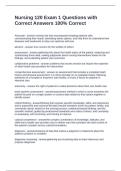
Nursing 120 Exam 1 Questions with
Correct Answers 100% Correct
Advocate - answer nursing role that encompasses keeping patients safe,
communicating their needs, identifying better options, and help them to understand their
diseases and treatments so they can optimize self-care
altruism - answer true concern for the welfare of others
assessment - answer gathering info about the health status of the patient, analyzing and
synthesizing those data, making judgments about nursing interventions based on the
findings, and evaluating patient care outcomes
collaborative problems - answer problems that nurses monitor but require the expertise
of other health care providers for intervention
comprehensive assessment - answer an assessment that includes a complete heath
history and physical assessment; it is done annually on an outpatient basis, following
admission to a hospital or long-term care facility, or every 8 hours for patients in
intensive care
autonomy - answer the right of patients to make decisions about their own health care
body systems assessment - answerassessment method in which a nurse examines the
patient focused on a single system or clusters data related to that system together to
identify issues
critical thinking - answerthinking that requires specific knowledge, skills, and experience
and is purposeful and outcome-directed (results-oriented); driven by patient, family, and
community needs; based on the nursing process, evidenced-based thinking, and the
scientific method; guided by professional standards and codes of ethics; and constantly
re-evaluating, self-correcting, and striving to improve
cultural competence - answerthe complex combination of knowledge, attitudes, and
skills that a health care provider uses to deliver care that considers the total context of
the patient's situation across cultural boundaries
diagnosis - answerclustering of data that makes a judgment or statement about the
patient's problem or condition
diagnostic reasoning - answergathering ans clustering data to draw inferences and
propose diagnoses
, emergency assessment - answeran assessment that involves a life-threatening or
unstable situation and that focuses on A-Airway (with cervical spine protection if injury
suspected); B-Breathing (rate and depth, use of accessory muscles); C-Circulation
(pulse rate and rhythm, skin color); and D-Disability (level of consciousness, pupils,
movement)
evaluation - answerjudgment of the effectiveness of nursing care in meeting the
patient's goals and outcomes based upon the patient's responses to the interventions
evidenced-based nursing - answerapproach to patient care that minimizes intuition and
personal experience and instead relies upon research findings and high-grade scientific
support
focused assessment - answeran assessment based on the patient's issues that can
occur in all health care settings; it usually involves one or two body systems and is
smaller in scope than the comprehensive assessment but more in depth on the specific
issues
functional assessment - answeran assessment that focuses on the functional patterns
all humans share: health perception and health management, activity and exercise,
nutrition and metabolism, elimination, sleep and rest, cognition and perception, self-
perception and self-concept, roles and relationships, coping and stress tolerance,
sexuality and reproduction, and values and beliefs
head-to-toe assessment - answeran assessment that organizes the collection of
comprehensive physical data by proceeding through the entire body from head to toe
health-belief model - answermodel focused on the relationship between beliefs and
actions, with the host (patient), agent (disease), and environment interacting
health-promotion model - answermodel that views individuals as multidimensional and
interaction with interpersonal and physical environments as they pursue health,
combining individual characteristics and experiences with behavior-specific cognitions
and affect, as well as with behavioral outcomes
human dignity - answerrespect for patients, such as by ensuring privacy and
confidentiality
illness - answerstate in which patients experience objective signs and subjective
symptoms of sickness, with subsequent disability
integrity - answerproviding honest information to patients, documenting care accurately,
and reporting errors
Correct Answers 100% Correct
Advocate - answer nursing role that encompasses keeping patients safe,
communicating their needs, identifying better options, and help them to understand their
diseases and treatments so they can optimize self-care
altruism - answer true concern for the welfare of others
assessment - answer gathering info about the health status of the patient, analyzing and
synthesizing those data, making judgments about nursing interventions based on the
findings, and evaluating patient care outcomes
collaborative problems - answer problems that nurses monitor but require the expertise
of other health care providers for intervention
comprehensive assessment - answer an assessment that includes a complete heath
history and physical assessment; it is done annually on an outpatient basis, following
admission to a hospital or long-term care facility, or every 8 hours for patients in
intensive care
autonomy - answer the right of patients to make decisions about their own health care
body systems assessment - answerassessment method in which a nurse examines the
patient focused on a single system or clusters data related to that system together to
identify issues
critical thinking - answerthinking that requires specific knowledge, skills, and experience
and is purposeful and outcome-directed (results-oriented); driven by patient, family, and
community needs; based on the nursing process, evidenced-based thinking, and the
scientific method; guided by professional standards and codes of ethics; and constantly
re-evaluating, self-correcting, and striving to improve
cultural competence - answerthe complex combination of knowledge, attitudes, and
skills that a health care provider uses to deliver care that considers the total context of
the patient's situation across cultural boundaries
diagnosis - answerclustering of data that makes a judgment or statement about the
patient's problem or condition
diagnostic reasoning - answergathering ans clustering data to draw inferences and
propose diagnoses
, emergency assessment - answeran assessment that involves a life-threatening or
unstable situation and that focuses on A-Airway (with cervical spine protection if injury
suspected); B-Breathing (rate and depth, use of accessory muscles); C-Circulation
(pulse rate and rhythm, skin color); and D-Disability (level of consciousness, pupils,
movement)
evaluation - answerjudgment of the effectiveness of nursing care in meeting the
patient's goals and outcomes based upon the patient's responses to the interventions
evidenced-based nursing - answerapproach to patient care that minimizes intuition and
personal experience and instead relies upon research findings and high-grade scientific
support
focused assessment - answeran assessment based on the patient's issues that can
occur in all health care settings; it usually involves one or two body systems and is
smaller in scope than the comprehensive assessment but more in depth on the specific
issues
functional assessment - answeran assessment that focuses on the functional patterns
all humans share: health perception and health management, activity and exercise,
nutrition and metabolism, elimination, sleep and rest, cognition and perception, self-
perception and self-concept, roles and relationships, coping and stress tolerance,
sexuality and reproduction, and values and beliefs
head-to-toe assessment - answeran assessment that organizes the collection of
comprehensive physical data by proceeding through the entire body from head to toe
health-belief model - answermodel focused on the relationship between beliefs and
actions, with the host (patient), agent (disease), and environment interacting
health-promotion model - answermodel that views individuals as multidimensional and
interaction with interpersonal and physical environments as they pursue health,
combining individual characteristics and experiences with behavior-specific cognitions
and affect, as well as with behavioral outcomes
human dignity - answerrespect for patients, such as by ensuring privacy and
confidentiality
illness - answerstate in which patients experience objective signs and subjective
symptoms of sickness, with subsequent disability
integrity - answerproviding honest information to patients, documenting care accurately,
and reporting errors