Page | 1
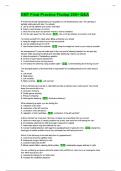
AAO Written Exam 1 Questions with
Detailed Verified Answers
When abducting the arm to reach into the backseat of a car, the
motion of the arm occurs in which plane? Ans: Frontal plane
which structure connects bone to bone Ans: Ligaments
the directional terms "cranial" and "caudal" are used when
referring to structures in which area of the body? Ans: the Trunk
Anatomically speaking, the term "proximal" provides what
directional information? Ans: the structure is closer to the trunk.
the structure closer to the back of the body than the front could
be described as: Ans: Posterior
what is another term for volar? Ans: ventral
Which plane of motion is also referred to as the coronal plane?
Ans: Frontal plane
A hinge joint allows which movements? Ans: flexion and extension
Which type of joint is capable of movement in every plane? Ans:
Ball & Socket (Shoulder)
A muscle contraction involving a change in muscle length and
joint motion while the muscle lengthens is called: Ans: Eccentric
(extension of the muscle)
, Page | 2
which abdominal muscle runs vertically from the rib cage to the
pubic crest? Ans: Rectus Abdominus
Which movement of the vertebral column would shorten the fibers
of the erector spinae muscles? Ans: Trunk Extension
Which region of the vertebral column is comprised of 12
vertebrae? Ans: Thoracic
The ribs are held to the skeleton by which 2 structures? Ans:
vertebrae & sternum
which vertebra identifies the end of the cervical spine & is often
most prominent? Ans: C-7
Primary purposeful movements of the temporomandibular joint
include elevation, depression, and: Ans: Protraction
Which bone is located at the base of the posterior skull? Ans:
Occipital
The depressor anguli oris works along with mentalis to create
which facial expression? Ans: Pouting
Which bone elevates and depresses thousands of times when
someone talks excessively? Ans: Mandible
which muscle allows us to chew our food? Ans: Masseter
Which of the following describes the arrangement of a third-class
lever? Ans: Axis, exerted force, external force
AAO Written Exam 1 Questions with
Detailed Verified Answers
When abducting the arm to reach into the backseat of a car, the
motion of the arm occurs in which plane? Ans: Frontal plane
which structure connects bone to bone Ans: Ligaments
the directional terms "cranial" and "caudal" are used when
referring to structures in which area of the body? Ans: the Trunk
Anatomically speaking, the term "proximal" provides what
directional information? Ans: the structure is closer to the trunk.
the structure closer to the back of the body than the front could
be described as: Ans: Posterior
what is another term for volar? Ans: ventral
Which plane of motion is also referred to as the coronal plane?
Ans: Frontal plane
A hinge joint allows which movements? Ans: flexion and extension
Which type of joint is capable of movement in every plane? Ans:
Ball & Socket (Shoulder)
A muscle contraction involving a change in muscle length and
joint motion while the muscle lengthens is called: Ans: Eccentric
(extension of the muscle)
, Page | 2
which abdominal muscle runs vertically from the rib cage to the
pubic crest? Ans: Rectus Abdominus
Which movement of the vertebral column would shorten the fibers
of the erector spinae muscles? Ans: Trunk Extension
Which region of the vertebral column is comprised of 12
vertebrae? Ans: Thoracic
The ribs are held to the skeleton by which 2 structures? Ans:
vertebrae & sternum
which vertebra identifies the end of the cervical spine & is often
most prominent? Ans: C-7
Primary purposeful movements of the temporomandibular joint
include elevation, depression, and: Ans: Protraction
Which bone is located at the base of the posterior skull? Ans:
Occipital
The depressor anguli oris works along with mentalis to create
which facial expression? Ans: Pouting
Which bone elevates and depresses thousands of times when
someone talks excessively? Ans: Mandible
which muscle allows us to chew our food? Ans: Masseter
Which of the following describes the arrangement of a third-class
lever? Ans: Axis, exerted force, external force