Wk. Author Main points
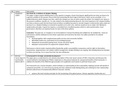
1 Friedmann The Good city: In Defence of Utopian Thinking
(2000) This paper is about utopian thinking which is the capacity to imagine a future that departs significantly from what we know to be
a general condition in the present. Most of the time presenting the best image of the future, which can be unrealistic. It is a
political discourse which changes over time, which also changes our view on what a good city entails. It is related to our views on
the present conditions: injustice etc. It is also related to the spatial planning discourse. But most important of all, utopian thinking
can help us choose a path into the future that we believe is justified, because its concrete imagery is informed by values which are
precious to us. Utopian thinking is connected to questions as to who’s city, and how would we see an utopic city? Related to
spatial justice principles. A good city requires a committed form of political practice which he calls transformative. Good
governance is therefore an important factor for each of the three spheres.
Conclusion: The good city, as I imagine it, has its foundations in human flourishing and multipli/city. By multipli/city, I mean an
autonomous civil life relatively free from direct supervision and control by the state. Four pillars provide for its material
foundations:
Housing together with complementary public services and community facilities.
Affordable health-care, particularly for less privileged groups.
Adequately remunerated (paying) work, income and social regard.
Adequate social provision (to support the weakest citizen).
Performance criteria include: inspired political leadership; public accountability; transparency and the right to information;
inclusiveness; responsiveness; non-violent conflict management. Utopian thinking is an ongoing, time-binding discourse intended
to inform our striving. It is no more than that, but also nothing less.
1 Broman, A framework for strategic sustainable development
Goran Ingvar & This paper gives a comprehensive and cohesive description of the most recent version of FSSD; it describes and discusses the
Karl-Hendrik overall method for developing the FFSSD; it elaborates on the general rationale for and general benefits of the framework; it
Robert (2017) validates the benefits of the FSDD through examples of its application and it points to pertinent future work.
The framework uses a funnel metaphor, which facilitates an understanding of the sustainability challenge and the self-benefit of
competent proactivity. It is a five-level structuring and inter-relational model distinguishing and clarifying the inter-relationships
between phenomena of fundamentally different character. Namely:
systems; this level includes principles for the functioning of the global system. (climate regulation, biodiversity etc).
, success; this level includes the definition of the vision.
guidelines; this includes guidelines for how to approach the principle-framed vision strategically.
actions; includes the actions which have been prioritized into a strategic plan. (sustainable education)
tools; methods and other forms of support. (modelling, simulation)
The ABCD procedure is a procedure for creative co-creation of strategic transition towards sustainability. Which is an iterative
process. Which uses the back-casting method:
A: participants learn about the sustainability challenge
B: Participants analyse and assess the current situation in relation to the vision
C: Participants apply creativity method such as brainstorming to identify challenges.
D: Participants apply strategic guidelines to prioritize among the possible solutions established in C into a strategic plan.
Forecasting = projects current trends into the future and is used often to predict and solve problems. Problem of path
dependency and is not appropriate for long term goals in complex systems. In such systems, back-casting is more appropriate.
1 Friedmann The Good city: In Defence of Utopian Thinking
(2000) This paper is about utopian thinking which is the capacity to imagine a future that departs significantly from what we know to be
a general condition in the present. Most of the time presenting the best image of the future, which can be unrealistic. It is a
political discourse which changes over time, which also changes our view on what a good city entails. It is related to our views on
the present conditions: injustice etc. It is also related to the spatial planning discourse. But most important of all, utopian thinking
can help us choose a path into the future that we believe is justified, because its concrete imagery is informed by values which are
precious to us. Utopian thinking is connected to questions as to who’s city, and how would we see an utopic city? Related to
spatial justice principles. A good city requires a committed form of political practice which he calls transformative. Good
governance is therefore an important factor for each of the three spheres.
Conclusion: The good city, as I imagine it, has its foundations in human flourishing and multipli/city. By multipli/city, I mean an
autonomous civil life relatively free from direct supervision and control by the state. Four pillars provide for its material
foundations:
Housing together with complementary public services and community facilities.
Affordable health-care, particularly for less privileged groups.
Adequately remunerated (paying) work, income and social regard.
Adequate social provision (to support the weakest citizen).
Performance criteria include: inspired political leadership; public accountability; transparency and the right to information;
inclusiveness; responsiveness; non-violent conflict management. Utopian thinking is an ongoing, time-binding discourse intended
to inform our striving. It is no more than that, but also nothing less.
1 Broman, A framework for strategic sustainable development
Goran Ingvar & This paper gives a comprehensive and cohesive description of the most recent version of FSSD; it describes and discusses the
Karl-Hendrik overall method for developing the FFSSD; it elaborates on the general rationale for and general benefits of the framework; it
Robert (2017) validates the benefits of the FSDD through examples of its application and it points to pertinent future work.
The framework uses a funnel metaphor, which facilitates an understanding of the sustainability challenge and the self-benefit of
competent proactivity. It is a five-level structuring and inter-relational model distinguishing and clarifying the inter-relationships
between phenomena of fundamentally different character. Namely:
systems; this level includes principles for the functioning of the global system. (climate regulation, biodiversity etc).
, success; this level includes the definition of the vision.
guidelines; this includes guidelines for how to approach the principle-framed vision strategically.
actions; includes the actions which have been prioritized into a strategic plan. (sustainable education)
tools; methods and other forms of support. (modelling, simulation)
The ABCD procedure is a procedure for creative co-creation of strategic transition towards sustainability. Which is an iterative
process. Which uses the back-casting method:
A: participants learn about the sustainability challenge
B: Participants analyse and assess the current situation in relation to the vision
C: Participants apply creativity method such as brainstorming to identify challenges.
D: Participants apply strategic guidelines to prioritize among the possible solutions established in C into a strategic plan.
Forecasting = projects current trends into the future and is used often to predict and solve problems. Problem of path
dependency and is not appropriate for long term goals in complex systems. In such systems, back-casting is more appropriate.