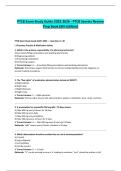
PTCB Exam Study Guide 2025-2026 - PTCB Secrets Review
Prep Book [8th Edition]
PTCB Exam Study Guide 2025–2026 — Questions 1–30
I. Pharmacy Practice & Medication Safety
1. Which is the primary responsibility of a pharmacy technician?
A) Accurately filling prescriptions and assisting pharmacists
B) Diagnosing patients
C) Prescribing medications
D) Performing surgery
✔ Correct Answer: A — Accurately filling prescriptions and assisting pharmacists
Rationale: Technicians support pharmacists but cannot independently prescribe, diagnose, or
provide medical procedures.
2. The “five rights” of medication administration include all EXCEPT:
A) Right patient
B) Right dose
C) Right physician
D) Right route
✔ Correct Answer: C — Right physician
Rationale: The five rights ensure safe administration: patient, medication, dose, route, and time.
3. A prescription for amoxicillin 500 mg q8h × 10 days means:
A) Take 500 mg every 8 hours for 10 days
B) Take 500 mg once daily
C) Take 500 mg only at bedtime
D) Take 500 mg every 12 hours for 5 days
✔ Correct Answer: A — Take 500 mg every 8 hours for 10 days
Rationale: “q8h” means every 8 hours; duration is 10 days.
4. Which abbreviation should be avoided due to risk of misinterpretation?
A) U (unit)
B) mg (milligram)
C) mL (milliliter)
D) PO (by mouth)
✔ Correct Answer: A — U (unit)
Rationale: “U” can be misread as zero or 4, leading to overdose; “unit” should be written in full.
, 5. Tall man lettering (e.g., predniSONE vs. prednisoLONE) is used to:
A) Reduce medication errors due to look-alike drug names
B) Make prescriptions look professional
C) Reduce cost
D) Shorten prescription writing
✔ Correct Answer: A — Reduce medication errors due to look-alike drug names
Rationale: Tall man lettering highlights differences in similar drug names to prevent errors.
6. Which action ensures correct patient identification in a pharmacy?
A) Verify name, date of birth, and address
B) Assume patient identity based on appearance
C) Skip verification for refills
D) Use only prescription number
✔ Correct Answer: A — Verify name, date of birth, and address
Rationale: Multiple identifiers prevent dispensing errors and protect patient safety.
7. Which is considered a high-alert medication requiring extra safety precautions?
A) Insulin
B) Acetaminophen
C) Diphenhydramine
D) Loratadine
✔ Correct Answer: A — Insulin
Rationale: High-alert medications carry higher risk of serious harm if used incorrectly.
8. Medication error reporting is important to:
A) Improve safety and prevent future errors
B) Punish staff exclusively
C) Avoid documentation
D) Reduce patient access
✔ Correct Answer: A — Improve safety and prevent future errors
Rationale: Reporting helps identify patterns and implement preventive measures.
9. A technician identifies a prescription with a potential drug allergy. Best action:
A) Notify the pharmacist immediately
B) Dispense as written
C) Call the physician directly without pharmacist input
D) Ignore and fill later
✔ Correct Answer: A — Notify the pharmacist immediately
Rationale: Pharmacists must review potential allergic reactions before dispensing.
Prep Book [8th Edition]
PTCB Exam Study Guide 2025–2026 — Questions 1–30
I. Pharmacy Practice & Medication Safety
1. Which is the primary responsibility of a pharmacy technician?
A) Accurately filling prescriptions and assisting pharmacists
B) Diagnosing patients
C) Prescribing medications
D) Performing surgery
✔ Correct Answer: A — Accurately filling prescriptions and assisting pharmacists
Rationale: Technicians support pharmacists but cannot independently prescribe, diagnose, or
provide medical procedures.
2. The “five rights” of medication administration include all EXCEPT:
A) Right patient
B) Right dose
C) Right physician
D) Right route
✔ Correct Answer: C — Right physician
Rationale: The five rights ensure safe administration: patient, medication, dose, route, and time.
3. A prescription for amoxicillin 500 mg q8h × 10 days means:
A) Take 500 mg every 8 hours for 10 days
B) Take 500 mg once daily
C) Take 500 mg only at bedtime
D) Take 500 mg every 12 hours for 5 days
✔ Correct Answer: A — Take 500 mg every 8 hours for 10 days
Rationale: “q8h” means every 8 hours; duration is 10 days.
4. Which abbreviation should be avoided due to risk of misinterpretation?
A) U (unit)
B) mg (milligram)
C) mL (milliliter)
D) PO (by mouth)
✔ Correct Answer: A — U (unit)
Rationale: “U” can be misread as zero or 4, leading to overdose; “unit” should be written in full.
, 5. Tall man lettering (e.g., predniSONE vs. prednisoLONE) is used to:
A) Reduce medication errors due to look-alike drug names
B) Make prescriptions look professional
C) Reduce cost
D) Shorten prescription writing
✔ Correct Answer: A — Reduce medication errors due to look-alike drug names
Rationale: Tall man lettering highlights differences in similar drug names to prevent errors.
6. Which action ensures correct patient identification in a pharmacy?
A) Verify name, date of birth, and address
B) Assume patient identity based on appearance
C) Skip verification for refills
D) Use only prescription number
✔ Correct Answer: A — Verify name, date of birth, and address
Rationale: Multiple identifiers prevent dispensing errors and protect patient safety.
7. Which is considered a high-alert medication requiring extra safety precautions?
A) Insulin
B) Acetaminophen
C) Diphenhydramine
D) Loratadine
✔ Correct Answer: A — Insulin
Rationale: High-alert medications carry higher risk of serious harm if used incorrectly.
8. Medication error reporting is important to:
A) Improve safety and prevent future errors
B) Punish staff exclusively
C) Avoid documentation
D) Reduce patient access
✔ Correct Answer: A — Improve safety and prevent future errors
Rationale: Reporting helps identify patterns and implement preventive measures.
9. A technician identifies a prescription with a potential drug allergy. Best action:
A) Notify the pharmacist immediately
B) Dispense as written
C) Call the physician directly without pharmacist input
D) Ignore and fill later
✔ Correct Answer: A — Notify the pharmacist immediately
Rationale: Pharmacists must review potential allergic reactions before dispensing.