APHY 101 Final Exam Questions and
Answers30
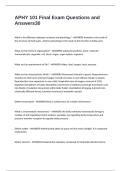
What is the difference between anatomy and physiology? - ANSWERS-Anatomy is the study of
the structure of body parts, whereas physiology is the study of the function of body parts
What are the levels of organization? - ANSWERS-subatomic particles, atom, molecule,
macromolecule, organelle, cell, tissue, organ, organ system, organism
What are the requirements of life? - ANSWERS-Water, food, oxygen, heat, pressure
What are the characteristics of life? - ANSWERS-Movement (internal or gross); Responsiveness
(reaction to internal or external change); Growth (increase in size without change in shape);
Reproduction (new organisms or new cells); Respiration (use of oxygen; removal of CO2);
Digestion (breakdown of food); Absorption (movement of substances through membranes and
into fluids); Circulation (movement within body fluids); Assimilation (changing nutrients into
chemically different forms); Excretion (removal of metabolic wastes)
Define homeostasis - ANSWERS-Body's maintenance of a stable environment
What is a homeostatic mechanism? - ANSWERS-the body maintains homeostasis through a
number of self-regulating control systems; examples are regulating body temperature and
pressure sensitive receptors to regulate body pressure
Define matter - ANSWERS-Anything that takes up space and has mass (weight). It is composed
of elements.
Define element - ANSWERS-fundamental substance composed of chemically identical atoms
,Define atoms - ANSWERS-smallest particle of an element; basic unit of matter
What is the structure of an atom? - ANSWERS-An atom consists of a nucleus containing protons
and neutrons, with electrons in
orbit around the nucleus.
Atomic nucleus - ANSWERS-the nucleus contains protons and neutrons
Proton - ANSWERS-subatomic particle that has a positive charge
Neutron - ANSWERS-subatomic particle that has no charge
Electron - ANSWERS-subatomic particle that has a negative charge
Atomic number - ANSWERS-number or protons in nucleus
Atomic mass - ANSWERS-number of protons plus number of neutrons
What are covalent bonds? - ANSWERS-Covalent bonds are formed when atoms share electrons
to become stable with filled
outer shells
What are ionic bonds? - ANSWERS-2 oppositely charged atoms form this bond when electrons
are transferred from one atom to another atom
, What are hydrogen bonds? - ANSWERS-Weak attraction between positive end of one polar
molecule and negative end of another polar molecule; formed between water molecules
Define ion - ANSWERS-When atoms gain or lose electrons, they become ions.
Define synthesis reaction - ANSWERS-Two or more atoms or molecules are joined together
Define decomposition reaction - ANSWERS-Larger molecules are broken down into smaller ones
Define exchange reaction - ANSWERS-Parts of molecules trade places
Define reactant - ANSWERS-The starting materials of the reaction - the atoms, ions, or
molecules
Define product - ANSWERS-Substances formed at the end of the chemical reaction
Define catalyst - ANSWERS-influence the rates of chemical reactions
What is an acid? - ANSWERS-Electrolytes that release hydrogen ions in water
What is a base? - ANSWERS-Electrolytes that release ions that combine with hydrogen ions in
water
What is a salt? - ANSWERS-Acids and bases that react to form water and electrolytes
What is a pH scale? - ANSWERS-represents the concentration of hydrogen ions [H+] in solution
Answers30
What is the difference between anatomy and physiology? - ANSWERS-Anatomy is the study of
the structure of body parts, whereas physiology is the study of the function of body parts
What are the levels of organization? - ANSWERS-subatomic particles, atom, molecule,
macromolecule, organelle, cell, tissue, organ, organ system, organism
What are the requirements of life? - ANSWERS-Water, food, oxygen, heat, pressure
What are the characteristics of life? - ANSWERS-Movement (internal or gross); Responsiveness
(reaction to internal or external change); Growth (increase in size without change in shape);
Reproduction (new organisms or new cells); Respiration (use of oxygen; removal of CO2);
Digestion (breakdown of food); Absorption (movement of substances through membranes and
into fluids); Circulation (movement within body fluids); Assimilation (changing nutrients into
chemically different forms); Excretion (removal of metabolic wastes)
Define homeostasis - ANSWERS-Body's maintenance of a stable environment
What is a homeostatic mechanism? - ANSWERS-the body maintains homeostasis through a
number of self-regulating control systems; examples are regulating body temperature and
pressure sensitive receptors to regulate body pressure
Define matter - ANSWERS-Anything that takes up space and has mass (weight). It is composed
of elements.
Define element - ANSWERS-fundamental substance composed of chemically identical atoms
,Define atoms - ANSWERS-smallest particle of an element; basic unit of matter
What is the structure of an atom? - ANSWERS-An atom consists of a nucleus containing protons
and neutrons, with electrons in
orbit around the nucleus.
Atomic nucleus - ANSWERS-the nucleus contains protons and neutrons
Proton - ANSWERS-subatomic particle that has a positive charge
Neutron - ANSWERS-subatomic particle that has no charge
Electron - ANSWERS-subatomic particle that has a negative charge
Atomic number - ANSWERS-number or protons in nucleus
Atomic mass - ANSWERS-number of protons plus number of neutrons
What are covalent bonds? - ANSWERS-Covalent bonds are formed when atoms share electrons
to become stable with filled
outer shells
What are ionic bonds? - ANSWERS-2 oppositely charged atoms form this bond when electrons
are transferred from one atom to another atom
, What are hydrogen bonds? - ANSWERS-Weak attraction between positive end of one polar
molecule and negative end of another polar molecule; formed between water molecules
Define ion - ANSWERS-When atoms gain or lose electrons, they become ions.
Define synthesis reaction - ANSWERS-Two or more atoms or molecules are joined together
Define decomposition reaction - ANSWERS-Larger molecules are broken down into smaller ones
Define exchange reaction - ANSWERS-Parts of molecules trade places
Define reactant - ANSWERS-The starting materials of the reaction - the atoms, ions, or
molecules
Define product - ANSWERS-Substances formed at the end of the chemical reaction
Define catalyst - ANSWERS-influence the rates of chemical reactions
What is an acid? - ANSWERS-Electrolytes that release hydrogen ions in water
What is a base? - ANSWERS-Electrolytes that release ions that combine with hydrogen ions in
water
What is a salt? - ANSWERS-Acids and bases that react to form water and electrolytes
What is a pH scale? - ANSWERS-represents the concentration of hydrogen ions [H+] in solution