Quantitative Modelling 1
DSC1520
Department of Decision Sciences
Assignment 01 for 2021 (compulsory)
Due Date: 28 May 2021
Instructions
• Work through Study units 1, 2 and 3 in the study guide before attempting this
assignment.
• Answer all the questions.
• Submit your answers electronically through myUnisa.
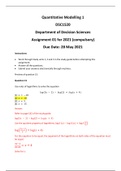
Preview of question 15:
Question 15
Use rules of logarithms to solve the equation
𝑙𝑜𝑔(3𝑥 − 2) − 𝑙𝑜𝑔(2) = 𝑙𝑜𝑔(𝑥 + 4)
[1] 𝑥 = −10
[2] 𝑥 = 10
[3] 𝑥 = 5
[4] 𝑥 = 15
Answer:
Refer to page 182 of the study guide.
log(3𝑥 − 2) − log(2) = 𝑙𝑜𝑔(𝑥 + 4)
𝑥
Use the quotient property of logarithms, log 𝑏 (𝑥) − log 𝑏 (𝑦) = log 𝑏 (𝑦)
3𝑥−2
log ( ) = log(𝑥 + 4)
2
For the equation to be equal, the argument of the logarithms on both sides of the equation must
be equal.
3𝑥−2
=𝑥+4
2𝑥+8
Solve for 𝑥:
,Multiply both sides of the equation by 2.
3𝑥−2
× 2 = (𝑥 + 4) × 2
2
Simplify:
Cancel the common factor of 2.
Rewrite the expression.
3𝑥 − 2 = (𝑥 + 4) × 2
Simplify (𝑥 + 4) × 2
Apply the distributive property 𝑎(𝑏 + 𝑐) = 𝑎𝑏 + 𝑎𝑐.
3𝑥 − 2 = 𝑥 × 2 + 4 × 2
Simplify the expression.
Move 2 to the left of 𝑥.
3𝑥 − 2 = 2 × 𝑥 + 4 × 2
Multiply 4 by 2.
3𝑥 − 2 = 2𝑥 + 8
Solve for 𝑥 by moving all terms containing 𝑥 to the left side of the equation:
Subtract 2𝑥 from both sides of the equation:
3𝑥 − 2 − 2𝑥 = 8
Subtract 2𝑥 from 3𝑥:
𝑥−2=8
Move all terms not containing 𝑥 to the right side of the equation:
Add 2 to both sides of the equation:
𝑥 = 8+2
Add 8 and 2:
𝑥 = 10
OR:
𝑙𝑜𝑔(3𝑥 − 2) − 𝑙𝑜𝑔(2) = 𝑙𝑜𝑔(𝑥 + 4)
, 3𝑥−2
log [ ]=0
2(𝑥+4)
3𝑥−2
100 [ ]
2(𝑥+4)
3𝑥−2
=1
2𝑥+8
3𝑥 − 2 = 2𝑥 + 8
3𝑥 − 2𝑥 = 10
𝑥 = 10
DSC1520
Department of Decision Sciences
Assignment 01 for 2021 (compulsory)
Due Date: 28 May 2021
Instructions
• Work through Study units 1, 2 and 3 in the study guide before attempting this
assignment.
• Answer all the questions.
• Submit your answers electronically through myUnisa.
Preview of question 15:
Question 15
Use rules of logarithms to solve the equation
𝑙𝑜𝑔(3𝑥 − 2) − 𝑙𝑜𝑔(2) = 𝑙𝑜𝑔(𝑥 + 4)
[1] 𝑥 = −10
[2] 𝑥 = 10
[3] 𝑥 = 5
[4] 𝑥 = 15
Answer:
Refer to page 182 of the study guide.
log(3𝑥 − 2) − log(2) = 𝑙𝑜𝑔(𝑥 + 4)
𝑥
Use the quotient property of logarithms, log 𝑏 (𝑥) − log 𝑏 (𝑦) = log 𝑏 (𝑦)
3𝑥−2
log ( ) = log(𝑥 + 4)
2
For the equation to be equal, the argument of the logarithms on both sides of the equation must
be equal.
3𝑥−2
=𝑥+4
2𝑥+8
Solve for 𝑥:
,Multiply both sides of the equation by 2.
3𝑥−2
× 2 = (𝑥 + 4) × 2
2
Simplify:
Cancel the common factor of 2.
Rewrite the expression.
3𝑥 − 2 = (𝑥 + 4) × 2
Simplify (𝑥 + 4) × 2
Apply the distributive property 𝑎(𝑏 + 𝑐) = 𝑎𝑏 + 𝑎𝑐.
3𝑥 − 2 = 𝑥 × 2 + 4 × 2
Simplify the expression.
Move 2 to the left of 𝑥.
3𝑥 − 2 = 2 × 𝑥 + 4 × 2
Multiply 4 by 2.
3𝑥 − 2 = 2𝑥 + 8
Solve for 𝑥 by moving all terms containing 𝑥 to the left side of the equation:
Subtract 2𝑥 from both sides of the equation:
3𝑥 − 2 − 2𝑥 = 8
Subtract 2𝑥 from 3𝑥:
𝑥−2=8
Move all terms not containing 𝑥 to the right side of the equation:
Add 2 to both sides of the equation:
𝑥 = 8+2
Add 8 and 2:
𝑥 = 10
OR:
𝑙𝑜𝑔(3𝑥 − 2) − 𝑙𝑜𝑔(2) = 𝑙𝑜𝑔(𝑥 + 4)
, 3𝑥−2
log [ ]=0
2(𝑥+4)
3𝑥−2
100 [ ]
2(𝑥+4)
3𝑥−2
=1
2𝑥+8
3𝑥 − 2 = 2𝑥 + 8
3𝑥 − 2𝑥 = 10
𝑥 = 10