WEEK 1
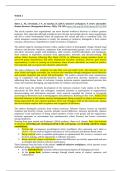
Shore, L. M., Cleveland, J. N., & Sanchez, D. (2017). Inclusive workplaces: A review and model.
Human Resource Management Review, 28(2), 176–189. https://doi.org/10.1016/j.hrmr.2017.07.003
The article explores how organizations can move beyond workforce diversity to achieve genuine
inclusion. They argue that although workplaces have become increasingly diverse, many organizations
still fail to create environments where all employees feel valued and able to contribute fully. The
article integrates existing literature to clarify the meaning of inclusion, distinguish it from related
concepts, and present a comprehensive model of inclusive workplaces.
The authors begin by situating inclusion within a global context of demographic change. Despite legal
advances and diversity initiatives, employees from underrepresented groups, such as women, racial
and ethnic minorities, people with disabilities, older workers, LGBTQ individuals, and immigrants,
often continue to experience exclusion from opportunities, networks, and decision-making. The
authors define diversity, following Mor Barak (2014), as differences among members based on
perceived group characteristics that affect employment outcomes. Inclusion, however, goes beyond
representation; it refers to creating an environment where diverse individuals are treated as insiders,
feel respected, and can express their identities authentically.
The paper emphasizes that exclusion can take both overt and subtle forms. Discriminatory acts are
often visible and legally actionable, but exclusion also manifests through ambiguous micro-behaviors
and systemic inequities that restrict full participation. The authors contend that many organizations
stop at compliance with anti-discrimination laws or surface-level diversity initiatives, without
addressing these deeper forms of exclusion. Genuine inclusion requires organizational practices that
ensure fair treatment, belonging, and opportunities for influence and advancement.
The article traces the scholarly development of the inclusion construct. Early studies in the 1990s,
particularly by Mor Barak and colleagues, examined inclusion as participation in organizational
decision-making and information networks. Later research expanded the concept to incorporate
psychological dimensions such as belongingness and authenticity. Building on this work, Nishii (2013)
described inclusion as the balance between belongingness (being accepted by others) and uniqueness
(being appreciated for one’s distinct qualities). Shore and colleagues build on this framework, arguing
that true inclusion requires both acceptance and recognition of difference.
The authors distinguish inclusion from related constructs. Whereas fairness focuses on equitable
treatment and diversity climate concerns attitudes toward difference, inclusion specifically captures
employees’ lived experiences of being valued members of their work groups and the organization.
Inclusion represents an environment that simultaneously values diversity and fosters connection
among employees.
Drawing from prior models and Ferdman’s (2014) synthesis, Shore et al. identify three core elements
of inclusion: (1) feeling safe, (2) being involved in the work group, and (3) being valued for unique
contributions.
1. Feeling safe encompasses psychological safety (confidence that expressing one’s ideas or
identity will not result in negative outcomes) as well as physical and identity-based safety.
2. Being involved refers to equitable participation in organizational life, access to resources and
decision-making, and the opportunity to influence outcomes.
3. Being valued for unique contributions means that differences are actively appreciated and seen
as strengths that enhance collective performance.
These elements form the basis of the authors’ model of inclusive workplaces, which operates across
individual, group, and organizational levels.
At the individual level, inclusion reflects personal perceptions of belonging and value.
At the group level, inclusion emerges through shared norms of respect, openness, and
collaboration.
, At the organizational level, inclusion becomes institutionalized through structures and
policies, such as transparent promotion systems, fair evaluation processes, and inclusive
leadership practices.
The model highlights reciprocal relationships: inclusive climates promote inclusive behaviors, which
reinforce norms that sustain inclusion. Leadership plays a central role; inclusive leaders demonstrate
openness, fairness, and empathy, soliciting input from diverse perspectives and recognizing individual
strengths. Human resource practices that ensure fairness in development, recognition, and flexibility
further reinforce inclusion.
The outcomes of inclusion span several domains. For individuals, inclusion enhances well-being,
engagement, and organizational identification, while reducing stress and withdrawal. Within groups,
inclusion fosters trust, communication, and collaboration, promoting creativity and effective problem-
solving. At the organizational level, inclusion supports retention, performance, innovation, and
reputation, helping firms adapt to diverse labor markets. Thus, inclusion not only benefits individuals
but strengthens overall organizational functioning.
Despite growing scholarly attention, Shore and colleagues highlight continuing research gaps.
Empirical
studies remain limited, especially regarding multilevel processes and cross-cultural comparisons. They
urge future research to examine the mechanisms linking structural practices, group climates, and
individual perceptions, and to explore how inclusion interacts with systems of power and privilege.
Studying both inclusion and exclusion, they argue, will help uncover barriers and inform more
effective interventions.
In conclusion, the authors stress that inclusion cannot be achieved through policy compliance or
numerical diversity alone. True inclusion requires ongoing effort to create environments where all
individuals, regardless of background, are respected, supported, and able to contribute authentically.
Their model provides a conceptual foundation for advancing both research and practice, guiding
organizations toward cultures that harness the potential of diversity through genuine inclusion.
, Martin, K. D., & Cullen, J. B. (2006). Continuities and Extensions of Ethical Climate Theory: A
Meta-Analytic Review. Journal Of Business Ethics, 69(2), 175–194.
https://doi.org/10.1007/s10551-006-9084-7
The article provides an extensive synthesis of research on Ethical Climate Theory (ECT) since its
introduction by Victor and Cullen in the late 1980s. Using meta-analytic techniques, the authors
evaluate how ECT has developed, the consistency of its findings, and its implications for
understanding organizational behavior. Their analysis integrates empirical research to clarify how
ethical climate perceptions relate to individual work outcomes and to identify future directions for
ethical climate research.
The authors begin by noting that organizations are increasingly expected to demonstrate ethical
behavior through codes of conduct and compliance structures. However, formal rules alone do not
capture the ethical culture within organizations. Ethical climate refers to employees’ shared
perceptions of the moral norms and practices that guide behavior. It functions as a psychological
mechanism influencing decision-making and ethical reasoning. The authors position ECT as a vital
framework for understanding how organizational environments shape ethical and unethical conduct.
Ethical climate is conceptualized as a form of work climate grounded in moral expectations. Victor
and Cullen’s original model defines it through two dimensions: ethical criteria (egoism, benevolence,
and principle) and locus of analysis (individual, local, and cosmopolitan). Crossing these dimensions
yields nine theoretical climate types, though empirical research has consistently identified five main
ones: instrumental, caring, independence, law and code, and rules climates.
Instrumental climates emphasize self-interest and organizational profit.
Caring climates focus on concern for others and collective welfare.
Independence climates emphasize personal moral judgment.
Law and code climates rely on external ethical standards such as legal or professional codes.
Rules climates prioritize adherence to internal policies and procedures.
These climate types are typically measured using the Ethical Climate Questionnaire (ECQ), which has
become the dominant instrument in ethical climate research due to its consistency and theoretical
grounding.
The article organizes the literature into two broad areas: antecedents and consequences of ethical
climate. The antecedents include external organizational context, organizational form, and managerial
or strategic orientations. For example, institutional pressures, such as regulations or industry norms,
can shape ethical climates. Similarly, organizational structure - whether bureaucratic, market-based, or
clan-oriented - affects prevailing ethical norms. Managerial orientations, such as leadership style or
moral development, also influence employees’ ethical perceptions. However, these antecedent studies
are fragmented, and insufficient data prevented a meta-analytic synthesis.
The consequences of ethical climate are more extensively studied and form the core of the meta-
analysis. Martin and Cullen examine four primary individual-level outcomes: organizational
commitment, job satisfaction, psychological well-being, and dysfunctional behavior. Results across 42
studies reveal consistent relationships between perceived ethical climates and these outcomes.
Organizational commitment is positively associated with caring, independence, law and code,
and rules climates, and negatively associated with instrumental climates.
Job satisfaction shows similar patterns, with caring and law and code climates promoting
satisfaction and instrumental climates reducing it.
Shore, L. M., Cleveland, J. N., & Sanchez, D. (2017). Inclusive workplaces: A review and model.
Human Resource Management Review, 28(2), 176–189. https://doi.org/10.1016/j.hrmr.2017.07.003
The article explores how organizations can move beyond workforce diversity to achieve genuine
inclusion. They argue that although workplaces have become increasingly diverse, many organizations
still fail to create environments where all employees feel valued and able to contribute fully. The
article integrates existing literature to clarify the meaning of inclusion, distinguish it from related
concepts, and present a comprehensive model of inclusive workplaces.
The authors begin by situating inclusion within a global context of demographic change. Despite legal
advances and diversity initiatives, employees from underrepresented groups, such as women, racial
and ethnic minorities, people with disabilities, older workers, LGBTQ individuals, and immigrants,
often continue to experience exclusion from opportunities, networks, and decision-making. The
authors define diversity, following Mor Barak (2014), as differences among members based on
perceived group characteristics that affect employment outcomes. Inclusion, however, goes beyond
representation; it refers to creating an environment where diverse individuals are treated as insiders,
feel respected, and can express their identities authentically.
The paper emphasizes that exclusion can take both overt and subtle forms. Discriminatory acts are
often visible and legally actionable, but exclusion also manifests through ambiguous micro-behaviors
and systemic inequities that restrict full participation. The authors contend that many organizations
stop at compliance with anti-discrimination laws or surface-level diversity initiatives, without
addressing these deeper forms of exclusion. Genuine inclusion requires organizational practices that
ensure fair treatment, belonging, and opportunities for influence and advancement.
The article traces the scholarly development of the inclusion construct. Early studies in the 1990s,
particularly by Mor Barak and colleagues, examined inclusion as participation in organizational
decision-making and information networks. Later research expanded the concept to incorporate
psychological dimensions such as belongingness and authenticity. Building on this work, Nishii (2013)
described inclusion as the balance between belongingness (being accepted by others) and uniqueness
(being appreciated for one’s distinct qualities). Shore and colleagues build on this framework, arguing
that true inclusion requires both acceptance and recognition of difference.
The authors distinguish inclusion from related constructs. Whereas fairness focuses on equitable
treatment and diversity climate concerns attitudes toward difference, inclusion specifically captures
employees’ lived experiences of being valued members of their work groups and the organization.
Inclusion represents an environment that simultaneously values diversity and fosters connection
among employees.
Drawing from prior models and Ferdman’s (2014) synthesis, Shore et al. identify three core elements
of inclusion: (1) feeling safe, (2) being involved in the work group, and (3) being valued for unique
contributions.
1. Feeling safe encompasses psychological safety (confidence that expressing one’s ideas or
identity will not result in negative outcomes) as well as physical and identity-based safety.
2. Being involved refers to equitable participation in organizational life, access to resources and
decision-making, and the opportunity to influence outcomes.
3. Being valued for unique contributions means that differences are actively appreciated and seen
as strengths that enhance collective performance.
These elements form the basis of the authors’ model of inclusive workplaces, which operates across
individual, group, and organizational levels.
At the individual level, inclusion reflects personal perceptions of belonging and value.
At the group level, inclusion emerges through shared norms of respect, openness, and
collaboration.
, At the organizational level, inclusion becomes institutionalized through structures and
policies, such as transparent promotion systems, fair evaluation processes, and inclusive
leadership practices.
The model highlights reciprocal relationships: inclusive climates promote inclusive behaviors, which
reinforce norms that sustain inclusion. Leadership plays a central role; inclusive leaders demonstrate
openness, fairness, and empathy, soliciting input from diverse perspectives and recognizing individual
strengths. Human resource practices that ensure fairness in development, recognition, and flexibility
further reinforce inclusion.
The outcomes of inclusion span several domains. For individuals, inclusion enhances well-being,
engagement, and organizational identification, while reducing stress and withdrawal. Within groups,
inclusion fosters trust, communication, and collaboration, promoting creativity and effective problem-
solving. At the organizational level, inclusion supports retention, performance, innovation, and
reputation, helping firms adapt to diverse labor markets. Thus, inclusion not only benefits individuals
but strengthens overall organizational functioning.
Despite growing scholarly attention, Shore and colleagues highlight continuing research gaps.
Empirical
studies remain limited, especially regarding multilevel processes and cross-cultural comparisons. They
urge future research to examine the mechanisms linking structural practices, group climates, and
individual perceptions, and to explore how inclusion interacts with systems of power and privilege.
Studying both inclusion and exclusion, they argue, will help uncover barriers and inform more
effective interventions.
In conclusion, the authors stress that inclusion cannot be achieved through policy compliance or
numerical diversity alone. True inclusion requires ongoing effort to create environments where all
individuals, regardless of background, are respected, supported, and able to contribute authentically.
Their model provides a conceptual foundation for advancing both research and practice, guiding
organizations toward cultures that harness the potential of diversity through genuine inclusion.
, Martin, K. D., & Cullen, J. B. (2006). Continuities and Extensions of Ethical Climate Theory: A
Meta-Analytic Review. Journal Of Business Ethics, 69(2), 175–194.
https://doi.org/10.1007/s10551-006-9084-7
The article provides an extensive synthesis of research on Ethical Climate Theory (ECT) since its
introduction by Victor and Cullen in the late 1980s. Using meta-analytic techniques, the authors
evaluate how ECT has developed, the consistency of its findings, and its implications for
understanding organizational behavior. Their analysis integrates empirical research to clarify how
ethical climate perceptions relate to individual work outcomes and to identify future directions for
ethical climate research.
The authors begin by noting that organizations are increasingly expected to demonstrate ethical
behavior through codes of conduct and compliance structures. However, formal rules alone do not
capture the ethical culture within organizations. Ethical climate refers to employees’ shared
perceptions of the moral norms and practices that guide behavior. It functions as a psychological
mechanism influencing decision-making and ethical reasoning. The authors position ECT as a vital
framework for understanding how organizational environments shape ethical and unethical conduct.
Ethical climate is conceptualized as a form of work climate grounded in moral expectations. Victor
and Cullen’s original model defines it through two dimensions: ethical criteria (egoism, benevolence,
and principle) and locus of analysis (individual, local, and cosmopolitan). Crossing these dimensions
yields nine theoretical climate types, though empirical research has consistently identified five main
ones: instrumental, caring, independence, law and code, and rules climates.
Instrumental climates emphasize self-interest and organizational profit.
Caring climates focus on concern for others and collective welfare.
Independence climates emphasize personal moral judgment.
Law and code climates rely on external ethical standards such as legal or professional codes.
Rules climates prioritize adherence to internal policies and procedures.
These climate types are typically measured using the Ethical Climate Questionnaire (ECQ), which has
become the dominant instrument in ethical climate research due to its consistency and theoretical
grounding.
The article organizes the literature into two broad areas: antecedents and consequences of ethical
climate. The antecedents include external organizational context, organizational form, and managerial
or strategic orientations. For example, institutional pressures, such as regulations or industry norms,
can shape ethical climates. Similarly, organizational structure - whether bureaucratic, market-based, or
clan-oriented - affects prevailing ethical norms. Managerial orientations, such as leadership style or
moral development, also influence employees’ ethical perceptions. However, these antecedent studies
are fragmented, and insufficient data prevented a meta-analytic synthesis.
The consequences of ethical climate are more extensively studied and form the core of the meta-
analysis. Martin and Cullen examine four primary individual-level outcomes: organizational
commitment, job satisfaction, psychological well-being, and dysfunctional behavior. Results across 42
studies reveal consistent relationships between perceived ethical climates and these outcomes.
Organizational commitment is positively associated with caring, independence, law and code,
and rules climates, and negatively associated with instrumental climates.
Job satisfaction shows similar patterns, with caring and law and code climates promoting
satisfaction and instrumental climates reducing it.