Accounting I summary
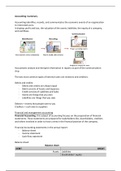
Accounting identifies, records, and communicates the economic events of an organisation
to interested users.
It displays profit and loss, the valuation of the assets, liabilities, the equity of a company,
and cashflows.
Accountants analyse and interpret information in reports as part of the communication
step.
The two most common types of external users are investors and creditors.
Debits and credits:
- Debits and credits are always equal
- Debit consists of Assets and Expenses
- Credit consists of Liabilities and Sales
- Assets are things that you own
- Liabilities are things that you owe
Debtors = money that people owe to you
Creditors = cash owe to suppliers
Financial and management accounting
Financial Accounting: this subject of accounting focuses on the preparation of financial
statements. These statements are prepared for stakeholders like, shareholders, creditors
and others involved in order to have a view in the financial position of the company.
Financial Accounting statements in the annual report:
- Balance sheet
- Income statement
- Cash flow statement
Balance sheet:
Balance sheet
DEBIT CREDIT
Assets Liabilities
Stockholders’ equity
,On a balance sheet, assets and liabilities have to be ranked. So, a more specific balance
sheet would look like this:
Balance sheet
DEBIT CREDIT
‘Non-current’ or ‘Fixed assets’ Stockholders’ equity
‘Current assets’ ‘Long-term’ or ‘Non-current liabilities’
‘Short-term’ or ‘Current liabilities’
‘Non-current’ of ‘Fixed assets’ are assets like buildings and inventories that are not very
liquid. ‘Current assets’ are very liquid and are for example cash.
‘Long-term’ or ‘Non-current liabilities’ are long-term loans by for example a bank. At the
credit side, you have stockholders’ equity on top and then it is important that you continue
with the liabilities that have a long pay-off date (like a bank loan) and on the bottom, you
have ‘short-term’ liabilities, like ‘accounts payable’.
Income statement / profit or loss statement:
Sales revenues
- expenses
= Net profit/ loss
On the income statement you take all expenses from the sales/ service revenue. ‘Unearned
sales/ services revenue’ is not part of the income statement!
Profit = Cash flow + (∆ other assets − ∆ liabilities) − share issues + dividends
Statement of retained earnings:
Retained earnings beginning balance
+/- net income
- dividends
= Retained Earnings ending balance
Retained earnings statement: a US-style financial statement presentation.
à It shows just the changes in equity relating to profits and dividends.
In the rest of the world a ‘statement of changes in equity’ is more common.
à This shows all changes in equity for whatever reason.
The investment of the shareholders is not included in retained earnings.
Statement of stockholders’ equity:
Stockholders’ equity, beginning balance
+/- net income
+ investments
- dividends
= Stockholders’ equity, ending balance
, Trial balance:
DEBIT CREDIT
ASSETS x
LIABILITIES x
STOCKHOLDERS’ EQUITY x
DIVIDENDS x
REVENUES x
EXPENSES x
Financial accounting summarises the economics of events using two key metrics:
- Equity (and change in equity)
- Cash (and change in cash)
Managerial Accounting activities focus on reports for internal users.
Forensic accounting = an area of accounting that uses accounting, auditing, and
investigative skills to conduct investigations into theft and fraud
Assets = Liabilities + Stockholders' Equity
Expanded accounting equation:
Assets = Liabilities + Common stock + Revenues − Expenses − Dividends
Assets are resources a business owns. Assets could be inventory, buildings, accounts
receivable, prepaid insurance premiums, debtors and cash.
Liabilities are claims against assets – that is, existing debts and obligations. Businesses
usually borrow money and purchase merchandise on credit. Liabilities could be accounts
payable, creditors, unearned amounts and a mortgage.
Stockholders’ Equity is the ownership claim on a corporation’s total assets. It is equal to
total assets minus total liabilities. The assets of a business are claimed by either creditors or
stockholders. Stockholders’ equity is often referred to as residual equity – that is, the equity
“left over” after creditors’ claims are satisfied. The stockholders’ equity generally consists of
common stock and retained earnings and is on the credit side of the balance sheet.
Common stock is the term used to describe the total amount paid in by stockholders for the
shares they purchase.
Treasury stock = stock that has been issued, but bought back by the company later on. It is
reported against the purchase cost of the stock and is a contra account for equity capital.
Fair value principle = an accounting principle stating that assets and liabilities should be
reported at fair value (the price received to sell an asset or settle a liability)
Historical cost principle = an accounting principle that states that companies should record
assets at their cost
Accounting identifies, records, and communicates the economic events of an organisation
to interested users.
It displays profit and loss, the valuation of the assets, liabilities, the equity of a company,
and cashflows.
Accountants analyse and interpret information in reports as part of the communication
step.
The two most common types of external users are investors and creditors.
Debits and credits:
- Debits and credits are always equal
- Debit consists of Assets and Expenses
- Credit consists of Liabilities and Sales
- Assets are things that you own
- Liabilities are things that you owe
Debtors = money that people owe to you
Creditors = cash owe to suppliers
Financial and management accounting
Financial Accounting: this subject of accounting focuses on the preparation of financial
statements. These statements are prepared for stakeholders like, shareholders, creditors
and others involved in order to have a view in the financial position of the company.
Financial Accounting statements in the annual report:
- Balance sheet
- Income statement
- Cash flow statement
Balance sheet:
Balance sheet
DEBIT CREDIT
Assets Liabilities
Stockholders’ equity
,On a balance sheet, assets and liabilities have to be ranked. So, a more specific balance
sheet would look like this:
Balance sheet
DEBIT CREDIT
‘Non-current’ or ‘Fixed assets’ Stockholders’ equity
‘Current assets’ ‘Long-term’ or ‘Non-current liabilities’
‘Short-term’ or ‘Current liabilities’
‘Non-current’ of ‘Fixed assets’ are assets like buildings and inventories that are not very
liquid. ‘Current assets’ are very liquid and are for example cash.
‘Long-term’ or ‘Non-current liabilities’ are long-term loans by for example a bank. At the
credit side, you have stockholders’ equity on top and then it is important that you continue
with the liabilities that have a long pay-off date (like a bank loan) and on the bottom, you
have ‘short-term’ liabilities, like ‘accounts payable’.
Income statement / profit or loss statement:
Sales revenues
- expenses
= Net profit/ loss
On the income statement you take all expenses from the sales/ service revenue. ‘Unearned
sales/ services revenue’ is not part of the income statement!
Profit = Cash flow + (∆ other assets − ∆ liabilities) − share issues + dividends
Statement of retained earnings:
Retained earnings beginning balance
+/- net income
- dividends
= Retained Earnings ending balance
Retained earnings statement: a US-style financial statement presentation.
à It shows just the changes in equity relating to profits and dividends.
In the rest of the world a ‘statement of changes in equity’ is more common.
à This shows all changes in equity for whatever reason.
The investment of the shareholders is not included in retained earnings.
Statement of stockholders’ equity:
Stockholders’ equity, beginning balance
+/- net income
+ investments
- dividends
= Stockholders’ equity, ending balance
, Trial balance:
DEBIT CREDIT
ASSETS x
LIABILITIES x
STOCKHOLDERS’ EQUITY x
DIVIDENDS x
REVENUES x
EXPENSES x
Financial accounting summarises the economics of events using two key metrics:
- Equity (and change in equity)
- Cash (and change in cash)
Managerial Accounting activities focus on reports for internal users.
Forensic accounting = an area of accounting that uses accounting, auditing, and
investigative skills to conduct investigations into theft and fraud
Assets = Liabilities + Stockholders' Equity
Expanded accounting equation:
Assets = Liabilities + Common stock + Revenues − Expenses − Dividends
Assets are resources a business owns. Assets could be inventory, buildings, accounts
receivable, prepaid insurance premiums, debtors and cash.
Liabilities are claims against assets – that is, existing debts and obligations. Businesses
usually borrow money and purchase merchandise on credit. Liabilities could be accounts
payable, creditors, unearned amounts and a mortgage.
Stockholders’ Equity is the ownership claim on a corporation’s total assets. It is equal to
total assets minus total liabilities. The assets of a business are claimed by either creditors or
stockholders. Stockholders’ equity is often referred to as residual equity – that is, the equity
“left over” after creditors’ claims are satisfied. The stockholders’ equity generally consists of
common stock and retained earnings and is on the credit side of the balance sheet.
Common stock is the term used to describe the total amount paid in by stockholders for the
shares they purchase.
Treasury stock = stock that has been issued, but bought back by the company later on. It is
reported against the purchase cost of the stock and is a contra account for equity capital.
Fair value principle = an accounting principle stating that assets and liabilities should be
reported at fair value (the price received to sell an asset or settle a liability)
Historical cost principle = an accounting principle that states that companies should record
assets at their cost