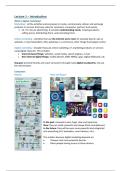
Lecture 1 – Introduction
What is digital marketing?
Marketing = all the activities and processes to create, communicate, deliver and exchange
products or services that have value for customers, companies, partners and society.
So, it’s not just advertising. It includes understanding needs, creating products,
setting prices, distributing them, and promoting them.
Online marketing = activities that use the internet and e-mail, for example banner ads on
websites, e-mail newsletters, SEO, webshops / e-commerce, other things that happen online.
Digital marketing = broader than just online marketing, it’s marketing products or services
using digital channels. This includes:
• Internet-based things: websites, social media, search engines, e-mail
• Non-internet digital things: mobile phones (SMS, MMS), apps, digital billboards, etc.
Key goal: promote brands and reach consumers through many digital touchpoints, not just
the web browser.
Computers
History Now and future
In the past: computers were huge, slow and expensive.
Now: they are small, powerful and cheap (think smartphones).
In the future: they will be even more powerful and integrated
into everything (IoT, wearables, smart devices, etc.).
This matters because digital marketing depends on:
• Cheaper and more powerful devices
• More people having access to these devices
,Moore’s Law
Moore’s Law = the number of transistors in a dense integrated circuit doubles approximately
every two years. In other words, computer chips become twice as powerful (or cheap)
roughly every two years.
This pattern also appears in other digital technologies: microprocessor power and price,
memory capacity (RAM, hard disks, SSDs), sensors (e.g. cameras in phones), and number and
size of pixels in digital cameras
Result is that digital possibilities grow exponentially, not in a straight line.
• What was impossible 10-20 years ago (streaming HD video on phones, real-time AI) is
normal today.
• This explains why digital marketing tools and analytics have become so powerful.
Storage different media
• 8 inch floppy disk: introduced in 1971, first storage 80KB, in 1979 reached 500KB
• 5 ¼ inch floppy disk: introduced in 1976, first storage ~100KB, eventually reaching
1.2MB
• 3 ½ inch floppy disk: introduced in 1980, first storage ~400KB, later 1.4MB
• CD: introduced in 1982, storage ~650-700MB
• DVD: introduced in 1995, 4.7GB (1 layer), -~8.7GB (2 layer) (also doubled sided)
• Blu-ray: introduced in 2006, storage 25GB (1 layer) –128GB (4 layer XL)
Moving a 5MB IBM hard drive in 1956
,Costs of storage decrease exponentially:
Similar exponential development AI
There’s also a parallel with AI, which is also improving very quickly (better models, more
data, more computing power). This exponential growth allows:
• Better personalization
• Better predictions
• More advanced digital marketing tools (recommendation systems, chatbots, etc.)
Cheap storage + fast computation + strong AI = perfect conditions for data-driven
digital marketing.
History of the internet
YOUTUBE VIDEO
Internet started as a small academic/military network. It grew into a global network
connecting billions of people.
Internet penetration
• High penetration in the developed world: most people in rich countries are online.
• The rest of the world is catching up quickly: rapid increase in internet access in
developing countries.
In developing countries, they may skip steps (for example, go straight to mobile
internet without ever having fixed landlines).
This is linked to the law of the handicap of a head start = those who start later can
sometimes adopt the newest technology faster, without old systems slowing them
down.
, High internet penetration: High penetration in the developed world:
Internet speed increases exponentially:
This results in a rapid increase in internet traffic:
What is digital marketing?
Marketing = all the activities and processes to create, communicate, deliver and exchange
products or services that have value for customers, companies, partners and society.
So, it’s not just advertising. It includes understanding needs, creating products,
setting prices, distributing them, and promoting them.
Online marketing = activities that use the internet and e-mail, for example banner ads on
websites, e-mail newsletters, SEO, webshops / e-commerce, other things that happen online.
Digital marketing = broader than just online marketing, it’s marketing products or services
using digital channels. This includes:
• Internet-based things: websites, social media, search engines, e-mail
• Non-internet digital things: mobile phones (SMS, MMS), apps, digital billboards, etc.
Key goal: promote brands and reach consumers through many digital touchpoints, not just
the web browser.
Computers
History Now and future
In the past: computers were huge, slow and expensive.
Now: they are small, powerful and cheap (think smartphones).
In the future: they will be even more powerful and integrated
into everything (IoT, wearables, smart devices, etc.).
This matters because digital marketing depends on:
• Cheaper and more powerful devices
• More people having access to these devices
,Moore’s Law
Moore’s Law = the number of transistors in a dense integrated circuit doubles approximately
every two years. In other words, computer chips become twice as powerful (or cheap)
roughly every two years.
This pattern also appears in other digital technologies: microprocessor power and price,
memory capacity (RAM, hard disks, SSDs), sensors (e.g. cameras in phones), and number and
size of pixels in digital cameras
Result is that digital possibilities grow exponentially, not in a straight line.
• What was impossible 10-20 years ago (streaming HD video on phones, real-time AI) is
normal today.
• This explains why digital marketing tools and analytics have become so powerful.
Storage different media
• 8 inch floppy disk: introduced in 1971, first storage 80KB, in 1979 reached 500KB
• 5 ¼ inch floppy disk: introduced in 1976, first storage ~100KB, eventually reaching
1.2MB
• 3 ½ inch floppy disk: introduced in 1980, first storage ~400KB, later 1.4MB
• CD: introduced in 1982, storage ~650-700MB
• DVD: introduced in 1995, 4.7GB (1 layer), -~8.7GB (2 layer) (also doubled sided)
• Blu-ray: introduced in 2006, storage 25GB (1 layer) –128GB (4 layer XL)
Moving a 5MB IBM hard drive in 1956
,Costs of storage decrease exponentially:
Similar exponential development AI
There’s also a parallel with AI, which is also improving very quickly (better models, more
data, more computing power). This exponential growth allows:
• Better personalization
• Better predictions
• More advanced digital marketing tools (recommendation systems, chatbots, etc.)
Cheap storage + fast computation + strong AI = perfect conditions for data-driven
digital marketing.
History of the internet
YOUTUBE VIDEO
Internet started as a small academic/military network. It grew into a global network
connecting billions of people.
Internet penetration
• High penetration in the developed world: most people in rich countries are online.
• The rest of the world is catching up quickly: rapid increase in internet access in
developing countries.
In developing countries, they may skip steps (for example, go straight to mobile
internet without ever having fixed landlines).
This is linked to the law of the handicap of a head start = those who start later can
sometimes adopt the newest technology faster, without old systems slowing them
down.
, High internet penetration: High penetration in the developed world:
Internet speed increases exponentially:
This results in a rapid increase in internet traffic: