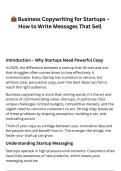
💼 Business Copywriting for Startups –
How to Write Messages That Sell
Introduction – Why Startups Need Powerful Copy
In 2025, the difference between a startup that thrives and one
that struggles often comes down to how effectively it
communicates. Every startup has a product or service, but
without clear, persuasive copy, even the best ideas can fail to
reach the right audience.
Business copywriting is more than writing words; it’s the art and
science of communicating value. Startups, in particular, face
unique challenges: limited budgets, competitive markets, and the
urgent need to convince customers to act. Strong copy solves all
of these problems by shaping perception, building trust, and
motivating action.
Think of your copy as a bridge between your innovative idea and
the people who will benefit from it. The stronger the bridge, the
faster your startup can grow.
Understanding Startup Messaging
Startups operate in high-pressure environments. Customers often
have little awareness of new products, which means your
messaging must be:
, Clear: Your audience should instantly understand what you
offer.
Compelling: Your copy must grab attention and spark curiosity.
Credible: Testimonials, data, or proof points build trust quickly.
A simple example: instead of writing “We have a new budgeting
app,” a startup could say:
“Save $200 a month effortlessly. Meet the budgeting app that
helps you take control of your finances — in just 5 minutes a day.”
This statement communicates value, explains the benefit, and
encourages immediate action — all in one sentence.
Core Principles of Business Copywriting for Startups
1. Focus on Benefits, Not Features
Customers care less about what your product does and more
about how it changes their lives. Features describe; benefits
persuade. For example:
Feature: “Our app tracks your expenses.”
Benefit: “Know exactly where your money goes and save
effortlessly every month.”
Benefits create emotional resonance. Emotion drives decisions,
which is why highlighting outcomes is more persuasive than
listing features.
2. Use Simple, Conversational Language
Startups often fall into the trap of industry jargon. Complex terms
confuse readers and slow engagement. Conversational copy, on
the other hand, reads naturally and builds rapport. Imagine
explaining your product to a friend — that’s your tone.
3. Include a Strong Call-to-Action (CTA)
How to Write Messages That Sell
Introduction – Why Startups Need Powerful Copy
In 2025, the difference between a startup that thrives and one
that struggles often comes down to how effectively it
communicates. Every startup has a product or service, but
without clear, persuasive copy, even the best ideas can fail to
reach the right audience.
Business copywriting is more than writing words; it’s the art and
science of communicating value. Startups, in particular, face
unique challenges: limited budgets, competitive markets, and the
urgent need to convince customers to act. Strong copy solves all
of these problems by shaping perception, building trust, and
motivating action.
Think of your copy as a bridge between your innovative idea and
the people who will benefit from it. The stronger the bridge, the
faster your startup can grow.
Understanding Startup Messaging
Startups operate in high-pressure environments. Customers often
have little awareness of new products, which means your
messaging must be:
, Clear: Your audience should instantly understand what you
offer.
Compelling: Your copy must grab attention and spark curiosity.
Credible: Testimonials, data, or proof points build trust quickly.
A simple example: instead of writing “We have a new budgeting
app,” a startup could say:
“Save $200 a month effortlessly. Meet the budgeting app that
helps you take control of your finances — in just 5 minutes a day.”
This statement communicates value, explains the benefit, and
encourages immediate action — all in one sentence.
Core Principles of Business Copywriting for Startups
1. Focus on Benefits, Not Features
Customers care less about what your product does and more
about how it changes their lives. Features describe; benefits
persuade. For example:
Feature: “Our app tracks your expenses.”
Benefit: “Know exactly where your money goes and save
effortlessly every month.”
Benefits create emotional resonance. Emotion drives decisions,
which is why highlighting outcomes is more persuasive than
listing features.
2. Use Simple, Conversational Language
Startups often fall into the trap of industry jargon. Complex terms
confuse readers and slow engagement. Conversational copy, on
the other hand, reads naturally and builds rapport. Imagine
explaining your product to a friend — that’s your tone.
3. Include a Strong Call-to-Action (CTA)