

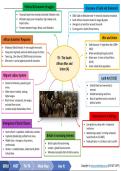
Political & Economic Struggles Discovery of Gold and Diamonds
• Transvaal taxed mines heavily but denied Uitlanders vote. • 1886: Gold on Witwatersrand → mineral & industrial revolution.
• Uitlanders angry over monopolies, high railway costs, • South Africans moved to towns for wages & goods.
import duties. • Immigrants arrived from around the world.
• Tensions between Kruger, Britain, and Uitlanders. • Turning point in South African history.
African Societies’ Response War and Union
• Gold discovery → Anglo-Boer War (1899–
• Rinderpest killed livestock → men sought mine work. 1902).
• Young men migrated; women & elderly stayed on farms. • Britain wanted gold supply control.
• Taxes (e.g., Glen Grey Act 1894) forced cash income. •
T6: The South Britain won → Union of South Africa
• Mine work = survival against poverty & starvation. (1910).
• African War and
• Union united white population.
Union (A) •
Migrant Labour System
Land Act (1913)
• Started in Kimberley, spread to gold
• Limited black land ownership to
mines.
reserves.
• White miners: families, training,
• Divided land along racial lines.
higher wages.
• Basis of apartheid social, economic &
• Black miners: compounds, low wages,
political system.
excluded from unions.
• Created racially divided labour force.
Development of Mining
Emergence of Social Classes • Low-grade ore, deep reefs → expensive
machinery.
• Rush to Rand → capitalists, middle class, workers. • Needed large capital → mining companies
• Capitalists (Randlords) profited from mines. Britain’s Increasing Interest raised funds on JSE (1887).
• Middle class = managers, shop owners, • Fixed gold price → cut labour costs to profit.
professionals. • British capital financed mining.
• Workers = unskilled labour, skilled mainly British • London = global financial centre.
& Australian. • Witwatersrand gold vital to British economy.
•
GR10 HIST T4-T6 Mind Map Ace It Copyright © www.summariessa.co.za (DO NOT COPY)
,
• Transvaal taxed mines heavily but denied Uitlanders vote. • 1886: Gold on Witwatersrand → mineral & industrial revolution.
• Uitlanders angry over monopolies, high railway costs, • South Africans moved to towns for wages & goods.
import duties. • Immigrants arrived from around the world.
• Tensions between Kruger, Britain, and Uitlanders. • Turning point in South African history.
African Societies’ Response War and Union
• Gold discovery → Anglo-Boer War (1899–
• Rinderpest killed livestock → men sought mine work. 1902).
• Young men migrated; women & elderly stayed on farms. • Britain wanted gold supply control.
• Taxes (e.g., Glen Grey Act 1894) forced cash income. •
T6: The South Britain won → Union of South Africa
• Mine work = survival against poverty & starvation. (1910).
• African War and
• Union united white population.
Union (A) •
Migrant Labour System
Land Act (1913)
• Started in Kimberley, spread to gold
• Limited black land ownership to
mines.
reserves.
• White miners: families, training,
• Divided land along racial lines.
higher wages.
• Basis of apartheid social, economic &
• Black miners: compounds, low wages,
political system.
excluded from unions.
• Created racially divided labour force.
Development of Mining
Emergence of Social Classes • Low-grade ore, deep reefs → expensive
machinery.
• Rush to Rand → capitalists, middle class, workers. • Needed large capital → mining companies
• Capitalists (Randlords) profited from mines. Britain’s Increasing Interest raised funds on JSE (1887).
• Middle class = managers, shop owners, • Fixed gold price → cut labour costs to profit.
professionals. • British capital financed mining.
• Workers = unskilled labour, skilled mainly British • London = global financial centre.
& Australian. • Witwatersrand gold vital to British economy.
•
GR10 HIST T4-T6 Mind Map Ace It Copyright © www.summariessa.co.za (DO NOT COPY)
,


