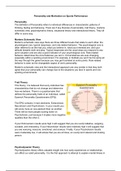
Personality and Motivation on Sports Performance
Personality
The definition of Personality refers to individual differences in characteristic patterns of
thinking, feeling and behaving. There are 5 key theories of personality, trait theory, martens
schematic view, psychodynamic theory, situational theory and interactional theory. They all
differ in some way.
Martens Schematic View
Marten's schematic view says there are three different levels that relate to each other: the
physiological core, typical responses, and role-related behavior. The psychological core is
often referred to as the real you: what you believe in, what your interests are, and your
attitude towards work and play. Typical responses are the usual ways you respond to any
given situation and are also a good indicator of your psychological core. Role-related
behavior determines the circumstances you are in. Circumstances are ever-changing,
especially within a sporting environment. For example, in football you won't be the same all
the way through the game because you may get frustrated at some points. Role-related
behavior is seen as the changeable aspect of one's personality.
Marten's schematic view and the interactional approach are very similar in that they both
agree that your personality can change due to the situations you face in sports and non-
sporting environments
Trait Theory
This theory, it is believed that every individual has
characteristics that do not change and determine
how we behave. There is a questionnaire that
defines the personality traits of an individual, called
Eysenck Personality Questionnaire (EPQ).
The EPQ contains 3 main elements, Extraversion,
Neuroticism and Psychoticism. In your results you
will score more on one element than on another.
There will be more people scoring lower on
Psychoticism, just because it implies more negative
qualities than the other 2.
If your Extroversion results were high it will suggest that you are overly talkative, outgoing,
sociable, and interacting. If your Neuroticism results were relatively high it will suggest that
you are worrying, insecure, emotional, and anxious. Finally, if your Psychoticism results
were moderately low, it will advise that you are at times, an overly kind natured and trusting
person.
Psychodynamic Theory
Psychodynamic theory offers valuable insight into how early experiences or relationships
can affect our adult personality. It is the first approach to attempt to explain mental illness in
, psychological terms and has had enormous influence on the understanding and treatment of
mental illness. It takes both nature and nurture into account which is a strength because it
emphasizes the importance of both. The psychodynamic theory focuses on the effects that
early childhood can have on the developing personality.
Situational Theory
This theory proposes that a person's behaviour depends on situations that they find
themselves in. For example a footballer might be able to score a penalty at training against a
goalkeeper every time, but when he must take one in front of a stadium filled with 50,000
fans he might miss. This comes to the circumstances that they found themselves in at the
time. Their behaviour has changed as they felt more pressure from how important the
penalty is and how many people are watching the match.
Interactional Theory
This theory predicts behaviour in sport. You must consider the environment and the athletes
behaviour. Your psychological traits and environmental influences interact and combine in
unique ways to shape your behaviour. For example, a footballer known for keeping a low
profile in the media to become anxious and angry when a decision is made against him.
There are two different types of personality, known as A and B.
Type A
People with this type of personality are less patient as they tend to try and aim for high goals
and always give the best, they are quite competitive people that hate to lose. They always
want to finish activities as quickly as they can. They are more prone to stress, although they
are quite resistant to pressure and will happily multitask if they are under pressure, however
they are more anxious people than Type B people.
Type B
Type B people tend to be much more calm and tolerant towards other people. They also
usually reflect more. These people are less prone to stress and anxiety and manage to stay
calm. They have more imagination and creativity than Type A personality.
Effects on Sports
Athletes v Non athletes
Athletes would be more concerned about their performance than non athletes. This is
because they would remind themselves of the moments when they struggled and worked
very hard to reach their full potential in their career. Therefore, they could feel pressure and
stress, as they need to perform well on the big day when they are given a chance. An
example for this, could be a footballer playing in the Champions League Final. People could
argue that they have so much experience that their personality is less prone to stress and
pressure, which means that they might treat it like a normal competton.
Non athletes would tend to be calm, as they would treat a sporting event as something to do
for fun. They wouldn’t think about it too much, because they didn’t train for this event for a
long time and didn’t show passion towards it unlike most professional athletes. Non athletes
could feel a lot of pressure if they are contributing in a big event because of inexperience
Personality
The definition of Personality refers to individual differences in characteristic patterns of
thinking, feeling and behaving. There are 5 key theories of personality, trait theory, martens
schematic view, psychodynamic theory, situational theory and interactional theory. They all
differ in some way.
Martens Schematic View
Marten's schematic view says there are three different levels that relate to each other: the
physiological core, typical responses, and role-related behavior. The psychological core is
often referred to as the real you: what you believe in, what your interests are, and your
attitude towards work and play. Typical responses are the usual ways you respond to any
given situation and are also a good indicator of your psychological core. Role-related
behavior determines the circumstances you are in. Circumstances are ever-changing,
especially within a sporting environment. For example, in football you won't be the same all
the way through the game because you may get frustrated at some points. Role-related
behavior is seen as the changeable aspect of one's personality.
Marten's schematic view and the interactional approach are very similar in that they both
agree that your personality can change due to the situations you face in sports and non-
sporting environments
Trait Theory
This theory, it is believed that every individual has
characteristics that do not change and determine
how we behave. There is a questionnaire that
defines the personality traits of an individual, called
Eysenck Personality Questionnaire (EPQ).
The EPQ contains 3 main elements, Extraversion,
Neuroticism and Psychoticism. In your results you
will score more on one element than on another.
There will be more people scoring lower on
Psychoticism, just because it implies more negative
qualities than the other 2.
If your Extroversion results were high it will suggest that you are overly talkative, outgoing,
sociable, and interacting. If your Neuroticism results were relatively high it will suggest that
you are worrying, insecure, emotional, and anxious. Finally, if your Psychoticism results
were moderately low, it will advise that you are at times, an overly kind natured and trusting
person.
Psychodynamic Theory
Psychodynamic theory offers valuable insight into how early experiences or relationships
can affect our adult personality. It is the first approach to attempt to explain mental illness in
, psychological terms and has had enormous influence on the understanding and treatment of
mental illness. It takes both nature and nurture into account which is a strength because it
emphasizes the importance of both. The psychodynamic theory focuses on the effects that
early childhood can have on the developing personality.
Situational Theory
This theory proposes that a person's behaviour depends on situations that they find
themselves in. For example a footballer might be able to score a penalty at training against a
goalkeeper every time, but when he must take one in front of a stadium filled with 50,000
fans he might miss. This comes to the circumstances that they found themselves in at the
time. Their behaviour has changed as they felt more pressure from how important the
penalty is and how many people are watching the match.
Interactional Theory
This theory predicts behaviour in sport. You must consider the environment and the athletes
behaviour. Your psychological traits and environmental influences interact and combine in
unique ways to shape your behaviour. For example, a footballer known for keeping a low
profile in the media to become anxious and angry when a decision is made against him.
There are two different types of personality, known as A and B.
Type A
People with this type of personality are less patient as they tend to try and aim for high goals
and always give the best, they are quite competitive people that hate to lose. They always
want to finish activities as quickly as they can. They are more prone to stress, although they
are quite resistant to pressure and will happily multitask if they are under pressure, however
they are more anxious people than Type B people.
Type B
Type B people tend to be much more calm and tolerant towards other people. They also
usually reflect more. These people are less prone to stress and anxiety and manage to stay
calm. They have more imagination and creativity than Type A personality.
Effects on Sports
Athletes v Non athletes
Athletes would be more concerned about their performance than non athletes. This is
because they would remind themselves of the moments when they struggled and worked
very hard to reach their full potential in their career. Therefore, they could feel pressure and
stress, as they need to perform well on the big day when they are given a chance. An
example for this, could be a footballer playing in the Champions League Final. People could
argue that they have so much experience that their personality is less prone to stress and
pressure, which means that they might treat it like a normal competton.
Non athletes would tend to be calm, as they would treat a sporting event as something to do
for fun. They wouldn’t think about it too much, because they didn’t train for this event for a
long time and didn’t show passion towards it unlike most professional athletes. Non athletes
could feel a lot of pressure if they are contributing in a big event because of inexperience