1
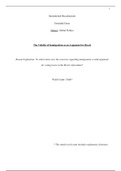
International Baccalaureate
Extended Essay
Subject: Global Politics
The Validity of Immigration as an Argument for Brexit
Research Question: To what extent were the concerns regarding immigration a valid argument
for voting Leave in the Brexit referendum?
Word Count: 3,844*
* The stated word count includes explanatory footnotes.
, 2
Table of Contents
Title Page ……………………………………………………………………………………….... 1
Contents ……………………………………………………………………………………….…. 2
Introduction ......………………………………………..………………………………………… 3
Methodology .……………………………………………………………………………………. 4
Main Body
I. Wages and employment in the labour market …..…………………………………… 5
II. Contributions to the welfare state and the fiscal system …..………………………… 8
III. Exclusivity of national and cultural identities ……………………….…….……..…. 11
Conclusion ………………………………….………………....…………………………...…… 14
Bibliography …………………………..…………………….……………………………….…. 16
Appendices ………..………………………………………………….………….……………... 22
, 3
Introduction
On June 23, 2016, the United Kingdom held a nationwide referendum in which citizens
across England, Scotland, Wales and Northern Ireland voted in response to the following
question: “Should the United Kingdom remain a member of the European Union or leave the
European Union?” (Zaken, 2019) More than 30 million votes were cast, resulting in a
referendum turnout of 72.2%. Leave won by 51.9% to 48.1% (Wheeler, Seddon, & Morris,
2019), with almost 17.5 million people voting to exit the EU (Casciani, 2018). A portmanteau of
“Britain” and “exit”, “Brexit” refers to Britain’s split from the EU, changing its economic and
political relationship to the bloc on trade, security and migration (Mueller, 2019). Although the
UK’s entry into the EU (formerly known as the European Economic Community) in 1973 had
initially been controversial, a referendum held in 1975 showed a 67% vote to Remain, indicating
a stable UK-EU relationship (Wilson, 2014). In 41 years, what had caused the turning point in
British attitudes towards EU integration?
The fundamental nature of the European Union has been subject to substantial discussion
in the Brexit debate. The EU is an economic and political union of 28 countries in Europe which
contains four freedoms that govern the free movement of goods, persons, services and capital
within its countries. Brexit has reignited the discussion surrounding the free movement of people
– the opportunity for EU citizens to live and work in any EU country (Brinke, 2017). In the
Brexit debate, the Leave campaign argued that Brexit entails tighter border control over EU
immigration to the UK. Immigration statistics show that between 1995 and 2015, the number of
EU immigrants in the UK tripled from 0.9 million to 3.3 million, increasing their share from
1.5% to 5.3% of the total population (Wadsworth, Dhingra, Ottaviano, & Reenen, 2016). As a
International Baccalaureate
Extended Essay
Subject: Global Politics
The Validity of Immigration as an Argument for Brexit
Research Question: To what extent were the concerns regarding immigration a valid argument
for voting Leave in the Brexit referendum?
Word Count: 3,844*
* The stated word count includes explanatory footnotes.
, 2
Table of Contents
Title Page ……………………………………………………………………………………….... 1
Contents ……………………………………………………………………………………….…. 2
Introduction ......………………………………………..………………………………………… 3
Methodology .……………………………………………………………………………………. 4
Main Body
I. Wages and employment in the labour market …..…………………………………… 5
II. Contributions to the welfare state and the fiscal system …..………………………… 8
III. Exclusivity of national and cultural identities ……………………….…….……..…. 11
Conclusion ………………………………….………………....…………………………...…… 14
Bibliography …………………………..…………………….……………………………….…. 16
Appendices ………..………………………………………………….………….……………... 22
, 3
Introduction
On June 23, 2016, the United Kingdom held a nationwide referendum in which citizens
across England, Scotland, Wales and Northern Ireland voted in response to the following
question: “Should the United Kingdom remain a member of the European Union or leave the
European Union?” (Zaken, 2019) More than 30 million votes were cast, resulting in a
referendum turnout of 72.2%. Leave won by 51.9% to 48.1% (Wheeler, Seddon, & Morris,
2019), with almost 17.5 million people voting to exit the EU (Casciani, 2018). A portmanteau of
“Britain” and “exit”, “Brexit” refers to Britain’s split from the EU, changing its economic and
political relationship to the bloc on trade, security and migration (Mueller, 2019). Although the
UK’s entry into the EU (formerly known as the European Economic Community) in 1973 had
initially been controversial, a referendum held in 1975 showed a 67% vote to Remain, indicating
a stable UK-EU relationship (Wilson, 2014). In 41 years, what had caused the turning point in
British attitudes towards EU integration?
The fundamental nature of the European Union has been subject to substantial discussion
in the Brexit debate. The EU is an economic and political union of 28 countries in Europe which
contains four freedoms that govern the free movement of goods, persons, services and capital
within its countries. Brexit has reignited the discussion surrounding the free movement of people
– the opportunity for EU citizens to live and work in any EU country (Brinke, 2017). In the
Brexit debate, the Leave campaign argued that Brexit entails tighter border control over EU
immigration to the UK. Immigration statistics show that between 1995 and 2015, the number of
EU immigrants in the UK tripled from 0.9 million to 3.3 million, increasing their share from
1.5% to 5.3% of the total population (Wadsworth, Dhingra, Ottaviano, & Reenen, 2016). As a