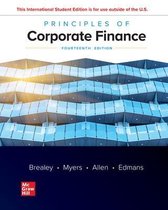
SOLUTION MANUAL FOR PRINCIPLES OF CORPORATE FINANCE 14TH EDITION BY RICHARD BREALEY, STEWART MYERS SOLUTION MANUAL FOR PRINCIPLES OF
CORPORATE FINANCE 14TH EDITION BY RICHARD BREALEY, STEWART MYERS
SOLUTION MANUAL FOR PRINCIPLES OF CORPORATE FINANCE 14TH
EDITION BY RICHARD BREALEY, STEWART MYERS, ALL CHAPTERS (1 - 34
COVERED 100% GUARANTEED SUCCESS.
,SOLUTION MANUAL FOR PRINCIPLES OF CORPORATE FINANCE 14TH EDITION BY RICHARD BREALEY, STEWART MYERS SOLUTION MANUAL FOR PRINCIPLES OF
CORPORATE FINANCE 14TH EDITION BY RICHARD BREALEY, STEWART MYERS
TABLE OF CONTENTSD D
Chapter 1: Introduction to Corporate Finance
Chapter 2: How to Calculate Present Values
Chapter 3: Valuing Bonds
Chapter 4: Valuing Stocks
Chapter 5: Net Present Value and Other Investment Criteria
Chapter 6: Making Investment Decisions with the Net Present Value Rule
Chapter 7: Introduction to Risk, Diversification, and Portfolio Selection
Chapter 8: The Capital Asset Pricing Model
Chapter 9: Risk and the Cost of Capital
Chapter 10: Project Analysis
Chapter 11: How to Ensure That Projects Truly Have PositiveNPVs
Chapter 12: Efficient Markets and Behavioral Finance
Chapter 13: An Overview of Corporate Financing
Chapter 14: How Corporations Issue Securities
Chapter 15: Payout Policy
Chapter 16: Does Debt Policy Matter?
Chapter 17: How Much Should a Corporation Borrow?
Chapter 18: Financing and Valuation
Chapter 19: Agency Problems and Corporate Governance
Chapter 20: Stakeholder Capitalism and Responsible Business
Chapter 21: Understanding Options
Chapter 22: Valuing Options
Chapter 23: Real Options
Chapter 24: Credit Risk and the Value of Corporate Debt
Chapter 25: The Many Different Kinds of Debt
Chapter 26: Leasing
Chapter 27: Managing Risk
Chapter 28: International Financial Management
Chapter 29: Financial Analysis
Chapter 30: Financial Planning
Chapter 31: Working Capital Management
Chapter 32: Mergers
Chapter 33: Corporate Restructuring
Chapter 34: Conclusion: What We Do and Do Not Know about Finance
,SOLUTION MANUAL FOR PRINCIPLES OF CORPORATE FINANCE 14TH EDITION BY RICHARD BREALEY, STEWART MYERS SOLUTION MANUAL FOR PRINCIPLES OF
CORPORATE FINANCE 14TH EDITION BY RICHARD BREALEY, STEWART MYERS
CHAPTER 1
Introduction to Corporate Finance
The values shown in the solutions may be rounded forDdisplayDpurposes. However, the answers were
derived using a spreadsheet without any intermediate rounding.
Answers to Problem Sets
1. a. real
b. executive airplanes
c. brand names
d. financial
e. bonds
*f. investment or capital expenditure
*g. capital budgeting or investment
h. financing
*Note that f and g are interchangeable in the question.
Est time: 01-05
2. A trademark, a factory, undeveloped land, and your work force (c, d, e, and g) are all real a
ssets. Real assets are identifiable as items with intrinsic value. The others in the list are fina
ncial assets, that is, these assets derive value because of a contractual claim.
Est time: 01-05
3. a.
Financial assets, such as stocks or bank loans, are claims held by investors.
Corporations sell financial assets to raise the cash to invest in real assets such a
s plant and equipment. Some real assets are intangible.
b. Capital expenditure means investment in real assets. Financing means raising the
cash for this investment.
, SOLUTION MANUAL FOR PRINCIPLES OF CORPORATE FINANCE 14TH EDITION BY RICHARD BREALEY, STEWART MYERS SOLUTION MANUAL FOR PRINCIPLES OF
CORPORATE FINANCE 14TH EDITION BY RICHARD BREALEY, STEWART MYERS
c. The shares ofDpublic corporations are traded on stock exchanges and can be purch
ased by a wide range of investors. The shares of closely held corporations are not
publicly traded and are held by a small group of private investors.
d. Unlimited liability: Investors are responsible for all the firm‘s debts. ADsole proprieto
r has unlimited liability. Investors in corporations have limited liability. They can lose
their investment, but no more.
Est time: 01-05
4. Items c and d apply to corporations. Because corporations have perpetual life, ownership ca
n be transferred without affecting operations, and managers can be fired with no effect on o
wnership. Other forms of business may have unlimited liability and limited life.
Est time: 01-05
5. Separation of ownership facilitates the key attributes of a corporation, including limited liabilit
y for investors, transferability of ownership, a separate legal personality of the corporation, a
nd delegated centralized management. These four attributes provide substantial benefit for i
nvestors, including the ability to diversify their investment among many uncorrelated returns
—
a very valuable tool explored in later chapters. Also, these attributes allow investors to quick
ly exit, enter, or short sell an investment, thereby generating an active liquid market for corp
orations.
However, these positive aspects also introduce substantial negative externalities as well. Th
e separation of ownership from management typically leads to agency problems, where man
agers prefer to consume private perks or make other decisions for their private benefit—
rather than maximize shareholder wealth. Shareholders tend to exercise less oversight of ea
ch individual investment as their diversification increases. Finally, the corporation‘s separate l
egal personality makes it difficult to enforce accountability if they externalize costs onto socie
ty.
Est time: 01-05
6. Shareholders will only vote to maximize shareholder wealth. Shareholders can modify th
eir pattern of consumption through borrowing and lending, match risk preferences, and h
opefully balance their own checkbooks (or hire a qualified professional to help them with
these tasks).
Est time: 01-05
7. If the investment increases the firm‘s wealth, it increases the firm‘s share value. Ms. Espi
noza could then sell some or all these more valuable shares to provide for her retirement
income.
Est time: 01-05
8. a.
Assuming that the encabulator market is risky, an 8% expected
return on the F&H encabulator investments may be inferior to a 4%
return on U.S.
government securities, depending on the relative risk between the two assets.
CORPORATE FINANCE 14TH EDITION BY RICHARD BREALEY, STEWART MYERS
SOLUTION MANUAL FOR PRINCIPLES OF CORPORATE FINANCE 14TH
EDITION BY RICHARD BREALEY, STEWART MYERS, ALL CHAPTERS (1 - 34
COVERED 100% GUARANTEED SUCCESS.
,SOLUTION MANUAL FOR PRINCIPLES OF CORPORATE FINANCE 14TH EDITION BY RICHARD BREALEY, STEWART MYERS SOLUTION MANUAL FOR PRINCIPLES OF
CORPORATE FINANCE 14TH EDITION BY RICHARD BREALEY, STEWART MYERS
TABLE OF CONTENTSD D
Chapter 1: Introduction to Corporate Finance
Chapter 2: How to Calculate Present Values
Chapter 3: Valuing Bonds
Chapter 4: Valuing Stocks
Chapter 5: Net Present Value and Other Investment Criteria
Chapter 6: Making Investment Decisions with the Net Present Value Rule
Chapter 7: Introduction to Risk, Diversification, and Portfolio Selection
Chapter 8: The Capital Asset Pricing Model
Chapter 9: Risk and the Cost of Capital
Chapter 10: Project Analysis
Chapter 11: How to Ensure That Projects Truly Have PositiveNPVs
Chapter 12: Efficient Markets and Behavioral Finance
Chapter 13: An Overview of Corporate Financing
Chapter 14: How Corporations Issue Securities
Chapter 15: Payout Policy
Chapter 16: Does Debt Policy Matter?
Chapter 17: How Much Should a Corporation Borrow?
Chapter 18: Financing and Valuation
Chapter 19: Agency Problems and Corporate Governance
Chapter 20: Stakeholder Capitalism and Responsible Business
Chapter 21: Understanding Options
Chapter 22: Valuing Options
Chapter 23: Real Options
Chapter 24: Credit Risk and the Value of Corporate Debt
Chapter 25: The Many Different Kinds of Debt
Chapter 26: Leasing
Chapter 27: Managing Risk
Chapter 28: International Financial Management
Chapter 29: Financial Analysis
Chapter 30: Financial Planning
Chapter 31: Working Capital Management
Chapter 32: Mergers
Chapter 33: Corporate Restructuring
Chapter 34: Conclusion: What We Do and Do Not Know about Finance
,SOLUTION MANUAL FOR PRINCIPLES OF CORPORATE FINANCE 14TH EDITION BY RICHARD BREALEY, STEWART MYERS SOLUTION MANUAL FOR PRINCIPLES OF
CORPORATE FINANCE 14TH EDITION BY RICHARD BREALEY, STEWART MYERS
CHAPTER 1
Introduction to Corporate Finance
The values shown in the solutions may be rounded forDdisplayDpurposes. However, the answers were
derived using a spreadsheet without any intermediate rounding.
Answers to Problem Sets
1. a. real
b. executive airplanes
c. brand names
d. financial
e. bonds
*f. investment or capital expenditure
*g. capital budgeting or investment
h. financing
*Note that f and g are interchangeable in the question.
Est time: 01-05
2. A trademark, a factory, undeveloped land, and your work force (c, d, e, and g) are all real a
ssets. Real assets are identifiable as items with intrinsic value. The others in the list are fina
ncial assets, that is, these assets derive value because of a contractual claim.
Est time: 01-05
3. a.
Financial assets, such as stocks or bank loans, are claims held by investors.
Corporations sell financial assets to raise the cash to invest in real assets such a
s plant and equipment. Some real assets are intangible.
b. Capital expenditure means investment in real assets. Financing means raising the
cash for this investment.
, SOLUTION MANUAL FOR PRINCIPLES OF CORPORATE FINANCE 14TH EDITION BY RICHARD BREALEY, STEWART MYERS SOLUTION MANUAL FOR PRINCIPLES OF
CORPORATE FINANCE 14TH EDITION BY RICHARD BREALEY, STEWART MYERS
c. The shares ofDpublic corporations are traded on stock exchanges and can be purch
ased by a wide range of investors. The shares of closely held corporations are not
publicly traded and are held by a small group of private investors.
d. Unlimited liability: Investors are responsible for all the firm‘s debts. ADsole proprieto
r has unlimited liability. Investors in corporations have limited liability. They can lose
their investment, but no more.
Est time: 01-05
4. Items c and d apply to corporations. Because corporations have perpetual life, ownership ca
n be transferred without affecting operations, and managers can be fired with no effect on o
wnership. Other forms of business may have unlimited liability and limited life.
Est time: 01-05
5. Separation of ownership facilitates the key attributes of a corporation, including limited liabilit
y for investors, transferability of ownership, a separate legal personality of the corporation, a
nd delegated centralized management. These four attributes provide substantial benefit for i
nvestors, including the ability to diversify their investment among many uncorrelated returns
—
a very valuable tool explored in later chapters. Also, these attributes allow investors to quick
ly exit, enter, or short sell an investment, thereby generating an active liquid market for corp
orations.
However, these positive aspects also introduce substantial negative externalities as well. Th
e separation of ownership from management typically leads to agency problems, where man
agers prefer to consume private perks or make other decisions for their private benefit—
rather than maximize shareholder wealth. Shareholders tend to exercise less oversight of ea
ch individual investment as their diversification increases. Finally, the corporation‘s separate l
egal personality makes it difficult to enforce accountability if they externalize costs onto socie
ty.
Est time: 01-05
6. Shareholders will only vote to maximize shareholder wealth. Shareholders can modify th
eir pattern of consumption through borrowing and lending, match risk preferences, and h
opefully balance their own checkbooks (or hire a qualified professional to help them with
these tasks).
Est time: 01-05
7. If the investment increases the firm‘s wealth, it increases the firm‘s share value. Ms. Espi
noza could then sell some or all these more valuable shares to provide for her retirement
income.
Est time: 01-05
8. a.
Assuming that the encabulator market is risky, an 8% expected
return on the F&H encabulator investments may be inferior to a 4%
return on U.S.
government securities, depending on the relative risk between the two assets.