

Ward Ready Hub
Welcome to Ward Ready Hub– your complete hub for medical students' clinical learning.
This store offers structured, exam-focused content including OSCE guides, history taking templates, clinical condition summaries, and key revision notes. All resources are designed with clarity and efficiency in mind- perfect for mastering ward-based skills, passing OSCEs, and feeling confident in exams and on placement. Ideal for students preparing for clinical years, finals, or just looking to streamline their revision. New content added regularly- follow to stay updated!
- 19
- 0
- 7
Community
- Followers
- Following
26 items
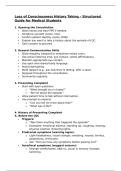
Loss of Consciousness History Taking Guide for Medical Students
This document is a structured guide designed for medical students to take a comprehensive history from patients presenting with loss of consciousness. It includes key questions to identify underlying causes such as syncope, seizures, and cardiovascular conditions. The guide emphasises communication skills, symptom exploration, risk factors, and collateral history to aid clinical reasoning and OSCE preparation.
- Package deal
- Summary
- • 3 pages •
This document is a structured guide designed for medical students to take a comprehensive history from patients presenting with loss of consciousness. It includes key questions to identify underlying causes such as syncope, seizures, and cardiovascular conditions. The guide emphasises communication skills, symptom exploration, risk factors, and collateral history to aid clinical reasoning and OSCE preparation.
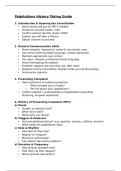
Palpitations History Taking Guide for Medical Students
This document is a structured guide designed for medical students to take a comprehensive history from patients presenting with palpitations. It includes key questions to identify underlying causes such as syncope, seizures, and cardiovascular conditions. The guide emphasises communication skills, symptom exploration, risk factors, and collateral history to aid clinical reasoning and OSCE preparation.
- Package deal
- Summary
- • 3 pages •
This document is a structured guide designed for medical students to take a comprehensive history from patients presenting with palpitations. It includes key questions to identify underlying causes such as syncope, seizures, and cardiovascular conditions. The guide emphasises communication skills, symptom exploration, risk factors, and collateral history to aid clinical reasoning and OSCE preparation.
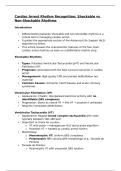
Cardiac Arrest Rhythm Recognition: Differentiating Shockable and Non-Shockable Rhythms for ALSACLS
This document provides a concise and structured overview of the four main cardiac arrest rhythms seen during advanced life support: ventricular fibrillation, pulseless ventricular tachycardia, pulseless electrical activity, and asystole. It explains how to identify these rhythms on a defibrillator rhythm strip, their clinical significance, and the appropriate management steps according to the ALS algorithm. It also highlights key priorities in cardiac arrest management, focusing on high-quality ...
- Package deal
- Summary
- • 3 pages •
This document provides a concise and structured overview of the four main cardiac arrest rhythms seen during advanced life support: ventricular fibrillation, pulseless ventricular tachycardia, pulseless electrical activity, and asystole. It explains how to identify these rhythms on a defibrillator rhythm strip, their clinical significance, and the appropriate management steps according to the ALS algorithm. It also highlights key priorities in cardiac arrest management, focusing on high-quality ...
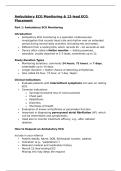
Comprehensive Guide to Ambulatory ECG Monitoring and 12-Lead ECG Placement for Medical Students
This document provides a detailed overview of ambulatory ECG monitoring, including clinical indications, study durations, how to request and fit the device, and patient management. It also covers the step-by-step process for performing a standard 12-lead ECG, including lead placement, patient preparation, and equipment setup, tailored for UK medical students.
- Package deal
- Summary
- • 3 pages •
This document provides a detailed overview of ambulatory ECG monitoring, including clinical indications, study durations, how to request and fit the device, and patient management. It also covers the step-by-step process for performing a standard 12-lead ECG, including lead placement, patient preparation, and equipment setup, tailored for UK medical students.
Cardiac Emergencies OSCE Bundle: Transcutaneous Pacing & DC Cardioversion
This bundle covers the essential theory and OSCE steps for Transcutaneous Pacing (TCP) and Direct Current Cardioversion (DCCV)—two high-yield emergency procedures. Includes indications, contraindications, equipment setup, pad positioning, sedation, energy settings, troubleshooting, and post-procedure steps. Ideal for final years, foundation doctors, and anyone revising for clinical skills stations or emergency assessments.
- Package deal
- Summary
- • 3 pages •
This bundle covers the essential theory and OSCE steps for Transcutaneous Pacing (TCP) and Direct Current Cardioversion (DCCV)—two high-yield emergency procedures. Includes indications, contraindications, equipment setup, pad positioning, sedation, energy settings, troubleshooting, and post-procedure steps. Ideal for final years, foundation doctors, and anyone revising for clinical skills stations or emergency assessments.
Ace Heart Murmurs – High-Yield Summary Pack for UK Med Students
High-yield heart murmurs summary pack for medical students. Covers key conditions, timing, location, radiation, clinical features, and exam tips. Perfect for OSCEs, written exams, and quick revision. Structured, easy-to-follow, and aligned with medical curriculum
- Package deal
- • 2 items •
High-yield heart murmurs summary pack for medical students. Covers key conditions, timing, location, radiation, clinical features, and exam tips. Perfect for OSCEs, written exams, and quick revision. Structured, easy-to-follow, and aligned with medical curriculum
Paediatric Heart Murmurs: Clinical Assessment and Differentiation for Medical Students
This structured guide provides a comprehensive overview of paediatric heart murmurs for UK medical students. It includes definitions, classifications, and clinical features of innocent vs pathological murmurs, with emphasis on common types such as Still’s murmur, pulmonary flow murmur, and venous hum. It outlines how to assess murmurs, when to refer, and how to differentiate using key features like the "Seven S's". Ideal for exam preparation and OSCEs.
- Package deal
- Summary
- • 3 pages •
This structured guide provides a comprehensive overview of paediatric heart murmurs for UK medical students. It includes definitions, classifications, and clinical features of innocent vs pathological murmurs, with emphasis on common types such as Still’s murmur, pulmonary flow murmur, and venous hum. It outlines how to assess murmurs, when to refer, and how to differentiate using key features like the "Seven S's". Ideal for exam preparation and OSCEs.
Heart Murmurs: Core Concepts for Clinical Practice
This concise clinical guide outlines the core principles of heart murmurs, including normal heart sounds, murmur timing, locations, radiation patterns, and response to manoeuvres. It features a high-yield summary table of key murmurs such as aortic stenosis, mitral regurgitation, and tricuspid regurgitation, with associated features and causes. Designed for medical students, this document is ideal for OSCE preparation and bedside learning.
- Package deal
- Summary
- • 3 pages •
This concise clinical guide outlines the core principles of heart murmurs, including normal heart sounds, murmur timing, locations, radiation patterns, and response to manoeuvres. It features a high-yield summary table of key murmurs such as aortic stenosis, mitral regurgitation, and tricuspid regurgitation, with associated features and causes. Designed for medical students, this document is ideal for OSCE preparation and bedside learning.
Complete Blood Pressure Examination Bundle – OSCE Guide for Medical Students
This bundle includes two key OSCE guides: 1) Manual BP examination with step-by-step technique, Korotkoff sounds, and documentation tips. 2) Lying & standing BP to assess postural hypotension. Ideal for medical students prepping for OSCEs, placements, or revision.
- Package deal
- • 2 items •
This bundle includes two key OSCE guides: 1) Manual BP examination with step-by-step technique, Korotkoff sounds, and documentation tips. 2) Lying & standing BP to assess postural hypotension. Ideal for medical students prepping for OSCEs, placements, or revision.
Lying and Standing Blood Pressure – OSCE Guide for Medical Students
This is a complete OSCE guide to measuring lying and standing blood pressure, commonly used to assess for postural (orthostatic) hypotension. It provides a step-by-step approach to the procedure, including equipment, patient communication, accurate BP measurement technique, and diagnostic criteria. Perfect for medical students preparing for OSCEs or clinical placements, especially in elderly care or cardiovascular stations. Includes clinical tips and documentation guidance.
- Package deal
- Summary
- • 3 pages •
This is a complete OSCE guide to measuring lying and standing blood pressure, commonly used to assess for postural (orthostatic) hypotension. It provides a step-by-step approach to the procedure, including equipment, patient communication, accurate BP measurement technique, and diagnostic criteria. Perfect for medical students preparing for OSCEs or clinical placements, especially in elderly care or cardiovascular stations. Includes clinical tips and documentation guidance.