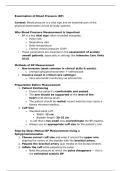
Examination of Blood Pressure (BP)
Context: Blood pressure is a vital sign and an essential part of the
physical examination across all body systems.
Why Blood Pressure Measurement Is Important
BP is a key vital sign, often recorded alongside:
o Pulse rate
o Respiratory rate
o Body temperature
o Central venous pressure (CVP)
These parameters are essential in the assessment of acutely
unwell patients, especially in settings like Intensive Care Units
(ICU).
Methods of BP Measurement
Non-invasive (most common in clinical skills & wards):
o Aneroid sphygmomanometer + stethoscope
Invasive (used in critical care settings):
o Intra-arterial BP monitoring via arterial line
Preparation Before Measurement
1. Patient Positioning
o Ensure the patient is comfortable and seated.
o The arm should be supported at the level of the
heart (mid-sternal level).
o The patient should be rested; recent exercise may cause a
falsely elevated reading.
2. Cuff Size
o Standard adult cuff:
Width: 12 cm
Bladder length: 30–35 cm
o A cuff that is too small may overestimate the BP reading.
o Always use an appropriate cuff size for the patient’s arm.
Step-by-Step: Manual BP Measurement Using a
Sphygmomanometer
1. Choose correct cuff size and wrap it around the upper arm,
aligning the centre of the bladder with the brachial artery.
2. Palpate the brachial artery (just medial to the biceps tendon).
3. Inflate the cuff while palpating the pulse:
o Note the pressure at which the pulse disappears — this is
the estimated systolic BP.
Context: Blood pressure is a vital sign and an essential part of the
physical examination across all body systems.
Why Blood Pressure Measurement Is Important
BP is a key vital sign, often recorded alongside:
o Pulse rate
o Respiratory rate
o Body temperature
o Central venous pressure (CVP)
These parameters are essential in the assessment of acutely
unwell patients, especially in settings like Intensive Care Units
(ICU).
Methods of BP Measurement
Non-invasive (most common in clinical skills & wards):
o Aneroid sphygmomanometer + stethoscope
Invasive (used in critical care settings):
o Intra-arterial BP monitoring via arterial line
Preparation Before Measurement
1. Patient Positioning
o Ensure the patient is comfortable and seated.
o The arm should be supported at the level of the
heart (mid-sternal level).
o The patient should be rested; recent exercise may cause a
falsely elevated reading.
2. Cuff Size
o Standard adult cuff:
Width: 12 cm
Bladder length: 30–35 cm
o A cuff that is too small may overestimate the BP reading.
o Always use an appropriate cuff size for the patient’s arm.
Step-by-Step: Manual BP Measurement Using a
Sphygmomanometer
1. Choose correct cuff size and wrap it around the upper arm,
aligning the centre of the bladder with the brachial artery.
2. Palpate the brachial artery (just medial to the biceps tendon).
3. Inflate the cuff while palpating the pulse:
o Note the pressure at which the pulse disappears — this is
the estimated systolic BP.