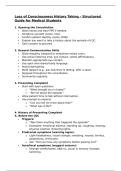
Loss of Consciousness History Taking – Structured
Guide for Medical Students
1. Opening the Consultation
Wash hands and wear PPE if needed.
Introduce yourself (name, role).
Confirm patient identity (name, DOB).
Explain you want to take a history about the episode of LOC.
Gain consent to proceed.
2. General Communication Skills
Show empathy (respond to verbal/non-verbal cues).
Use active listening (nod, eye contact, verbal affirmations).
Maintain appropriate eye contact.
Use open and relaxed body language.
Avoid interrupting.
Build rapport (e.g., ask how they’re feeling, offer a seat).
Signpost throughout the consultation.
Summarise regularly.
3. Presenting Complaint
Start with open questions:
o “What brought you in today?”
o “Tell me about the episode.”
Allow patient time to talk without interruption.
Use prompts to expand:
o “Can you tell me more about that?”
o “What was it like?”
4. History of Presenting Complaint
A. Before the LOC
Triggers:
o “Was there anything that triggered the episode?”
o Examples: emotional distress, standing up, coughing, shaving,
physical exertion, flickering lights.
Prodromal symptoms (warning signs):
o Light-headedness, visual changes, sweating, nausea, tinnitus,
palpitations, chest pain.
o Ask: “Did you have any symptoms before passing out?”
Aura/focal symptoms (suggest seizure):
o Strange smells/tastes, déjà-vu, visual or sensory changes,
twitching.
Guide for Medical Students
1. Opening the Consultation
Wash hands and wear PPE if needed.
Introduce yourself (name, role).
Confirm patient identity (name, DOB).
Explain you want to take a history about the episode of LOC.
Gain consent to proceed.
2. General Communication Skills
Show empathy (respond to verbal/non-verbal cues).
Use active listening (nod, eye contact, verbal affirmations).
Maintain appropriate eye contact.
Use open and relaxed body language.
Avoid interrupting.
Build rapport (e.g., ask how they’re feeling, offer a seat).
Signpost throughout the consultation.
Summarise regularly.
3. Presenting Complaint
Start with open questions:
o “What brought you in today?”
o “Tell me about the episode.”
Allow patient time to talk without interruption.
Use prompts to expand:
o “Can you tell me more about that?”
o “What was it like?”
4. History of Presenting Complaint
A. Before the LOC
Triggers:
o “Was there anything that triggered the episode?”
o Examples: emotional distress, standing up, coughing, shaving,
physical exertion, flickering lights.
Prodromal symptoms (warning signs):
o Light-headedness, visual changes, sweating, nausea, tinnitus,
palpitations, chest pain.
o Ask: “Did you have any symptoms before passing out?”
Aura/focal symptoms (suggest seizure):
o Strange smells/tastes, déjà-vu, visual or sensory changes,
twitching.