

Applying material from Item b and your knowledge, evaluate sociological explanations of the
relationship between ethnicity, offending and victimisation. (30 marks)
The evidence in relation to offending, victimisation and ethnicity shows striking differences in the
rates of criminalisation and victimisation between different ethnic groups, for example, blacks are
more likely to be both criminalised and victimised than whites. However, there is no clear-cut
argument when it comes to explaining these trends. Whilst some sociologists believe there are real
differences by ethnicity, largely holding factors such as societal discrimination or poverty as
explaining why certain groups are more likely to commit and face crime than others, other
sociologists are more interested in examining the view that the criminal justice system is
institutionally racist and therefore official statistics are socially constructed. The latter of these two
arguments seems most convincing although there is definitely some merit in investigating the
relationship between class and ethnicity.
Of important significance to sociologists, official statistics suggest there is a real difference in the rate
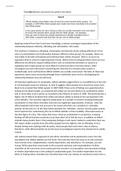
of criminalisation based on ethnicity. As Item B suggests ‘Black people were nearly four times more
likely to be arrested than White people’ in 2007/2008. These sorts of findings are supported when
looking at how black people, as compared with whites are 3x more likely to be cautioned by police
and 5x more likely to be in prison as recorded by the Ministry of Justice in 2008. This demonstrates a
higher rate of offence by blacks than whites and shows whites as being far less represented in the
crime statistics. This has been argued to being down to a number of reasons including inadequate
socialisation or that ethnic minorities may have less legitimate opportunities. However, what the
official statistics fail to take into account is the reason why there are variations in criminality.
Instead, all they tell us is of the interactions between the ‘offenders’ and the criminal justice system.
Most important for undermining the use of official statistics is their invalidity, otherwise known as
the dark figure of crime. This means that many crimes go undetected or unreported, so basing
findings off official statistics would be to just base them off of half the story. In addition to official
statistics being invalid, there’s the juxtaposing findings of self-report studies to undermine their use.
Self-report studies actually show that white people have the highest rates of offending. In fact,
despite having more dealings with the police, black people had much lower rates of offence.
Therefore, while official statistics do lay the basis of sociological research, they should not be wholly
trusted.
Left realists present their argument of why ethnic minorities mat be pushed into crime from the
assumption that official statistics are the truth. They look into three key areas as to why someone
may commit crime: marginalisation, relative deprivation, and subcultures. For example, Lea and
Young (1993) argue that racism leads to the economic exclusion and marginalisation of ethnic
minorities at the same time as the media push the narrative of consumption and exacerbate feelings
of relative deprivation due to the setting of unobtainable goals. This relative deprivation has the
effect of making ethnic minorities feel resentful where the only release of resentment comes from a
relationship between ethnicity, offending and victimisation. (30 marks)
The evidence in relation to offending, victimisation and ethnicity shows striking differences in the
rates of criminalisation and victimisation between different ethnic groups, for example, blacks are
more likely to be both criminalised and victimised than whites. However, there is no clear-cut
argument when it comes to explaining these trends. Whilst some sociologists believe there are real
differences by ethnicity, largely holding factors such as societal discrimination or poverty as
explaining why certain groups are more likely to commit and face crime than others, other
sociologists are more interested in examining the view that the criminal justice system is
institutionally racist and therefore official statistics are socially constructed. The latter of these two
arguments seems most convincing although there is definitely some merit in investigating the
relationship between class and ethnicity.
Of important significance to sociologists, official statistics suggest there is a real difference in the rate
of criminalisation based on ethnicity. As Item B suggests ‘Black people were nearly four times more
likely to be arrested than White people’ in 2007/2008. These sorts of findings are supported when
looking at how black people, as compared with whites are 3x more likely to be cautioned by police
and 5x more likely to be in prison as recorded by the Ministry of Justice in 2008. This demonstrates a
higher rate of offence by blacks than whites and shows whites as being far less represented in the
crime statistics. This has been argued to being down to a number of reasons including inadequate
socialisation or that ethnic minorities may have less legitimate opportunities. However, what the
official statistics fail to take into account is the reason why there are variations in criminality.
Instead, all they tell us is of the interactions between the ‘offenders’ and the criminal justice system.
Most important for undermining the use of official statistics is their invalidity, otherwise known as
the dark figure of crime. This means that many crimes go undetected or unreported, so basing
findings off official statistics would be to just base them off of half the story. In addition to official
statistics being invalid, there’s the juxtaposing findings of self-report studies to undermine their use.
Self-report studies actually show that white people have the highest rates of offending. In fact,
despite having more dealings with the police, black people had much lower rates of offence.
Therefore, while official statistics do lay the basis of sociological research, they should not be wholly
trusted.
Left realists present their argument of why ethnic minorities mat be pushed into crime from the
assumption that official statistics are the truth. They look into three key areas as to why someone
may commit crime: marginalisation, relative deprivation, and subcultures. For example, Lea and
Young (1993) argue that racism leads to the economic exclusion and marginalisation of ethnic
minorities at the same time as the media push the narrative of consumption and exacerbate feelings
of relative deprivation due to the setting of unobtainable goals. This relative deprivation has the
effect of making ethnic minorities feel resentful where the only release of resentment comes from a


