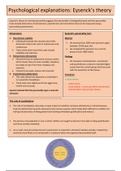
Psychological explanations: Eysenck’s theory
Eysenck’s theory of criminal personality suggests that personality is biologically based and that personality
traits include dimensions of extraversion, psychoticism and neuroticism that can be measured using a
personality questionnaire.
Dimensions: Eysenck’s personality test:
1. Neuroticism-stability Method
• Individuals towards the neurotic end of this
• He assessed over 2000 male prisoners aged
dimension show traits such as anxiousness and
between 16-69 years old.
restlessness.
• He compared the prisoners to a control
• Traits at the other end of the scale include
group of over 2000 males.
reliability and calmness.
2. Extraversion-introversion Findings
• Extraverts have an underactive nervous system
which means they are more sociable, impulsive, • On measures of extraversion, neuroticism
less likely to learn from their mistakes and and psychoticism, prisoners recorded higher
assertive. scores than the control group which accords
• Introverts are quiet, passive and reserved. with the prediction of the theory.
3. Psychoticism (added later) Evaluation
• This scale shows how disposed an individual is
to a psychotic breakdown. + Large sample
• Those who score highly tend to be aggressive, - Androcentric
hostile and uncaring. - Lacks validity – screw you effect and demand
Eysenck claimed that the personality type is neurotic- characteristics may’ve been shown.
extravert.
The role of socialisation
• The role of socialisation also plays a major impact on whether someone will become a criminal because
Eysenck claimed that neurotic-extraverts have nervous systems which make them difficult to condition for
having characteristics of being patient (not wanting immediate gratification) and mature.
• The process of socialisation is one in which children are taught to become more able to delay gratification
and more socially orientated.
• As a result, neurotic-extraverts won’t easily learn to respond to antisocial impulses anxiety; instead they
would be more likely to act antisocially in situations where the opportunity presented itself.