Psychological explanations: Cognitive
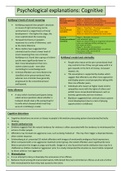
Kohlberg’s levels of moral reasoning
• Kohlberg proposed that people’s decisions
on issues of right and wrong can be
summarised in a stage theory of moral
development – the higher the stage, the
more sophisticated the reasoning.
• He based his theory on people's
responses to a series of dilemmas, such
as the Heinz Dilemma.
• Many studies have suggested that
criminals tend to show a lower level of
moral reasoning than non-criminals.
Kohlberg et al. found that a group of violent Kohlberg’s model and criminality
youths were significantly lower in
their moral development than non- • People who reason at the pre-conventional level
violent violent youth - even after may commit crime if they can get away with it or
controlling for social background. gain rewards in the form of money, increased
respect, etc.
• Criminal offenders are more likely to be
classified at the preconventional level, • This assumption is supported by studies which
whereas non-criminals have generally suggest that offenders are often more egocentric
progressed to the conventional level and display poorer social perspective-taking skills
and beyond. than non-offender peers,
• Individuals who reason at higher levels tend to
Heinz dilemma sympathise more with the rights of others and
exhibit more conventional behaviours such as
• A story which involved participants being honesty, generosity and non-violence.
asked various questions about whether a • Blackburn suggested that criminals show a poorer
husband should steal a life-saving drug for moral development due to a lack of playing
his wife which showed which level they opportunities in childhood.
were at in Kohlberg’s model.
Cognitive distortions
• Cognitive distortions are errors or biases in people's information processing system characterised by faulty
thinking.
1. Hostile attribution bias
• Evidence suggests that the natural tendency for violence is often associated with the tendency to misinterpret the
actions of other people.
• Offenders may misread non-aggressive cues, such as being 'looked at'. This may then trigger a disproportionate,
often violent response.
• Schönenberg et al. presented 55 violent offenders with images of emotionally ambiguous facial expressions.
When compared with a non-aggressive matched control group, the violent offenders were significantly more
likely to perceive the images as angry and hostile. Dodge et al. also found that hostile attribution bias may lie in
childhood as children marked as 'aggressive' prior to a study interpreted the situation as more hostile compared
to those called as 'non-aggressive'.
2. Minimalisation
• It is an attempt to deny or downplay the seriousness of an offence.
• Barbaree found among 26 incarcerated rapists, 54% denied they had committed an offence at all and a further
40% minimalised the harm they had caused to the victim.