Philosophy and Ethics: Chapter 4: Exam question plan
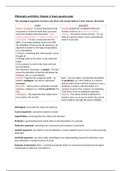
‘The ontological argument convinces only those who already believe in God.’ Discuss. (30 marks)
AGREE DISAGREE
Anslem ‘Proslogion’ (a prayer directed to God, Gaunilo (empiricist) ‘on Behalf of the Fool’:
its purpose is to demonstrate that God exists Anslem’s theory is an ‘exercise in wishful
and is the Christian-described God) - ‘faith thinking’. The perfect island criticism – if I can
seeking understanding’, ‘I believe so that I may think of a perfect island, it does automatically
understand’ – he was a monk and later the mean it must exist
ABOC. True understanding comes from faith.
The definition of God proves His existence. His
argument is based on the logical impossibility
of a contradiction.
[1] God is ‘something that which greater can be
thought of’
[2] Things exists in the mind, or the mind and
reality
[3] It is greater to exist in the mind and body
SO GOD EXISTS
The statement ‘God exists’ is analytic. ‘The fool’
knows the definition of God but still denies his
existence, this is a contradiction.
Anselm’s response (in a separate work) – an Kant – you can reject a concept but also define
island is contingent, but God is ‘supremely its predicates, eg, I don’t believe in creatures
necessary’ that are half-woman half-fish. Existence is not a
Descartes – God is perfect, perfection includes predicate, it doesn’t add description to a
existence, existence is a ‘defining predicate’ for concept, its part of the ‘essence’ of something.
God ‘God exists’ is not an analytical statement
Cottingham – the argument only makes sense Aquinas – the nature of God is unknown to
from within a life of faith humans, how can we say he exists? Our way to
God is indirect, through the world. Ineffable
Ontological: to do with the nature of existence
A priori argument: conclusions based on reason
Logical fallacy: reasoning that has a flaw in its structure
Predicate: a grammatical term which refers to the description of a concept
Deductive argument: reasoning from statements and coming to a conclusion
Analytic argument: one which is true by definition, no tests needed to prove it as it can be proved by
deduction
Synthetic argument: one which adds something to our understanding, beyond its definition, more
than deduction is needed to prove its truth
Reductio ad absurdum (latin): a method proving the falsity of a premise by showing that its logical
consequence is absurd or contradictory
‘The ontological argument convinces only those who already believe in God.’ Discuss. (30 marks)
AGREE DISAGREE
Anslem ‘Proslogion’ (a prayer directed to God, Gaunilo (empiricist) ‘on Behalf of the Fool’:
its purpose is to demonstrate that God exists Anslem’s theory is an ‘exercise in wishful
and is the Christian-described God) - ‘faith thinking’. The perfect island criticism – if I can
seeking understanding’, ‘I believe so that I may think of a perfect island, it does automatically
understand’ – he was a monk and later the mean it must exist
ABOC. True understanding comes from faith.
The definition of God proves His existence. His
argument is based on the logical impossibility
of a contradiction.
[1] God is ‘something that which greater can be
thought of’
[2] Things exists in the mind, or the mind and
reality
[3] It is greater to exist in the mind and body
SO GOD EXISTS
The statement ‘God exists’ is analytic. ‘The fool’
knows the definition of God but still denies his
existence, this is a contradiction.
Anselm’s response (in a separate work) – an Kant – you can reject a concept but also define
island is contingent, but God is ‘supremely its predicates, eg, I don’t believe in creatures
necessary’ that are half-woman half-fish. Existence is not a
Descartes – God is perfect, perfection includes predicate, it doesn’t add description to a
existence, existence is a ‘defining predicate’ for concept, its part of the ‘essence’ of something.
God ‘God exists’ is not an analytical statement
Cottingham – the argument only makes sense Aquinas – the nature of God is unknown to
from within a life of faith humans, how can we say he exists? Our way to
God is indirect, through the world. Ineffable
Ontological: to do with the nature of existence
A priori argument: conclusions based on reason
Logical fallacy: reasoning that has a flaw in its structure
Predicate: a grammatical term which refers to the description of a concept
Deductive argument: reasoning from statements and coming to a conclusion
Analytic argument: one which is true by definition, no tests needed to prove it as it can be proved by
deduction
Synthetic argument: one which adds something to our understanding, beyond its definition, more
than deduction is needed to prove its truth
Reductio ad absurdum (latin): a method proving the falsity of a premise by showing that its logical
consequence is absurd or contradictory