
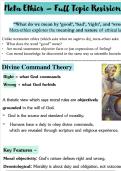
Meta Ethics – Full Topic Revis
Sheet
“What do we mean by ‘good’, ‘bad’, ‘right
‘wrong’?”
Meta-ethics explores the meaning and natu
Unlike normative ethics (which asks what we ought to do)
ethics asks: ethical language.
- What does the word “good” mean?
- Are moral statements objective facts or just expressions
feeling?
------------------------------------------------------------
- Can moral knowledge be discovered in the same way as
Divine
knowledge? Command
----------------------------------
Theory
Right = what God
commands
Wrong = what God
A theistic view which says
forbids
moral rules are objectively
grounded in the will of God.
-- God is thehave
Humans source and to
a duty
which areofrevealed
standard
obey divine through scriptu
morality.
commands,
and religious experience.
Key Features -
Moral objectivity: God's nature de
right and wrong.
, Meta Ethics – Full Topic Revis
Sheet
Divine Command
Theory
Key Thinkers
William of Ockham: God can
command anything — morality is
based on His will.
Robert Adams: Modified DCT —
God’s commands are rooted in
His omnibenevolent nature, so He
Critical
wouldn't command cruelty.
Euthyphro
flaw - Dilemma (Plato):
Is something good because G
commands it, or does God comm
If the former
it --> morality
because it’s becomes
good?
arbitrary (e.g. God could command
torture, and it would become good).
If the latter --> moral standards ex
independently of God, so He isn’t t
Evaluation of
source of morality.
Strengths the TheoryWeakness
Objective and clear Euthyphro Dilem
moral rules (Plato)
Authority: Motivates Conflicting script
moral action through Which religion’s
Sheet
“What do we mean by ‘good’, ‘bad’, ‘right
‘wrong’?”
Meta-ethics explores the meaning and natu
Unlike normative ethics (which asks what we ought to do)
ethics asks: ethical language.
- What does the word “good” mean?
- Are moral statements objective facts or just expressions
feeling?
------------------------------------------------------------
- Can moral knowledge be discovered in the same way as
Divine
knowledge? Command
----------------------------------
Theory
Right = what God
commands
Wrong = what God
A theistic view which says
forbids
moral rules are objectively
grounded in the will of God.
-- God is thehave
Humans source and to
a duty
which areofrevealed
standard
obey divine through scriptu
morality.
commands,
and religious experience.
Key Features -
Moral objectivity: God's nature de
right and wrong.
, Meta Ethics – Full Topic Revis
Sheet
Divine Command
Theory
Key Thinkers
William of Ockham: God can
command anything — morality is
based on His will.
Robert Adams: Modified DCT —
God’s commands are rooted in
His omnibenevolent nature, so He
Critical
wouldn't command cruelty.
Euthyphro
flaw - Dilemma (Plato):
Is something good because G
commands it, or does God comm
If the former
it --> morality
because it’s becomes
good?
arbitrary (e.g. God could command
torture, and it would become good).
If the latter --> moral standards ex
independently of God, so He isn’t t
Evaluation of
source of morality.
Strengths the TheoryWeakness
Objective and clear Euthyphro Dilem
moral rules (Plato)
Authority: Motivates Conflicting script
moral action through Which religion’s


