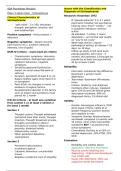
AQA Psychology Revision Issues with the Classification and
Diagnosis of Schizophrenia:
Paper 3 option topic – Schizophrenia
Research: Rosenhan 1972
Clinical Characteristics of
Schizophrenia: - 8 “pseudo-patients” 5 m 3 f, admit
psychiatric hospital, tell psychiatrist
- “split mind”, 1 in 100, disturbed
hearing voice “thud” “empty” – not
thought, perception, emotion, self
in academic literature common
and relationships
schizo
Positive symptoms - Hallucinations + - All admitted, 7 schizo, 1 manic
delusions depression – act normal real caught
on “you’re not crazy”
Negative symptoms - Speech poverty - When kept diaries 1 doctor
(lack fluency etc.), avolition (reduced pathological writing, all release 7-52
interests, loss of goals) days, av 19 days
DSM-IV Criteria – must meet all criteria - Follow up study, R tell send more
pseudo-patients, sent none – 3
- Characteristic symptoms: delusions, months 193 admitted, 23 thought be
hallucinations, disorganised speech, pseudo by at least one psychiatrist,
catatonic behaviour, negative 41 by at least 2 staff
symptoms
- Social/Occupational Dysfunction: Reliability
impact on social areas like work or - Inter-rater: sometimes big difference,
self-care Rosenham 1 person manic
- Duration: persistent at least 6 m, be depression
diagno healthy again must have 6 m - Test-retest: Rosenham diff release
no symptoms times
- Parts 4/5/6: no changes in mood, no - Culture: tendency over-diagnose
evidence of organic factors, members other cultures, Copeland
developmental disorder in the family gave 134 US and 194 British given
such as autism and symptoms must description of patient, 69% US
persist for 1 month diagnosed shcizo, 2% British did
ICD-10 Criteria – at least one symptom Validity
from section 1 or at least 2 section 2
for least 1 month - Gender: stereotypes influence, DSM
gives equal criteria, Castle et al
Section 1 greater frequency positive women
- Thought control: Thought withdrawal and negative in men
(extracted from their mind), Thought - Symptom Overlap: Konstrantareas
insertion, Thought broadcast (private and Kewitt compared 14 autistic with
thoughts accessible to others) 14 schizo, none schizo had autistic
- Delusions of control, influence and symptoms BUT 7 of autistics had
passivity: distorted beliefs schizo symptoms
- Hallucinatory voices - Comorbidity: Buckley et al 50% co-
- Other persistent delusions: morbid depression, 29% PTSD, 23%
superpowers OCD
Section 2 Evaluation
- Persistent hallucinations - Reliability and validity above
- Incoherent speech - Application: effective treatments
- Catatonic behaviour: uncontrolled - Must be careful labelling and
moves diagnosing – stigma and stereotypes
- Negative symptoms: lack of empathy may inhibit jobs
- Issues with definitions: often use
subjective words like bizarre
, The Biological Approach to underdevelop or damage with
Schizophrenia: unmyelinated axons
- Reduced Myelination also cause in
Genetics - Considered be cause change
white matter PFC, Hippo account neg
dopamine and brain structure that cause
symptoms
symptoms
Research: Vita et al 2012
Research: Gottesman 1991
- 19 studies, 813 schizo, 718 healthy
- 40 studies Ger, Switzerland,
controls
Scandinavia and UK by looking
- Schizo higher progressive reduction
medical records
in cortical grey matter volume over
- Both parents have 46% chance
time
Research: Tienari et al 2000 - Underlying pathological process
associated loss of grey matter
- Adopted children Finland, 164 appear especially active first stages
adoptees who bio mothers disease - consistent early onset
schizophrenia
- Adopted children with schizo mothers Evaluation
that also had schizo themselves 11,
- Research support
6.7%
- Treatments anti-psychotic drugs
- Control adoptees no relative schiz 4,
effective
2%
- Diathesis-stress model, reductionist
The Dopamine Hypothesis - Twin studies, concordance never
100%
- In excess regions associate pos
symptom Biological Treatments of Schizophrenia
- Neurons fire too easily = positive
Antipsychotics - 1950s, initial method,
symptoms
duplicity therapy, based dopamine
- Higher number D2 receptors, means
hypothesis, lower
dopamine binds, so more neurons
firing Typical antipsychotics
- Negative, cognitive symptoms deficit
- Antagonists e.g. Chlorpromazine,
dop areas of PFC meaning not
first line used, binds dopamine
function ‘normal’
receptor sites particularly D2
Research: Leutch et al 2013 receptor site
- Blocks dopamine transmission, so
- Meta-analysis 212 studies analysing
post-synaptic neuron cannot be
effectiveness anti-psychotic drugs
stimulated, eliminating positive
compare placebo – all more effective
symptoms
than placebo
Atypical antipsychotics
Neural Correlates
- Mostly when typical failed e.g.
- Prefrontal cortex planning, reasoning,
Clozapine, bind receptor sites also
research impaired in schizophrenia
bind some serotonin sites blocking
patients
function brain area
- Cognitive impairment changes in
- Block neurotransmission BUT
hippocampus and connections PFC
temporary rapidly dissociate, temp
where damage nerve connections or
reduce symptoms
small Hippo
- Influence dopamine release in basil Research: Bagnall et al 2003
ganglia affecting process of PFC =
- 223 trials, 31 economic evaluations
impairment
asses effectiveness, side effects,
- Other cognitive due grey matter, part
costs
enlarged ventricles result of
Diagnosis of Schizophrenia:
Paper 3 option topic – Schizophrenia
Research: Rosenhan 1972
Clinical Characteristics of
Schizophrenia: - 8 “pseudo-patients” 5 m 3 f, admit
psychiatric hospital, tell psychiatrist
- “split mind”, 1 in 100, disturbed
hearing voice “thud” “empty” – not
thought, perception, emotion, self
in academic literature common
and relationships
schizo
Positive symptoms - Hallucinations + - All admitted, 7 schizo, 1 manic
delusions depression – act normal real caught
on “you’re not crazy”
Negative symptoms - Speech poverty - When kept diaries 1 doctor
(lack fluency etc.), avolition (reduced pathological writing, all release 7-52
interests, loss of goals) days, av 19 days
DSM-IV Criteria – must meet all criteria - Follow up study, R tell send more
pseudo-patients, sent none – 3
- Characteristic symptoms: delusions, months 193 admitted, 23 thought be
hallucinations, disorganised speech, pseudo by at least one psychiatrist,
catatonic behaviour, negative 41 by at least 2 staff
symptoms
- Social/Occupational Dysfunction: Reliability
impact on social areas like work or - Inter-rater: sometimes big difference,
self-care Rosenham 1 person manic
- Duration: persistent at least 6 m, be depression
diagno healthy again must have 6 m - Test-retest: Rosenham diff release
no symptoms times
- Parts 4/5/6: no changes in mood, no - Culture: tendency over-diagnose
evidence of organic factors, members other cultures, Copeland
developmental disorder in the family gave 134 US and 194 British given
such as autism and symptoms must description of patient, 69% US
persist for 1 month diagnosed shcizo, 2% British did
ICD-10 Criteria – at least one symptom Validity
from section 1 or at least 2 section 2
for least 1 month - Gender: stereotypes influence, DSM
gives equal criteria, Castle et al
Section 1 greater frequency positive women
- Thought control: Thought withdrawal and negative in men
(extracted from their mind), Thought - Symptom Overlap: Konstrantareas
insertion, Thought broadcast (private and Kewitt compared 14 autistic with
thoughts accessible to others) 14 schizo, none schizo had autistic
- Delusions of control, influence and symptoms BUT 7 of autistics had
passivity: distorted beliefs schizo symptoms
- Hallucinatory voices - Comorbidity: Buckley et al 50% co-
- Other persistent delusions: morbid depression, 29% PTSD, 23%
superpowers OCD
Section 2 Evaluation
- Persistent hallucinations - Reliability and validity above
- Incoherent speech - Application: effective treatments
- Catatonic behaviour: uncontrolled - Must be careful labelling and
moves diagnosing – stigma and stereotypes
- Negative symptoms: lack of empathy may inhibit jobs
- Issues with definitions: often use
subjective words like bizarre
, The Biological Approach to underdevelop or damage with
Schizophrenia: unmyelinated axons
- Reduced Myelination also cause in
Genetics - Considered be cause change
white matter PFC, Hippo account neg
dopamine and brain structure that cause
symptoms
symptoms
Research: Vita et al 2012
Research: Gottesman 1991
- 19 studies, 813 schizo, 718 healthy
- 40 studies Ger, Switzerland,
controls
Scandinavia and UK by looking
- Schizo higher progressive reduction
medical records
in cortical grey matter volume over
- Both parents have 46% chance
time
Research: Tienari et al 2000 - Underlying pathological process
associated loss of grey matter
- Adopted children Finland, 164 appear especially active first stages
adoptees who bio mothers disease - consistent early onset
schizophrenia
- Adopted children with schizo mothers Evaluation
that also had schizo themselves 11,
- Research support
6.7%
- Treatments anti-psychotic drugs
- Control adoptees no relative schiz 4,
effective
2%
- Diathesis-stress model, reductionist
The Dopamine Hypothesis - Twin studies, concordance never
100%
- In excess regions associate pos
symptom Biological Treatments of Schizophrenia
- Neurons fire too easily = positive
Antipsychotics - 1950s, initial method,
symptoms
duplicity therapy, based dopamine
- Higher number D2 receptors, means
hypothesis, lower
dopamine binds, so more neurons
firing Typical antipsychotics
- Negative, cognitive symptoms deficit
- Antagonists e.g. Chlorpromazine,
dop areas of PFC meaning not
first line used, binds dopamine
function ‘normal’
receptor sites particularly D2
Research: Leutch et al 2013 receptor site
- Blocks dopamine transmission, so
- Meta-analysis 212 studies analysing
post-synaptic neuron cannot be
effectiveness anti-psychotic drugs
stimulated, eliminating positive
compare placebo – all more effective
symptoms
than placebo
Atypical antipsychotics
Neural Correlates
- Mostly when typical failed e.g.
- Prefrontal cortex planning, reasoning,
Clozapine, bind receptor sites also
research impaired in schizophrenia
bind some serotonin sites blocking
patients
function brain area
- Cognitive impairment changes in
- Block neurotransmission BUT
hippocampus and connections PFC
temporary rapidly dissociate, temp
where damage nerve connections or
reduce symptoms
small Hippo
- Influence dopamine release in basil Research: Bagnall et al 2003
ganglia affecting process of PFC =
- 223 trials, 31 economic evaluations
impairment
asses effectiveness, side effects,
- Other cognitive due grey matter, part
costs
enlarged ventricles result of